
Thanksgiving ombre nails are the softest way to wear the whole harvest palette on one hand. Instead of picking a single autumn shade, an ombre fade moves from one warm colour into another across each nail, so you get cream and caramel and cranberry all at once, without any nail art or extra decoration. This palette gathers six warm gradient blends that cover the full Thanksgiving range, from pale cream to deep plum, so you can find the fade that suits your skin tone, your outfit, and the kind of day you have planned.
An ombre is not a two-tone nail. A real ombre is a smooth blend with no hard line where one colour stops and the next begins, and that softness is exactly what makes it work for Thanksgiving. The season is all about warmth and comfort — roasted food, candlelight, knitwear, falling leaves — and a hard-edged design can feel too sharp against all of that. A gradient, by contrast, looks like the season itself: leaves turning, light fading, one warm tone melting into the next. It is also forgiving in a way that nail art is not. A slightly uneven blend still looks like a gradient, while a slightly uneven stripe or dot just looks like a mistake.
The six blends below are chosen to work as a set for Thanksgiving week, not just as six separate ideas. You can wear one blend on all ten nails for the whole long weekend, mix two blends across hands, or move from the palest fade to the deepest as the day turns from a daytime family lunch into an evening gathering. Each blend is described in full — undertone, finish, skin tones, occasions, and how it wears — so you can pick with confidence instead of guessing from a bottle. If you are new to gradients altogether, our ombre nail colors guide walks through fifteen gradient blends across every colour family, which is a useful starting point before you commit to a Thanksgiving fade.
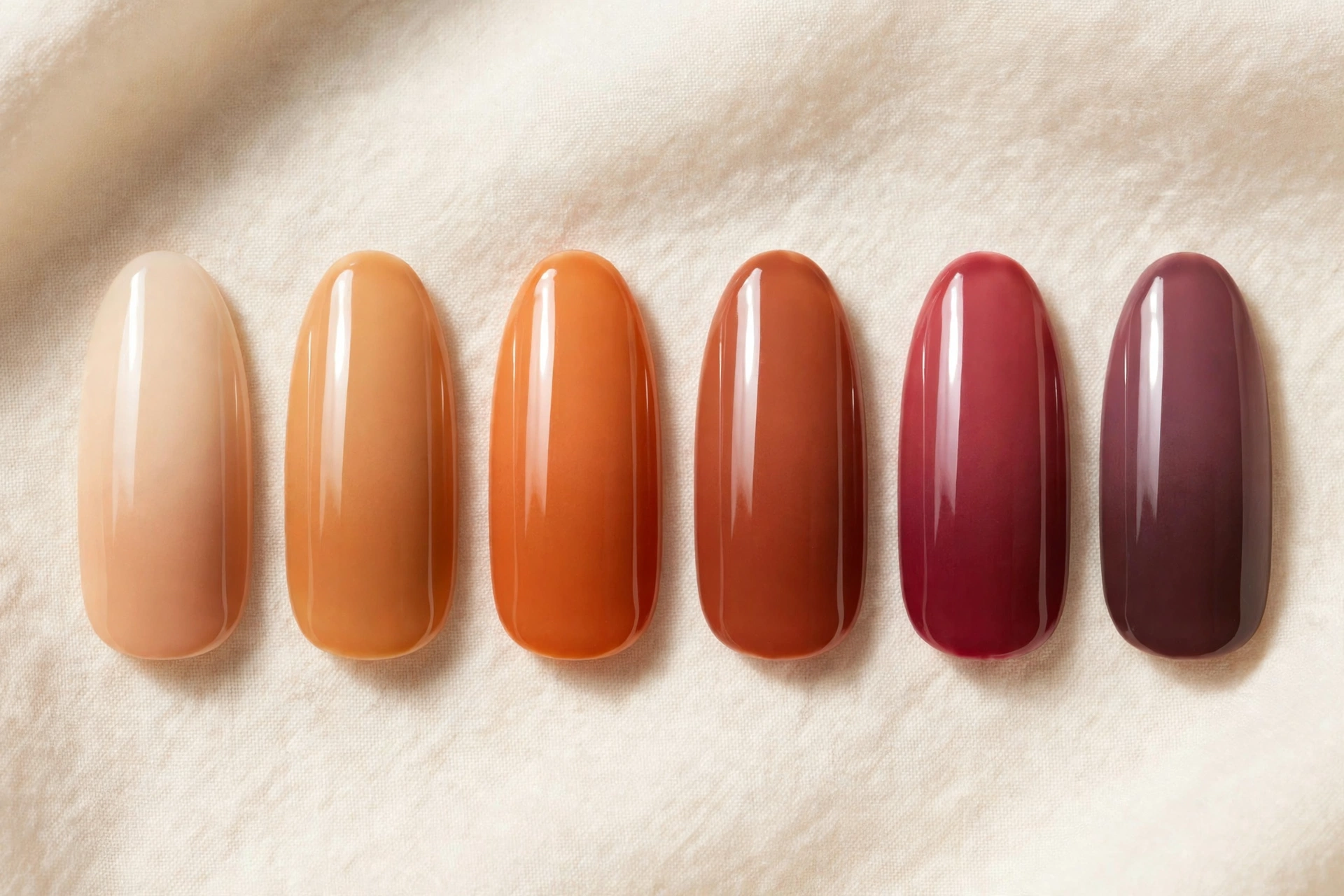
How to Use This Thanksgiving Ombre Nails Palette
- Start with the palest blend if you are new to ombre. Harvest Cream Fade is the easiest entry point, and it shows you how a gradient looks on your hands before you commit to the deepest cranberry or plum tones.
- Wear one blend on all ten nails for the most polished result. Ombre looks best when the fade is even and the direction is the same on every nail, so keep the pale end at the cuticle and the deep end at the tip, or the reverse, on all ten.
- Use the deepest blend as an accent on one or two nails. Espresso Plum Fade on the ring fingers, with Golden Pumpkin Fade everywhere else, gives depth without making the whole manicure feel heavy.
- Try a vertical ombre on short nails. A side-to-side fade suits short nails particularly well, because a tip-to-cuticle gradient can make a short nail look even shorter, while a horizontal blend keeps the length you have.
- Match your outfit loosely, not exactly. A cranberry ombre with a cream knit and brown boots looks intentional, while an exact colour match between nails and accessories can look overdone. Keep the rest of the outfit warm and simple.
- Keep cuticles neat and moisturised. Ombre shows every dry edge and every ridge, because the gradient draws the eye slowly across the whole nail, so a drop of cuticle oil each evening makes more difference here than it does with a flat cream polish.
- Blend while the polish is still slightly wet. Ombre is built with a sponge or a soft brush, and the colours need to be damp enough to melt into each other. Work on one nail at a time, and seal the free edge with top coat so the gradient does not wear away at the tips first.
- Give ombre a pale, opaque base. A sheer or streaky base makes the gradient patchy, so one thin coat of the lightest shade in the blend, dried fully, gives the colours something even to sit on.
Thanksgiving Ombre Nails: The 6 Shades
1. Harvest Cream Fade — #E9D9BE
Harvest Cream Fade is the palest blend in the palette, and the one to choose if you want Thanksgiving colour without a bold nail. It moves from a soft, warm cream at the cuticle into a gentle caramel at the tip, like the colour of toasted marshmallow or the edge of a pie crust. Indoors it reads as a quiet, creamy nude with a warm glow; in sunlight the caramel end comes forward and the nails look like they have been dipped in honey. It is the shade for people who love a neutral manicure but want something warmer and more seasonal than a plain nude.
The undertone is warm and golden, with cream clearly in charge and just enough caramel underneath to keep it from looking chalky or flat. That warmth is what makes this blend so forgiving. Cool-toned pale polishes with a strong white pull can look stark on warm skin, and sheer nudes can disappear entirely on deep skin, but Harvest Cream Fade sits in the middle of the warm neutral family. It reads as soft and polished on cool skin and as warm and seamless on warm skin, which is rare for a pale gradient. The finish is a glossy cream, with no glitter and no shimmer fleck, so the blend itself does all the work. A matte top coat turns it soft and velvety, and suits an evening gathering, though matte will show fingerprints and wear faster at the tips.
On fair skin, Harvest Cream Fade gives gentle, warm contrast and makes hands look neat and deliberate without drawing attention to the nails. It is the kind of blend that turns a plain black dress or a cream knit into a finished outfit. On medium skin it looks warm and glowing, almost like a deeper version of the skin’s own warmth, and it pairs beautifully with gold jewellery and brown leather. On deep skin it is a soft, luminous nude, and the caramel end keeps it from washing out — the gradient gives it dimension that a single pale cream would not. There is no skin tone this blend argues with, which is why it earns its place at the head of the palette.
Wear it anywhere across Thanksgiving week. It is understated enough for a daytime family lunch, a walk after the meal, or a quiet evening at home, and polished enough for Thanksgiving dinner. It suits short nails, long nails, almond, square, and oval shapes alike, though it looks particularly good on a short almond or a neat square, where the soft fade keeps the shape looking clean. For a dressier touch, add a thin gold line at the cuticle on one nail, or wear it with a chunky gold ring. Keep the rest plain and let the gradient lead.
Next to its sibling blends, Harvest Cream Fade is the reference point for lightness. It is paler and softer than Golden Pumpkin Fade, and warmer and more golden than a plain white ombre. If you hold the two together, Harvest Cream Fade is the quiet start of the warm scale: the blend you reach for when you want Thanksgiving colour without any drama. That quiet position also makes it the easiest to wear with a full Thanksgiving outfit, because it picks up the cream, camel, and gold tones already in the room. For more ideas in this soft gradient family, our aura nail colors palette explores fifteen dreamy gradient shades that use the same soft-blend technique in cooler and brighter colour families.
For longevity, expect a good gel ombre version to last two to three weeks with a proper top coat, and a regular polish version to last four to six days before tip wear shows. The pale end of the gradient means chips are less visible than they are with a dark polish, which is a real advantage if you are doing your own nails before a busy holiday. Two thin coats of the cream base are usually enough for full opacity, and the gradient layer should be sponged on thinly and evenly — a thick or patchy sponge layer is the main cause of a streaky, blotchy fade. If you are doing it at home, work on one nail at a time and seal the free edge with top coat.
2. Golden Pumpkin Fade — #D97B2B
Golden Pumpkin Fade is the most obviously Thanksgiving blend in the palette, and the one that captures the season in a single nail. It moves from a warm, honeyed gold at the cuticle into a rich pumpkin orange at the tip, like late-afternoon light falling across a pumpkin patch. Indoors it reads as a warm, glowing orange with a golden heart. In sunlight the gold comes alive, and the nails look like they are lit from within. It is the blend for people who love orange nails but want something softer and more wearable than a flat, single-colour orange.
The undertone is warm yellow-orange, with gold clearly in charge at the pale end and a true pumpkin orange taking over at the tip. That warmth makes it flattering on warm and golden skin tones, where it looks vibrant and healthy, and on olive skin, where it brings out the warmth without clashing. On fair skin it is bold but not overwhelming, because the golden base keeps it grounded and the fade stops it from looking like a single block of orange. On deep skin it is rich and glowing, a true statement orange with a harvest twist. If you love autumn leaves but have never worn orange nails, this is the blend to start with.
The finish is a glossy cream with a soft, almost satin glow. There is no glitter, which is the right choice here, because glitter would lighten the colour and take away the smooth, liquid quality that makes a gradient special. With a high-shine top coat, the nails look wet and lacquered, almost like glazed fruit. With a matte top coat, the same blend turns soft and velvety, and looks wonderful for a daytime gathering, though matte will dull the golden glow that is the point of this fade, so gloss is the better choice here.
This is a daytime blend first and an evening blend second. It is perfect for a Thanksgiving lunch, for a walk through falling leaves, and for any daytime gathering where you want your nails to be part of the autumn picture. It also works for Thanksgiving dinner, especially if your outfit is warm and simple, but it is honest to say it reads as cheerful and bright rather than elegant in a formal, candlelit room. For a softer everyday version, wear it on short nails, where the bright orange covers less surface and feels less intense, or use it as an accent with Harvest Cream Fade.
Compared with its closest sibling, Golden Pumpkin Fade is brighter, more orange, and more golden than Spiced Cider Fade. Side by side, Golden Pumpkin looks like afternoon sunlight, while Spiced Cider looks like evening spice. It is also lighter and more yellow than most pumpkin polishes, which often lean brown — if you have tried orange shades before and found them too dark or too muddy, this one sits a step brighter and warmer. It is the blend in the palette that most rewards a smooth base, because any ridge under a bright gradient shows as a wavy line in the fade.
Wear notes matter with a blend this bright. The orange end can stain the nail plate if it is worn without a base coat, so never skip that step, and use a double layer of base on the thumbnails if you are prone to staining. Removal takes a little patience: hold a remover-soaked cotton pad on each nail for ten seconds before wiping, rather than scrubbing, which pushes pigment into the cuticles. In gel, this blend is a strong performer — bright gradient gels cure well and resist chipping, and you can expect a full two to three weeks. In regular polish, plan on a top coat refresh around day three to keep the gloss alive.
3. Spiced Cider Fade — #B4552D
Spiced Cider Fade is the warmest brown-orange in the palette, and the most quietly cosy. It moves from a soft amber at the cuticle into a deep, burnt orange-brown at the tip, like a glass of spiced cider held up to the light. Indoors it reads as a rich, spiced brown with only a hint of orange at the edges. In sunlight or under bright light, the amber comes alive, and the nails look like warm, glowing spice. It is the blend for people who love brown nails but want something richer and more alive than a flat cream brown.
The undertone is warm deep brown-orange, with an amber base and a faint cinnamon-red pull. Unlike a true chocolate brown, which can look flat and heavy, this blend has warmth and light hiding in it. That warmth is what keeps it from looking severe, and it is also what makes it flattering on deep skin, where it reads as a rich, glossy spice. On fair skin it is high-contrast and elegant, the kind of manicure that looks deliberate and polished, so it suits people who are comfortable with a deeper nail. On medium skin it looks warm and seamless, especially with bronze and gold jewellery and with dark autumn fabrics like wool and leather.
The finish is a deep glossy cream. There is no glitter, which is the right choice here, because glitter would lighten the colour and take away the spiced depth that makes it special. The gloss is what saves it from looking matte and heavy. With a high-shine top coat, the nails look wet and lacquered, almost like polished wood. With a matte top coat, the same blend turns soft and velvety, and looks wonderful for an evening gathering, though matte will show fingerprints and wear faster at the tips, and it dulls the amber glow that is the point of this fade.
This is a dinner-table blend first and an everyday blend second. It is perfect for Thanksgiving dinner, for an evening with family, and for any occasion where you want your nails to be part of the outfit rather than a background detail. It also works for the office if your workplace is relaxed about deeper nails, but it is honest to say it reads as bold in a bright, formal office. For a softer everyday version, wear it on short nails, where the deep spice covers less surface and feels less intense, or use it as an accent with Harvest Cream Fade.
Compared with its closest sibling, Spiced Cider Fade is darker, browner, and quieter than Golden Pumpkin Fade. Side by side, Golden Pumpkin looks bright and golden, while Spiced Cider looks like its shadow. It is also deeper and less yellow than most amber polishes, which often lean gold — if you have tried amber shades before and found them too light or too yellow, this one sits a step darker and warmer. It is the blend in the palette that most rewards a smooth base, because any ridge under a dark gradient shows as a wavy line in the fade.
Wear notes matter with a blend this deep. The brown-orange end can stain the nail plate if it is worn without a base coat, so never skip that step, and use a double layer of base on the thumbnails if you are prone to staining. Removal takes a little patience: hold a remover-soaked cotton pad on each nail for ten seconds before wiping, rather than scrubbing, which pushes pigment into the cuticles. In gel, this blend is a strong performer — deep gradient gels cure well and resist chipping, and you can expect a full two to three weeks. In regular polish, plan on a top coat refresh around day three to keep the gloss alive.
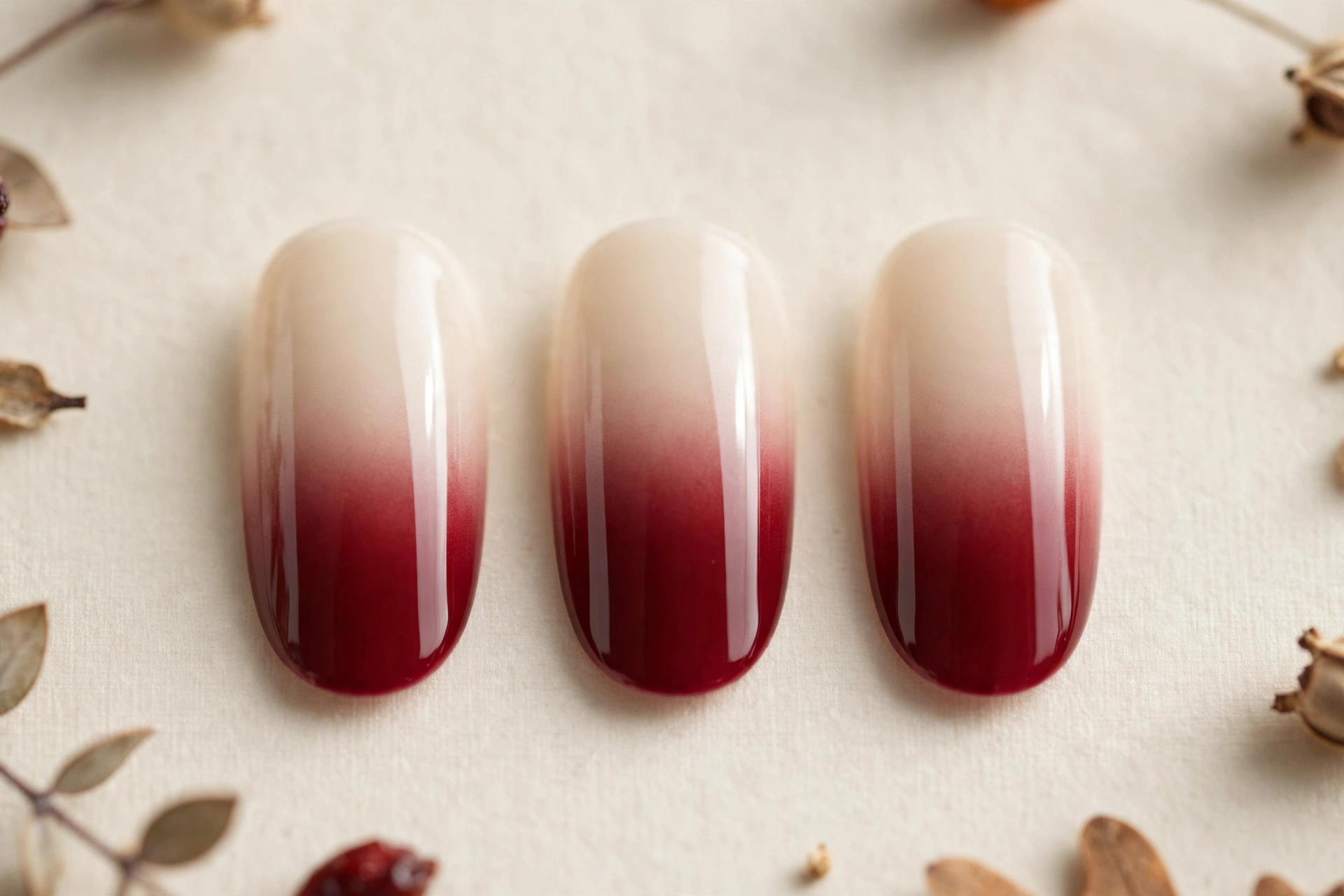
4. Cranberry Harvest Fade — #8E2B3B
Cranberry Harvest Fade is the jewel of the palette, and the blend that turns a Thanksgiving manicure into a holiday manicure. It moves from a soft, dusty rose at the cuticle into a deep, rich cranberry at the tip, like cranberry sauce spooned over something pale and creamy. Indoors it reads as a deep, wine-red with a soft rose heart. In candlelight the cranberry comes forward, and the nails look like polished garnets. It is the blend for people who love red nails but want something softer and more seasonal than a flat, single-colour red.
The undertone is warm red with a clear berry pull, rose at the pale end and cranberry at the deep end, with just enough blue underneath the red to keep it from turning orange. That balance is what makes this blend so forgiving. Warm reds with a strong orange pull can look brassy on cool skin, and cool reds with a strong blue pull can look harsh on warm skin, but Cranberry Harvest Fade sits in the middle of the berry family. It reads as rich and glowing on cool skin and as deep and seamless on warm skin. The finish is a glossy cream, with no glitter and no shimmer fleck, so the blend itself does all the work.
On fair skin, Cranberry Harvest Fade gives strong, berry contrast and makes hands look polished and festive. It is the kind of blend that turns a plain black dress or a cream knit into an outfit. On medium skin it looks warm and glowing, almost like a deeper version of the skin’s own warmth, and it pairs beautifully with gold jewellery and dark autumn fabrics. On deep skin it shines — the cranberry comes forward, the rose recedes, and the result is a jewel-like finish that looks especially striking in candlelight. There is no skin tone this blend argues with, which is why it earns its place at the heart of the palette.
Wear it anywhere across Thanksgiving week, and well beyond it. It is festive enough for Thanksgiving dinner and relaxed enough for a daytime family lunch, a walk after the meal, or a quiet evening at home, and it carries straight into December holiday parties without looking out of place. It suits short nails, long nails, almond, square, and oval shapes alike, though it looks particularly good on a medium almond or a neat square, where the deep cranberry keeps the shape looking clean. For a dressier touch, add a thin gold line at the cuticle on one nail, or wear it with a chunky gold ring. Keep the rest plain and let the gradient lead.
Next to its sibling blends, Cranberry Harvest Fade is the reference point for red. It is deeper and redder than Spiced Cider Fade, and softer and rosier than a flat cranberry cream. If you hold the two together, Cranberry Harvest Fade is the berry end of the warm scale: the blend you reach for when you want a holiday nail without any glitter or nail art. That position also makes it the easiest to wear with a full Thanksgiving outfit, because it picks up the cranberry, wine, and rose tones already in the room. For more shades in this berry family, our Thanksgiving nail colors 2026 palette explores twenty-four harvest shades across every colour group, including a full cranberry section.
For longevity, expect a good gel ombre version to last two to three weeks with a proper top coat, and a regular polish version to last four to six days before tip wear shows. The deep cranberry end means chips are more visible than they are with a pale polish, because a break in the surface breaks the gradient, so a top coat refresh around day three helps a lot. Two thin coats of the rose base are usually enough for full opacity, and the gradient layer should be sponged on thinly and evenly — a thick or patchy sponge layer is the main cause of a streaky, blotchy fade. If you are doing it at home, work on one nail at a time and seal the free edge with top coat.
5. Rust & Plum Fade — #7A3B4F
Rust & Plum Fade is the most unusual blend in the palette, and the one that rewards people who like their nails to start a conversation. It moves from a warm, earthy rust at the cuticle into a soft, dusky plum at the tip, two colours that should not work together but do, because they share the same warm, muted depth. Indoors it reads as a rich, autumnal blend with the rust clearly in charge at the base and the plum whispering at the tips. In sunlight the plum comes forward, and the nails look like fallen leaves with a wine-coloured edge. It is the blend for people who have worn every brown and every red and want something that feels new without feeling strange.
The undertone is warm and muted, rust-orange at the pale end and plum-brown at the deep end, with a shared brown base that holds the two together. That shared base is what makes this blend work. A rust-to-plum fade built from bright, clashing colours would look like two different nails glued together, but these two are muted in the same way, so the eye reads them as one continuous colour that simply changes as it moves. The finish is a glossy cream, with no glitter and no shimmer fleck, so the blend itself does all the work. A matte top coat turns it soft and velvety, and suits an evening gathering, though matte will show fingerprints and wear faster at the tips.
On fair skin, Rust & Plum Fade gives warm, earthy contrast and makes hands look polished and interesting without drawing attention away from the outfit. It is the kind of blend that turns a plain brown sweater or a cream knit into a finished look. On medium skin it looks warm and glowing, almost like a deeper version of the skin’s own warmth, and it pairs beautifully with copper jewellery and dark autumn fabrics. On deep skin it is a soft, luminous blend, and the plum end keeps it from washing out — the gradient gives it dimension that a single rust would not. There is no skin tone this blend argues with, though it suits people who like muted, earthy colours best.
Wear it anywhere across Thanksgiving week. It is understated enough for a daytime family lunch, a walk after the meal, or a quiet evening at home, and interesting enough for Thanksgiving dinner. It suits short nails, long nails, almond, square, and oval shapes alike, though it looks particularly good on a medium almond or a neat oval, where the unusual fade has room to show. For a dressier touch, add a thin copper line at the cuticle on one nail, or wear it with a chunky copper ring. Keep the rest plain and let the gradient lead.
Next to its sibling blends, Rust & Plum Fade is the reference point for contrast. It is earthier and more muted than Cranberry Harvest Fade, and deeper and more purple than Spiced Cider Fade. If you hold the three together, Rust & Plum is the bridge between the orange family and the plum family: the blend you reach for when you want Thanksgiving colour that nobody else in the room will be wearing. That unusual position also makes it the easiest to wear with a full Thanksgiving outfit, because it picks up the rust, brown, and wine tones already in the room. For more shades in this warm, spiced family, our pumpkin spice nails palette explores twelve cosy orange shades that share the same harvest warmth.
For longevity, expect a good gel ombre version to last two to three weeks with a proper top coat, and a regular polish version to last four to six days before tip wear shows. The muted tones mean chips are less visible than they are with a bright polish, which is a real advantage if you are doing your own nails before a busy holiday. Two thin coats of the rust base are usually enough for full opacity, and the gradient layer should be sponged on thinly and evenly — a thick or patchy sponge layer is the main cause of a streaky, blotchy fade. If you are doing it at home, work on one nail at a time and seal the free edge with top coat.
6. Espresso Plum Fade — #4A2C3A
Espresso Plum Fade is the deepest blend in the palette, and the most quietly luxurious. It moves from a warm, dark espresso brown at the cuticle into a deep, almost-black plum at the tip, like coffee poured into red wine. Indoors it reads as a dark, polished brown-plum, with only a hint of purple at the edges. In sunlight or under bright light, the plum comes alive, and the nails look like warm, burnished wine. It is the blend for people who love dark nails but want something richer and more alive than a flat cream brown or a flat black.
The undertone is warm deep brown-plum, with an espresso base and a faint wine-red pull. Unlike a true black, which can look flat and heavy, this blend has warmth and light hiding in it. That warmth is what keeps it from looking severe, and it is also what makes it flattering on deep skin, where it reads as a rich, glossy plum. On fair skin it is high-contrast and elegant, the kind of manicure that looks deliberate and polished, so it suits people who are comfortable with a darker nail. On medium skin it looks warm and seamless, especially with gold jewellery and with dark autumn fabrics like wool and leather.
The finish is a deep glossy cream. There is no glitter, which is the right choice here, because glitter would lighten the colour and take away the burnished depth that makes it special. The gloss is what saves it from looking matte and heavy. With a high-shine top coat, the nails look wet and lacquered, almost like polished wood. With a matte top coat, the same blend turns soft and velvety, and looks wonderful for an evening gathering, though matte will show fingerprints and wear faster at the tips, and it dulls the plum glow that is the point of this fade.
This is a dinner-table blend first and an everyday blend second. It is perfect for Thanksgiving dinner, for an evening with family, and for any occasion where you want your nails to be part of the outfit rather than a background detail. It also works for the office if your workplace is relaxed about dark nails, but it is honest to say it reads as bold in a bright, formal office. For a softer everyday version, wear it on short nails, where the dark blend covers less surface and feels less intense, or use it as an accent with Harvest Cream Fade.
Compared with its closest sibling, Espresso Plum Fade is darker, browner, and quieter than Rust & Plum Fade. Side by side, Rust & Plum looks warm and earthy, while Espresso Plum looks like its shadow. It is also deeper and less red than most plum polishes, which often lean purple — if you have tried plum shades before and found them too bright or too cool, this one sits a step darker and warmer. It is the blend in the palette that most rewards a smooth base, because any ridge under a dark gradient shows as a wavy line in the fade.
Wear notes matter with a blend this deep. The dark end can stain the nail plate if it is worn without a base coat, so never skip that step, and use a double layer of base on the thumbnails if you are prone to staining. Removal takes a little patience: hold a remover-soaked cotton pad on each nail for ten seconds before wiping, rather than scrubbing, which pushes pigment into the cuticles. In gel, this blend is a strong performer — dark gradient gels cure well and resist chipping, and you can expect a full two to three weeks. In regular polish, plan on a top coat refresh around day three to keep the gloss alive.
If you are choosing between two blends, the differences are clearer side by side. Harvest Cream Fade versus Golden Pumpkin Fade is quiet versus bright: Harvest Cream is the soft, creamy neutral, and Golden Pumpkin is the warm, golden statement. Choose Harvest Cream if you want one blend to wear all week; choose Golden Pumpkin if you want a statement for Thanksgiving lunch and daytime gatherings.
Spiced Cider Fade versus Cranberry Harvest Fade is spice versus jewel. Spiced Cider is deeper, browner, and warmer; Cranberry Harvest is redder, brighter, and more festive. If you wear a lot of black and grey, Cranberry Harvest will stand out beautifully. If you wear cream, camel, and warm neutrals, Spiced Cider will blend in a warm, harmonious way.
Rust & Plum Fade versus Espresso Plum Fade is unusual versus deep. Rust & Plum is earthier, lighter, and more interesting; Espresso Plum is darker, browner, and more elegant. Warm skin tones will usually prefer Rust & Plum for daytime and Espresso Plum for evening; cool skin tones will usually prefer Espresso Plum, because the deep plum suits them, and Rust & Plum as an accent. If you are neutral, either works, and the choice comes down to whether you want a conversation starter or a quiet luxury.
Golden Pumpkin Fade versus Spiced Cider Fade is the closest comparison in the palette, because they share a warm orange family. The difference is depth: Golden Pumpkin is bright and golden, Spiced Cider is deep and spiced. If you love autumn leaves, Golden Pumpkin will match them; if you love spiced cider and roasted food, Spiced Cider will match them. If you cannot decide, wear Golden Pumpkin on most nails and Spiced Cider as an accent on the ring fingers — the two oranges sit together naturally, and the mix looks intentional rather than mismatched.
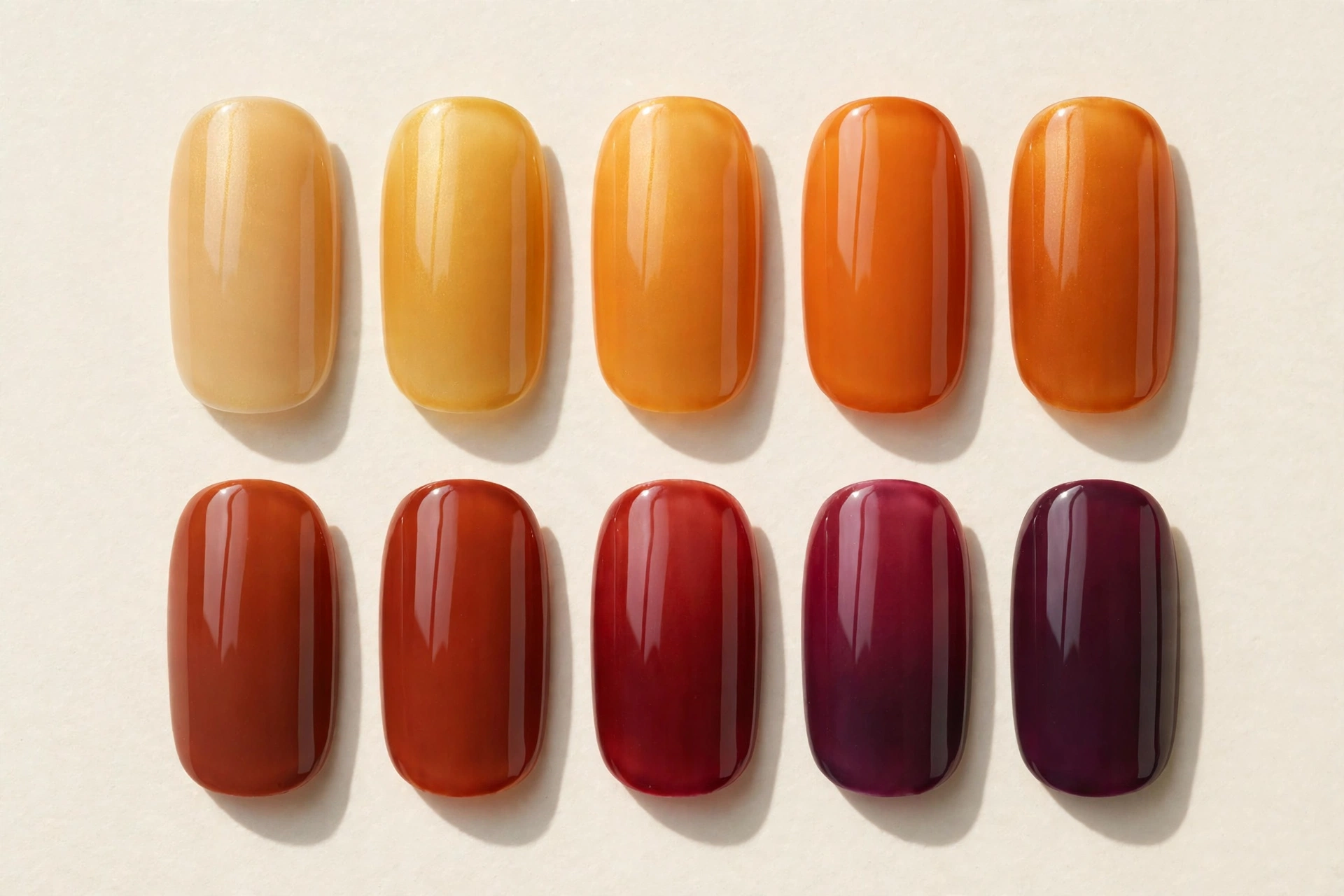
How to Style This Thanksgiving Ombre Palette
Styling an ombre palette is mostly about letting the gradient do the talking. The fade is already the interesting part of the outfit, so the rest of your look should stay warm and simple. A cream knit, a camel coat, brown leather boots, and gold or copper jewellery are the natural partners for every blend in this palette, because they pick up the same warm tones without competing. Black works too, especially with the deeper blends — Cranberry Harvest Fade and Espresso Plum Fade both look striking against a black dress — but keep the black plain, so the nails stay the warmest thing in the room.
Jewellery deserves a little thought. Gold suits the golden blends — Harvest Cream Fade, Golden Pumpkin Fade, and Spiced Cider Fade — because it shares their warm, yellow heart. Copper suits the rust and plum blends, because it shares their earthy depth. Silver can work with Espresso Plum Fade, because the deep plum has a cool edge hiding in it, but silver against Golden Pumpkin Fade can look cold and mismatched, so reach for gold or copper first. Rings matter more than usual with an ombre, because the gradient draws the eye to the hands, and a chunky ring on the same hand can crowd the fade. One ring, worn plainly, is usually enough.
Think about your outfit in the same warm register as your nails. If you are wearing Cranberry Harvest Fade, a cream or camel top lets the berry come forward; a bright red top next to it can look like too much of the same colour family. If you are wearing Golden Pumpkin Fade, a cream or brown outfit lets the orange glow; a bright orange outfit next to it can look like a costume. The rule is simple: one warm star at a time, and let the nails be that star when you want them to be.
Best Occasions to Wear Thanksgiving Ombre Nails
Thanksgiving ombre nails suit the whole Thanksgiving week, and the six blends cover every part of it. Harvest Cream Fade and Golden Pumpkin Fade are the daytime blends: family lunch, a walk through falling leaves, a casual afternoon at home, a Friendsgiving gathering. Spiced Cider Fade and Rust & Plum Fade are the bridge blends: they work at lunch and they work at dinner, so they are the right choice if you only want one manicure for the whole week. Cranberry Harvest Fade and Espresso Plum Fade are the evening blends: Thanksgiving dinner, a candlelit gathering, a night out after the meal.
The same blends carry well beyond Thanksgiving itself. Cranberry Harvest Fade and Espresso Plum Fade both look right at December holiday parties, so a manicure done for Thanksgiving can still look right a week or two later, especially in gel. Golden Pumpkin Fade and Spiced Cider Fade carry into late November and early December as general autumn nails, and Harvest Cream Fade works all winter as a warm neutral. If you are doing your nails once for the whole holiday season, Cranberry Harvest Fade is the safest single choice, because it is festive without being tied to one day.
Short nails deserve a special note here, because ombre is often sold as a long-nail look and that is not the whole story. A vertical ombre — a side-to-side fade rather than a tip-to-cuticle fade — suits short nails beautifully, because it keeps the length you have and gives the eye a wide, soft gradient to follow. A tip-to-cuticle fade on a short nail can make the nail look even shorter, because the deep end at the tip takes up most of the visible nail. If your nails are short, ask for a vertical blend, or sponge the gradient across rather than along the nail, and the result will look longer and more elegant than a flat colour would.
Application Tips for a Smooth Ombre at Home
A good ombre is built in thin layers, and patience matters more than talent. Start with clean, shaped nails and a ridge-filling base coat, because any ridge under a gradient shows as a wavy line in the fade. Apply one thin coat of the lightest shade in your blend and let it dry fully — this is your canvas, and a sheer or streaky canvas makes the whole gradient patchy. Then paint the two shades side by side on a makeup sponge, with the boundary between them in the middle of the sponge, and dab it gently onto the nail in short, light presses. Do not drag the sponge, or you will smear the blend into a muddy single colour.
Two or three light sponge layers are better than one heavy one. Let each layer dry for a minute before the next, and the gradient will build up smoothly instead of going on thick and blotchy. Clean up the skin around each nail with a small brush dipped in remover before the polish dries, because ombre sponging always leaves a little colour on the skin, and a clean edge is what makes a home manicure look professional. Finish with a glossy top coat, and seal the free edge by running the brush along the tip, so the gradient does not wear away there first.
The sponge matters. A dense, fine-pore makeup sponge gives a smoother blend than a coarse one, and a damp sponge gives a softer fade than a dry one. If your first attempt looks streaky, the sponge is usually the problem, not your technique — try a finer sponge, or dampen it lightly before you load it with polish. And if the blend still will not cooperate, a glitter top coat over the join will hide a multitude of sins, though it changes the finish from a pure cream gradient to something sparklier, so save that trick for a blend you are happy to make festive.
Finish and Longevity
Ombre nails wear about as well as any other manicure, and the gradient itself helps. A pale blend like Harvest Cream Fade hides tip wear better than a dark cream polish does, because the fade is already a change in colour, so a small chip at the tip reads as part of the gradient rather than a flaw. A deep blend like Espresso Plum Fade shows chips more clearly, because a break in the surface breaks the dark fade, so a top coat refresh at day three helps a lot there. In gel, every blend in this palette should last two to three weeks with a proper top coat. In regular polish, plan on four to six days before tip wear shows, and a little less if you are cooking, washing up, or handling a lot of dishes across Thanksgiving week.
Top coat is the single biggest factor in how long an ombre lasts. A good, glossy top coat protects the gradient, keeps the shine alive, and stops the sponge texture from catching on fabric. Reapply a thin layer every two or three days, and seal the free edge each time. Cuticle oil matters too: a drop each evening keeps the skin around the nails soft, and soft skin makes the whole manicure look newer for longer. Gloves for washing up are not glamorous, but they are the difference between a manicure that survives Thanksgiving week and one that gives up on the second day.
Polish and Gel Picks
Harvest Cream Fade polish: OPI Cream Caramel Fade, Essie Warm Cream Blend, Sally Hansen Creamy Caramel. Harvest Cream Fade gel: OPI Cream Caramel Fade Gel, Essie Gel Couture Cream, DND Warm Cream Ombre.
Golden Pumpkin Fade polish: OPI Golden Pumpkin, Essie Pumpkin Glow, China Glaze Harvest Gold Orange. Golden Pumpkin Fade gel: OPI Golden Pumpkin Gel, Essie Gel Couture Pumpkin, DND Golden Pumpkin.
Spiced Cider Fade polish: OPI Spiced Cider, Essie Amber Spice, Sally Hansen Cider Glow. Spiced Cider Fade gel: OPI Spiced Cider Gel, Essie Gel Couture Cider, DND Spiced Cider.
Cranberry Harvest Fade polish: OPI Cranberry Harvest, Essie Cranberry Crush, China Glaze Cranberry Fade. Cranberry Harvest Fade gel: OPI Cranberry Harvest Gel, Essie Gel Couture Cranberry, DND Cranberry Harvest.
Rust & Plum Fade polish: OPI Rust Plum, Essie Rustic Plum, Sally Hansen Rust & Plum. Rust & Plum Fade gel: OPI Rust Plum Gel, Essie Gel Couture Plum, DND Rust Plum.
Espresso Plum Fade polish: OPI Espresso Plum, Essie Dark Plum Espresso, China Glaze Espresso Plum. Espresso Plum Fade gel: OPI Espresso Plum Gel, Essie Gel Couture Espresso, DND Espresso Plum.
These shades are inspiration picks to help you find the colours in the palette. Exact shade names vary by brand and season, so check the bottle in daylight before you buy, and swatch on one nail first if you are unsure.
Frequently Asked Questions
What are Thanksgiving ombre nails?
Thanksgiving ombre nails are a gradient manicure in warm autumn shades — cream, caramel, pumpkin, cider, cranberry, and plum — worn for Thanksgiving week. The ombre fade is built by blending two or more colours into each other with a sponge or a soft brush, so there is no hard line where one colour stops and the next begins. Unlike a single-colour manicure, an ombre lets you wear the whole harvest palette on one hand, and unlike nail art, it needs no drawing or decoration to look finished.
When should I wear Thanksgiving ombre nails?
Thanksgiving ombre nails suit the whole Thanksgiving week, from a family lunch through Thanksgiving dinner and into the weekend after. The warm gradients match the season’s colours — autumn leaves, harvest food, candlelight, and warm fabrics — so they feel right in a way a cool blue or a bright pink would not. The same blends also carry into December holiday parties, so a manicure done for Thanksgiving can still look right a week later, especially Cranberry Harvest Fade and Espresso Plum Fade.
Which Thanksgiving ombre shade suits fair skin best?
Harvest Cream Fade and Cranberry Harvest Fade suit fair skin particularly well, because they give warm, polished contrast without looking harsh. Golden Pumpkin Fade is also a good choice if you want a brighter autumn look. The darkest blend, Espresso Plum Fade, looks dramatic on fair skin, so it suits people who like a bold manicure, while Rust & Plum Fade suits fair skin with warm undertones and looks soft and earthy in photographs.
Can I do Thanksgiving ombre nails at home?
Yes, Thanksgiving ombre nails are one of the most forgiving designs to do at home, because a gradient hides small mistakes that a stripe or a dot would not. You need two shades from the same blend, a makeup sponge, a base coat, and a glossy top coat. Paint the shades side by side on the sponge, dab them onto the nail in light presses, and repeat in thin layers until the fade looks smooth. Work on one nail at a time, clean up the edges with a small brush and remover, and seal the free edge with top coat. If the blend looks streaky, try a finer sponge or dampen it lightly before loading it with polish.