
Pumpkin spice nails take October’s favorite flavor and turn it into a manicure: twelve warm orange shades running from true pumpkin through cinnamon, maple, and nutmeg. This chart breaks down every shade with hex codes, skin-tone notes, and the finish details that keep orange nails looking rich and cozy instead of loud.
Orange is the trickiest fall color to wear well. Go too bright and it reads like a traffic cone; drift too brown and it turns muddy on the nail. The pumpkin spice palette solves this by staying in the warm, edible zone — every shade here carries red or gold undertones that flatter warm skin and add life to cool skin. The result looks deliberate rather than accidental, which is exactly what separates a seasonal manicure from a color mishap. None of these are neon, none are flat brown; they sit in the sweet spot where the color clearly says fall without shouting it.
If you have never worn orange nails, do not start with all ten in Burnt Cinnamon Pumpkin. Pick one shade in the middle of the chart — Pumpkin Spice or Autumn Harvest — and wear it on two accent nails first, with the rest in a neutral you already trust. Orange is a commitment color in the sense that it changes how your hands look in every photo, and a one-day test tells you honestly whether it reads cozy or costume on your skin. Most people who think they “cannot wear orange” have simply never met the right orange; a red-leaning shade behaves completely differently from a yellow-leaning one.
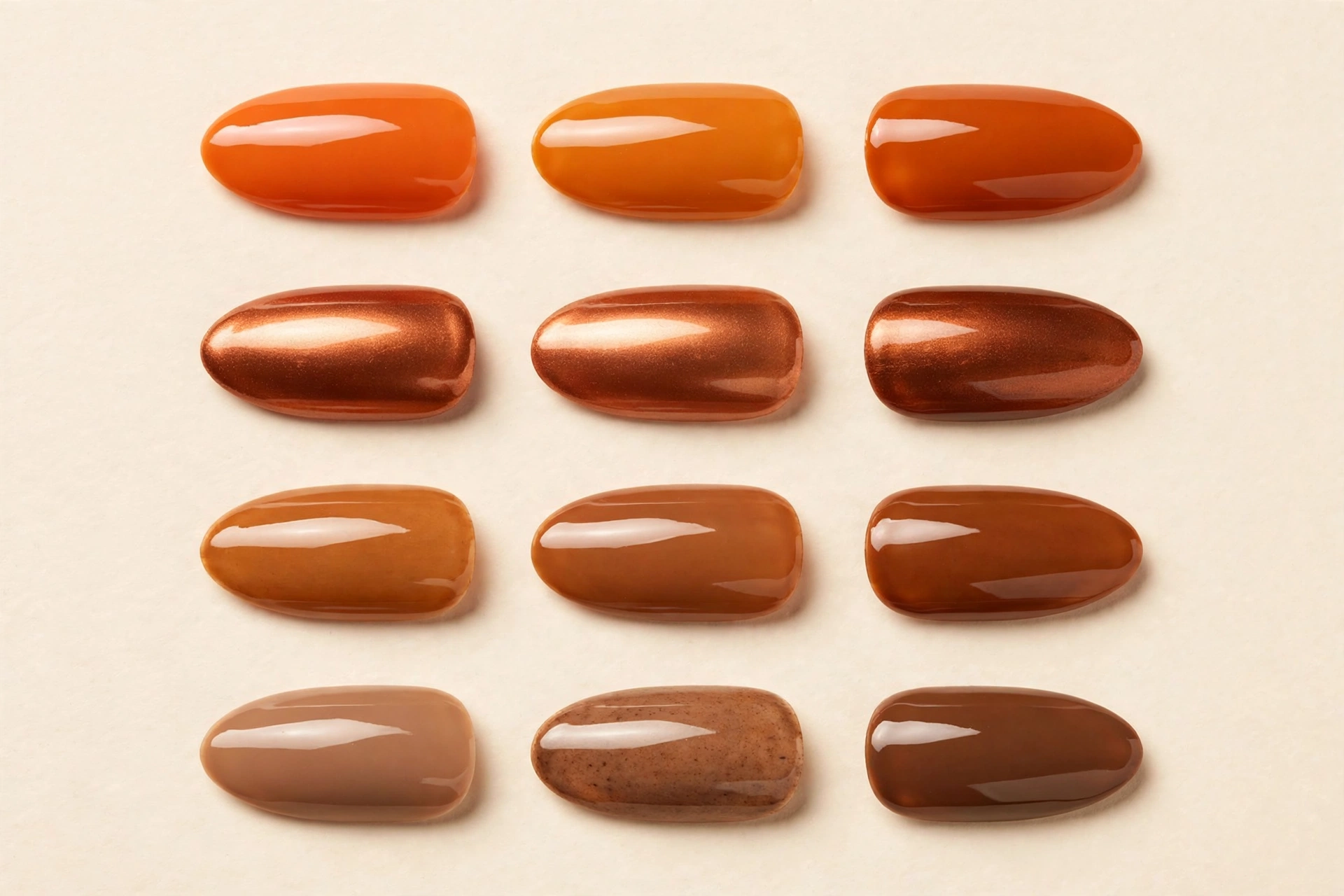
How to use this palette
- Screenshot this post and bring it to your appointment — pointing at Roasted Pumpkin is faster than describing “like a pumpkin, but classy” from memory.
- Wear-test orange before you commit: one accent nail in Pumpkin Spice for a day tells you whether orange reads cozy or loud on your skin tone.
- Keep the finish glossy on your first try — gloss deepens warm oranges and hides the slightly chalky look that a matte top coat can give the palest shades like Toasted Marshmallow.
- Pair neighboring shades, not opposites: Maple Glow with Cider Glow, Nutmeg Dust with Clay Pot. Pumpkin spice shades blend into each other; they do not contrast, and that is the point.
- Match the undertone to your skin: red-leaning shades (Burnt Cinnamon Pumpkin, Spiced Ember) flatter cool and olive skin, while golden shades (Maple Glow, Golden Gourd) flatter warm skin best.
- Remember the shape: these shades look most expensive on short almond or rounded-square nails, where the color reads as a deliberate seasonal choice rather than a long-claw statement.
One decision changes how pumpkin spice nails wear: gel or regular polish. Gel is the practical default for this palette — warm oranges are pigment-heavy colors, and in gel they cure to an even, saturated layer that resists the fading regular polish shows at the tips after a few days of hand-washing. Expect two to three weeks of wear from gel, which is enough to carry one shade through most of October. Regular polish can absolutely do this look, but plan on a fresh top coat every two to three days and about a week of wear; the trade-off is freedom — you can rotate through four or five shades on this chart in a single month, which suits people who change their manicure weekly anyway.
Pumpkin spice nails: 12 cozy orange shades, charted
Roasted Spice — #C0572B
The true-pumpkin end of the chart: the most literal oranges here, the ones that look like the thing on the porch. Roasted Pumpkin is the balanced middle of the trio — a genuine mid-tone pumpkin with equal parts red and gold, and the safest first pick if you want the theme to read clearly. Pumpkin Spice is lighter and softer, the latte version, while Burnt Cinnamon Pumpkin is the deepest and most dramatic, the shade that borders on red. All three flatter medium and warm skin tones with almost no effort; on fair skin they pop as statement shades, and on deep skin they glow like embers. If you can only buy one bottle from this group, make it Roasted Pumpkin — it is the shade the whole palette is named after, and it pairs with everything else on the chart.
Roasted Pumpkin #C0572B — The namesake: a true mid-tone pumpkin orange with balanced red-gold undertones, neither neon nor brown. It flatters medium and warm skin tones beautifully, reads as a cheerful statement on fair skin, and glows richly against deep skin. The most versatile shade on the chart — wear it alone or use it as the anchor for a multi-shade manicure.
Pumpkin Spice #D97B3D — Lighter and softer than Roasted Pumpkin, with more gold in the mix — this is the wearable, everyday version of the theme. It flatters fair to light-medium skin tones best, where it reads warm without overwhelming. On deep skin it works as a bright accent nail rather than a full set; pair it with a deeper shade from this group for balance.
Burnt Cinnamon Pumpkin #A84E24 — The deepest of the trio, a red-brown orange that leans almost rust. It flatters deep and olive skin tones gorgeously and reads as richly dramatic on medium skin; on fair skin it is a bold statement, best kept to shorter nail lengths. The red undertone makes it the most flattering pick in this group for cool undertones.
Polish pick: a true-orange crème polish in a roasted pumpkin tone.
Gel pick: a warm terracotta-orange gel with a high-gloss finish.
Maple & Nutmeg — #E09A52
The golden-brown end of the chart, where pumpkin fades toward spice-jar browns. Maple Glow is the lightest and most golden — an amber shade that catches light beautifully. Nutmeg Dust is the brownest and most muted member of the entire chart, the office-safe pick hiding in a cozy palette. Autumn Harvest sits between them, a harvest gold-orange that does the heavy lifting as an everyday fall shade. These three are the most forgiving for at-home application; the brown and gold undertones hide small imperfections that a brighter orange would expose. Nutmeg Dust in particular pairs naturally with the deeper end of our chocolate brown nail shades for a tonal brown-orange manicure that reads expensive.
Maple Glow #E09A52 — A golden amber-orange with real luminosity, the shade that looks like late-afternoon sun through maple leaves. It flatters warm and medium skin tones best; on fair cool skin it can emphasize pinkness in the fingers, so pair it with gold jewelry to tie the warmth together. Lovely as a full set on almond nails.
Nutmeg Dust #8A5A33 — The most brown and muted shade on the chart, a warm spiced brown with just enough orange to stay in the pumpkin family. It flatters every skin tone honestly: a rich neutral on deep skin, warm and subtle on fair skin, and completely office-appropriate everywhere. If your workplace frowns on orange, this is your loophole.
Autumn Harvest #B4652A — A harvest gold-orange that sits squarely between Maple Glow and Nutmeg Dust in depth. It flatters medium and olive skin tones especially well, reading as a natural extension of warm undertones. The easiest everyday shade on the chart — noticeable enough to feel seasonal, muted enough for any setting.
Polish pick: a golden-maple shimmer polish with fine warm sparkle.
Gel pick: a sheer amber-brown jelly gel, two coats for depth.
Pie & Ember — #9C3F1E
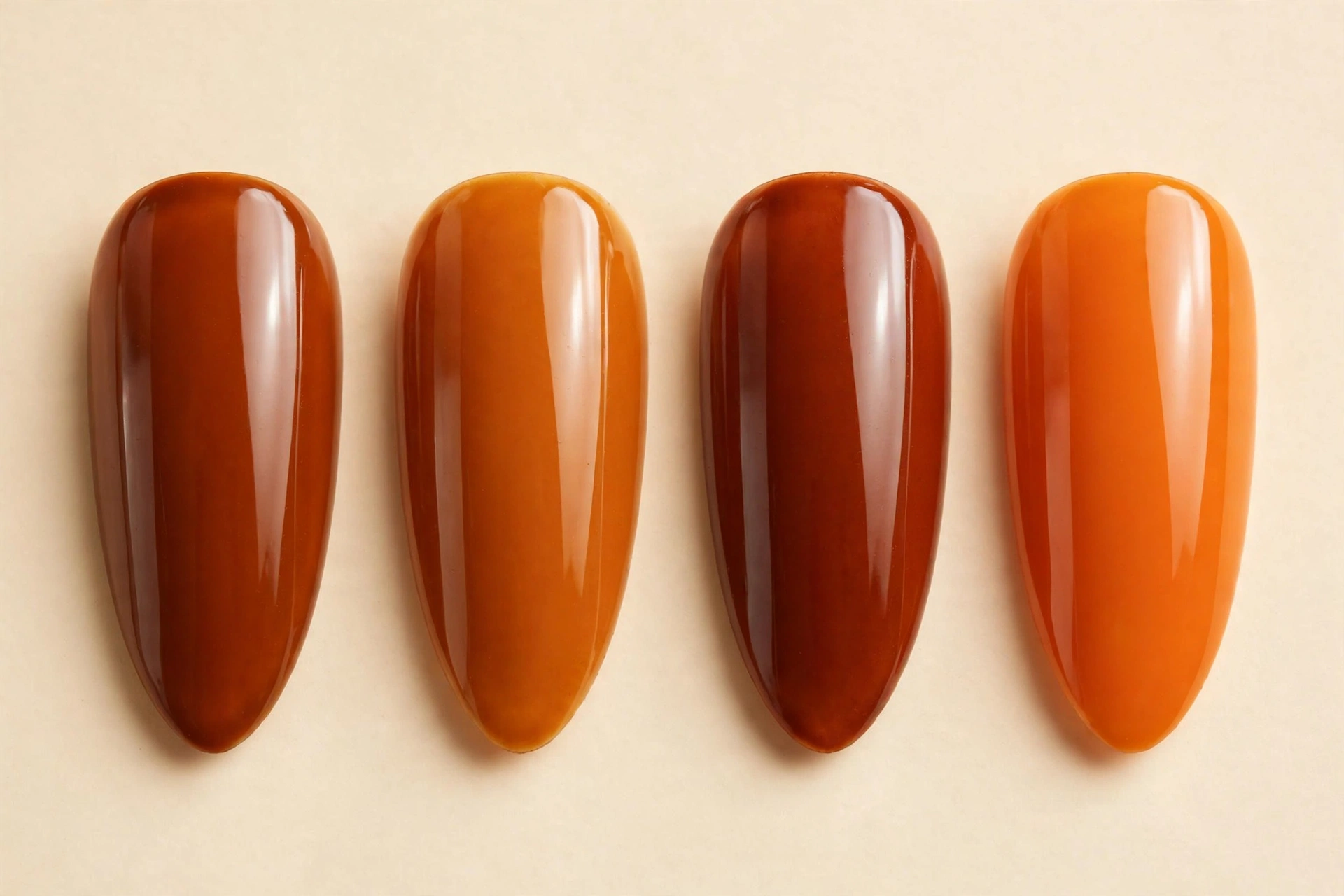
The extremes of the chart: the palest shade and the deepest shade, with a golden gourd holding the middle. Pumpkin Pie is the creamiest, lightest orange here — a pastel pumpkin that behaves almost like a nude on fair skin. Spiced Ember is the darkest and most intense, a deep ember red-orange that reads as pure drama. Golden Gourd bridges them with sunny, golden warmth. This group rewards mixing: Spiced Ember on most nails with one Pumpkin Pie accent is a striking combination, and Golden Gourd softens either extreme. The pale and the deep also show why finish matters — Pumpkin Pie needs gloss to avoid looking chalky, while Spiced Ember looks stunning under both gloss and matte.
Pumpkin Pie #E8A15A — The palest shade on the chart, a creamy light orange that reads almost nude on fair to light-medium skin. It flatters fair skin beautifully as a soft, warm neutral. On deep skin it works best as an accent nail against a deeper base — a full set can look washed out without a tan to anchor it. Keep it glossy; matte makes this shade look powdery.
Spiced Ember #9C3F1E — The deepest, most intense shade here: a dark ember red-orange with real depth. It flatters deep skin stunningly and reads as richly dramatic on medium skin; on fair skin it is a full statement, best on short to medium nails. The red undertone keeps it flattering on cool undertones where brighter oranges would clash.
Golden Gourd #DDA04C — A sunny golden-orange, warmer and more yellow than Maple Glow. It is warm skin’s best friend — golden undertones amplify it — and it flatters medium skin beautifully. On fair cool skin, wear it on shorter nails so the warmth stays playful rather than overwhelming.
Polish pick: a deep ember-orange crème polish.
Gel pick: a burnt-orange gel with a glassy finish.
Clay & Cider — #B25A38
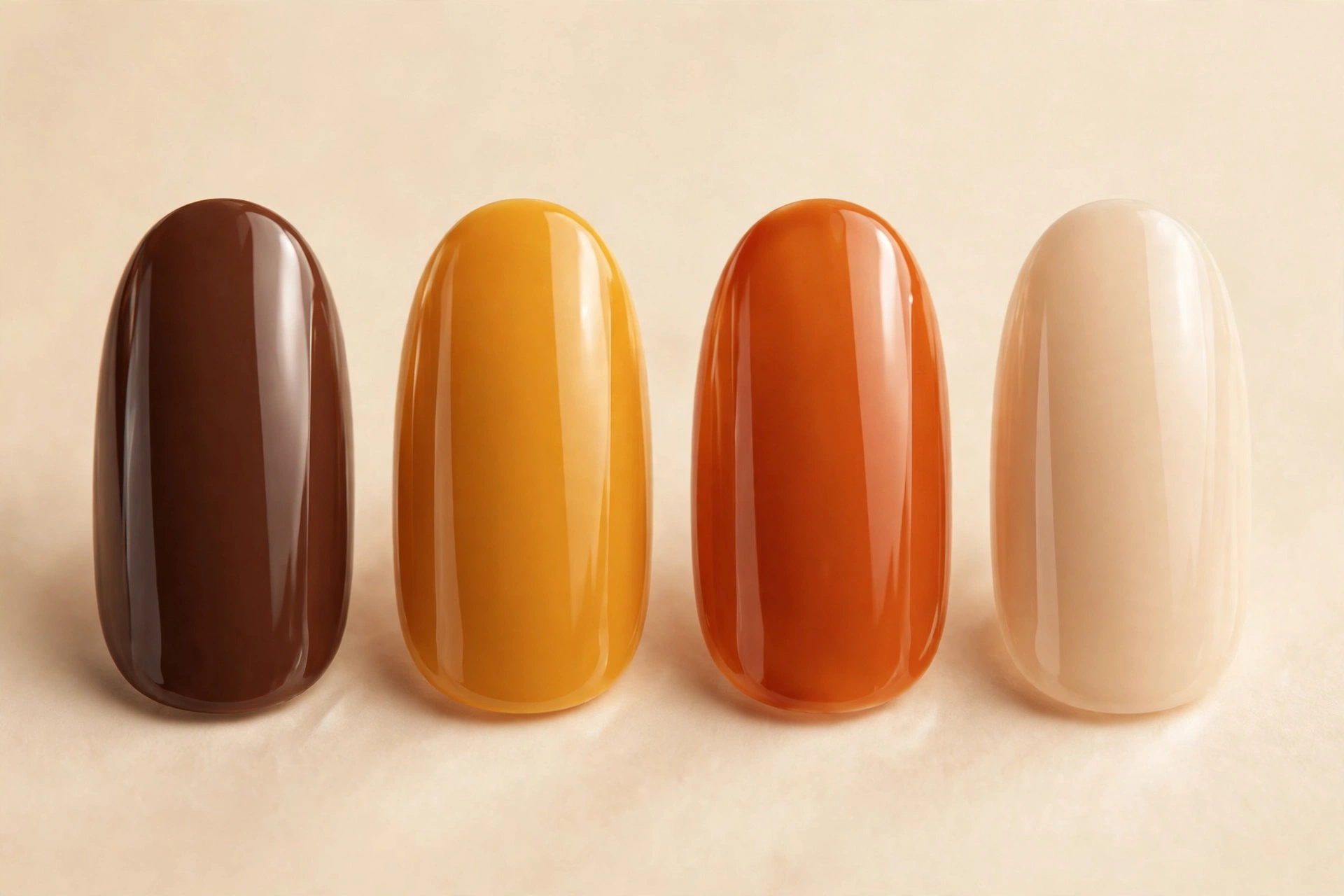
The earthy end of the chart, where pumpkin meets pottery and warm drinks. Clay Pot is a true terracotta — the shade that launched a thousand fall Pinterest boards — and the most universally flattering orange here because its red-brown balance suits nearly every undertone. Cider Glow is a warm spiced orange with golden depth, like the drink in a clear mug. Toasted Marshmallow is the palest neutral on the chart, a creamy beige-orange that functions as the palette’s nude. Together these three make the most wearable trio for anyone nervous about orange: start with Toasted Marshmallow, graduate to Cider Glow, and arrive at Clay Pot when you are ready for the real thing.
Clay Pot #B25A38 — True terracotta: a red-brown orange that flatters olive and medium skin tones especially well, since it echoes their natural warmth. It is the most universally wearable orange on the chart — the red-brown balance keeps it flattering on cool, warm, and neutral undertones alike. The safe statement shade.
Cider Glow #C77B43 — A warm spiced orange with golden depth, like apple cider held up to the light. It flatters medium to deep skin tones beautifully and reads as cozy rather than loud on fair skin. Slightly softer than Roasted Pumpkin, slightly deeper than Maple Glow — the diplomat of the chart.
Toasted Marshmallow #E5B98A — The palest neutral here: a creamy beige-orange that works as this palette’s nude. It flatters fair to light-medium skin as an understated warm neutral and makes a lovely base for nail art on any skin tone. Pair it with any deeper shade on the chart for a tonal gradient that looks professionally done.
Polish pick: a terracotta crème polish with warm red-brown depth.
Gel pick: a warm nude-orange gel, perfect for a sheer wash of color.
Styling tips for the pumpkin spice palette
Jewelry makes or breaks an orange manicure. Gold is the default pairing — yellow gold amplifies the golden shades (Maple Glow, Golden Gourd, Pumpkin Pie), while rose gold flatters the red-leaning ones (Burnt Cinnamon Pumpkin, Spiced Ember, Clay Pot). Copper and bronze jewelry is the advanced move: it matches the palette so closely that the whole hand reads as one coordinated autumn story. Silver can work, but only with the deepest shades; against the lighter oranges it creates a temperature clash that looks accidental.
Clothing follows the same warmth rule. Cream, camel, chocolate brown, forest green, burgundy, and denim are the natural partners — essentially the colors already hanging in a fall wardrobe. A cream cable-knit sweater with Clay Pot nails is the entire aesthetic in one photo. Black works too, especially with Spiced Ember or Burnt Cinnamon Pumpkin, where the contrast turns the manicure into the focal point. The one pairing to avoid is neon or icy pastels, which fight the warmth instead of supporting it.
Makeup should echo, not match. A terracotta blush, warm brown mascara instead of black, and a nude or brick lip keep the face in the same family without looking themed. Matching your lipstick exactly to your nail shade is the fastest way to make both look cheaper — let them be cousins, not twins. If you wear the deeper shades, a soft brown smoky eye ties everything together for evening.
Best occasions to wear pumpkin spice nails
This is a September-through-November palette first and everything else second. It peaks at the events fall is built around: pumpkin patch outings, apple picking, hayrides, and bonfire nights, where the manicure matches the setting so well it looks intentional in every photo. Thanksgiving dinner is the headline occasion — the whole chart was practically designed for it — and our Thanksgiving nail colors chart has two dozen more harvest shades if you want to build a full holiday manicure around the meal.
Fall weddings are another natural fit, with one rule: as a guest, any shade here works; in the wedding party, check with the bride before going full Spiced Ember in the close-up ring photos. The muted end of the chart — Nutmeg Dust, Toasted Marshmallow, Cider Glow — is genuinely office-appropriate and can carry you through the workweek without a second thought. Save the vivid middle (Roasted Pumpkin, Pumpkin Spice) for weekends and social plans.
Two occasions to think twice about: job interviews and conservative client meetings, where even pretty orange can read as distracting — stick to Nutmeg Dust or Toasted Marshmallow those days. And the week after Thanksgiving, when the palette starts to feel dated; that is the moment to transition toward deeper winter shades rather than squeezing one more week out of pumpkin.
Making pumpkin spice nails last: finish, application, and wear tips
Finish choice changes what these shades say. Glossy is the default and the most flattering — it deepens warm oranges, makes the golden shades glow, and keeps the pale shades from looking chalky. Matte gives the deeper shades (Burnt Cinnamon Pumpkin, Spiced Ember, Clay Pot) a velvet, powdered-cinnamon effect that looks incredibly rich, but skip matte on Pumpkin Pie and Toasted Marshmallow, where it reads as dry. A glazed or chrome finish is the trend-forward option: a pearly chrome layer over Cider Glow or Maple Glow gives the lit-from-within look, and our glazed donut nail colors chart breaks down exactly how that finish behaves over warm bases.
Application matters more with orange than with most colors because the pigments are prone to streaking. Use three thin coats instead of two thick ones — orange levels poorly when applied heavy, and thin coats self-level into an even layer. A ridge-filling base coat is worth the extra minute; it smooths the nail surface so the warm pigment sits evenly instead of pooling in ridges. Cap the free edge with each coat, color and top coat both — orange shows tip wear faster than darker colors, and capping buys you two to three extra days.
For wear time, gel is the set-and-forget option at two to three weeks, and warm oranges are forgiving as they grow out since the color family is naturally soft at the cuticle line. With regular polish, expect five to seven days before the tips start to go; refresh the top coat on day three and day six rather than waiting for dullness, and keep cuticle oil in your bag. Orange against dry, ragged cuticles is the difference between a manicure that looks intentional and one that looks tired — thirty seconds of oil nightly is the cheapest upgrade on this chart.
A note on color matching
Screens shift warm tones, so treat this chart as inspiration rather than an exact product match. Compare any bottle against this chart in daylight to find your closest shade.
Frequently asked questions
Which pumpkin spice shade is most office-friendly?
Nutmeg Dust, without contest — it reads as a warm brown neutral in most office lighting and raises no eyebrows. Clay Pot and Toasted Marshmallow are the runners-up; keep nails short to medium with a rounded or almond shape and the whole look stays professional. Save Roasted Pumpkin and Spiced Ember for the weekend.
Do pumpkin spice nails work on short nails?
They work better on short nails than most seasonal palettes. The deeper shades — Burnt Cinnamon Pumpkin, Spiced Ember, Clay Pot — make short nails look neat and intentional rather than stubby, because dark warm colors visually streamline the nail. If your nails are short, start at the deep end of the chart; our guide to flattering shades for short nails has more picks built around shorter lengths.
When is the best time to wear pumpkin spice nails?
Late September through November is the sweet spot, when the color matches the season outside your window. The muted shades — Nutmeg Dust, Toasted Marshmallow — work year-round as warm neutrals, and Clay Pot carries comfortably into early December before the palette starts to feel dated. Wearing Roasted Pumpkin in March will get you looks; wearing it in October will get you compliments.
Should I choose matte or glossy for pumpkin spice nails?
Glossy for your first attempt — it deepens every shade on this chart and is the most forgiving finish. Once you know which shades you love, try matte on the deeper ones (Burnt Cinnamon Pumpkin, Spiced Ember, Clay Pot) for a velvet, spiced-cocoa effect. Avoid matte on the two palest shades, Pumpkin Pie and Toasted Marshmallow, where it turns chalky instead of velvety.