
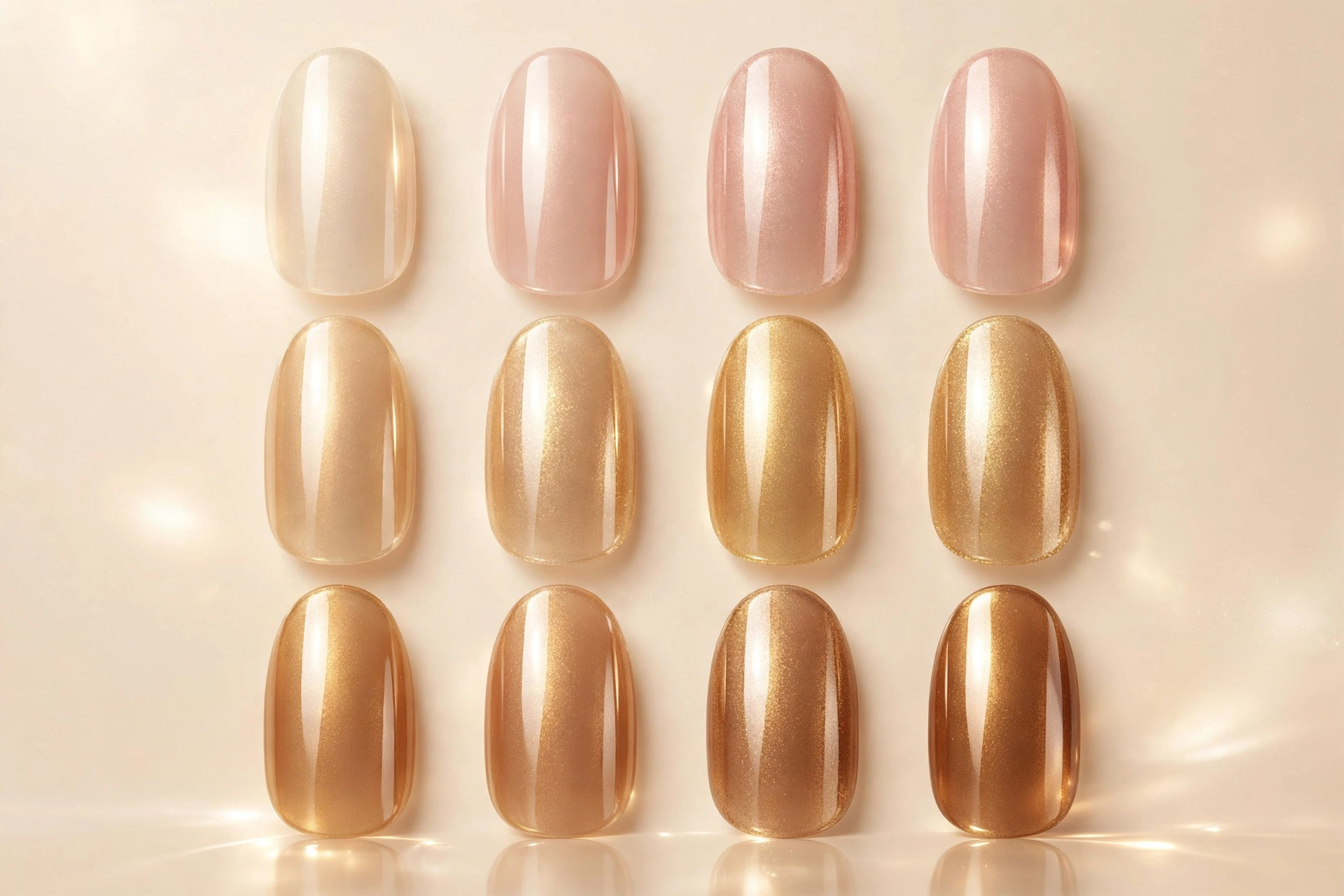
Champagne nails are the holiday manicure that never looks like it is trying too hard. Gold can feel loud, silver can feel cold, but champagne — that warm, fizzy middle ground — lands right where festive and wearable meet. This chart breaks down twelve champagne nail shades, from icy pale golds to deep toasted ambers, with hex codes, skin-tone notes, and finish guidance so you can find your version.
The reason champagne nails come back every single winter is that they solve the metallic problem. True gold metallics demand perfect lighting and confidence; champagne tones carry the same celebratory warmth in a softer, more forgiving register. They photograph well in the yellow light of restaurants and parties, they do not clash with most outfits, and they sit comfortably next to both gold and silver jewelry. If gold has ever felt like too much on you, the answer was probably never “skip metallics” — it was champagne all along.
How to use this palette
- Screenshot the chart before your appointment — pointing at a swatch beats describing “not too gold, but gold” to your nail tech.
- Decide your metal temperature first: rosé-leaning shades (Rosé, Pink Champagne) suit cool undertones, while golden and toasted shades (Golden, Toasted) suit warm undertones.
- Two thin coats beats one thick coat with every champagne on this chart — metallics and shimmers pool at the cuticle if they go on too heavy.
- Pick a finish before a shade: sheer shimmer for daytime, full metallic for evening, satin pearl for the office.
- Try one accent nail in a deeper champagne (Deep or Midnight) against a paler base for a NYE look that costs almost nothing.
The single biggest upgrade you can make to any champagne manicure is the base coat. Champagne shades, especially the shimmery ones, magnify every ridge and dip on the nail plate — a ridge-filling base coat is what separates a champagne manicure that looks like glass from one that looks streaky. On top, a glossy top coat does more for a champagne shade than an extra coat of color ever will; the shine is what sells the “bubbly” effect. Reapply top coat on day four or five and a champagne manicure keeps its just-poured look for a full week in regular polish, two-plus weeks in gel.
Champagne nails: 12 shades, charted
Pale Champagne — #E8D5A8
The lightest corner of the chart: pale golds with a soft, luminous glow. These are the most wearable champagnes in existence — subtle enough for daytime, festive enough for a holiday party, and the easiest entry point if metallics make you nervous. On the nail they read as an elevated nude with light in it.
Classic Champagne #E8D5A8 — The reference pale gold of the chart: warm, but not yellow. It flatters fair skin without washing it out because the beige undertone sits close to natural nail beds, and it turns luminous against deep skin where the gold tones pick up warmth. If you only ever try one champagne shade, this is the one.
Icy Champagne #EBDCBE — The coolest pale here, a near silver-gold with a frosted feel. It suits fair to light skin with cool undertones best, where it reads like frozen gold; on deep skin it works better as an accent nail, since the pale tone can flatten out without a darker contrast shade beside it. The pick for minimalist holiday looks.
Champagne Pearl #E9DCC8 — A soft pearlescent beige with a satin glow rather than a metal shine. It flatters medium skin tones beautifully — the pearl finish evens out redness along the cuticle line — and it is the most forgiving champagne on short nails, where chunky metallics can overwhelm. The office-safe champagne.
The pale trio comparison: Classic is your all-rounder, Icy is your cool-toned specialist, and Pearl is your texture choice when you want glow without glitter. Wear them alone for everyday winter elegance, or use any of the three as a base layer under a deeper champagne tip for a reverse-french effect that costs nothing extra at the salon.
Polish pick: a pale-gold pearl crème polish.
Gel pick: a soft-gold shimmer gel sealed with a satin top coat.
Rosé Champagne — #E5B8A8
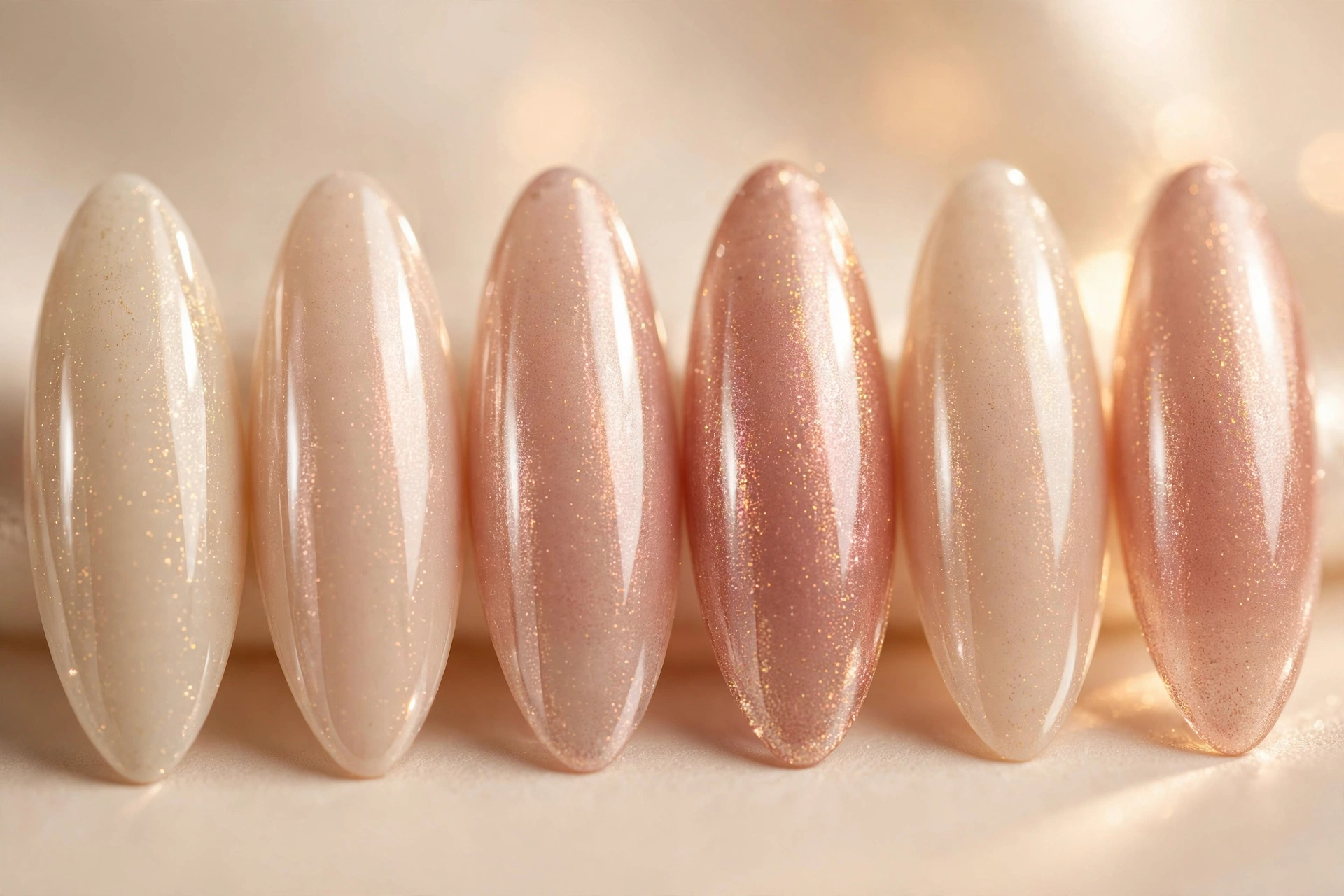
Blush pink melted into pale gold — the romantic corner of the chart. Rosé champagnes are the most forgiving metallics in existence because the pink undertone keeps them wearable on skin tones that true gold fights. They also happen to be the most photographed champagne category every December, since they flatter hands in close-up holiday photos.
Rosé Champagne #E5B8A8 — The blush-gold hybrid that made this category famous. It is close to universally flattering: the pink undertone keeps it wearable on fair skin that fears gold, while the gold shimmer gives it presence on medium and deep skin. The hardest shade to choose wrong on the entire chart.
Pink Champagne #EDC5B8 — The pinkest shade here, barely gold at all. Its glow factor peaks on deep skin tones, where the blush pops against darker hands; on fair skin it reads like a tinted nude with holiday sparkle. Pick this for weddings when you want romantic rather than metallic.
Champagne Shimmer #DCC39A — Fine gold shimmer suspended in a sheer champagne base. The sheerness makes it the most forgiving shade on every skin tone — it tints rather than covers, so it works with your undertones instead of fighting them. It is also the best layering shade on the chart: one coat over any nude turns it into champagne.
The rosé trio comparison: Rosé Champagne is the balanced signature, Pink Champagne leans romantic and is the best bridal-adjacent pick, and Champagne Shimmer is the utility player — sheer enough to top anything, warm enough to count as a champagne on its own in two coats. If your skin has strong pink or red undertones, start with the rosé corner before you ever touch the golden shades.
Polish pick: a rosé-gold shimmer polish.
Gel pick: a sheer pink-gold gel with a glass finish.
Golden Champagne — #E3C580
The true golds of the chart: warm, rich, and unapologetically celebratory. This is the corner that earns champagne its NYE reputation — these shades catch candlelight and camera flashes the way no other neutral can. They demand a little more confidence than the pales, but the payoff is a manicure that looks expensive from across the room.
Golden Champagne #E3C580 — The headline gold: warm, vivid, and luminous. It was made for medium and deep skin tones, where it looks lit from within; on fair skin it reads bolder, so save it for evening when the depth pays off. This is the shade to wear when the countdown starts.
Vintage Champagne #C9A86A — An aged gold with a brushed, antique feel — less sparkle, more patina. It flatters warm and olive undertones across light to deep skin, and it reads expensive rather than flashy, which makes it the pick when you want gold energy without a disco finish. It pairs beautifully with heirloom or vintage jewelry.
Brut Champagne #D9C08E — Dry, refined gold with the sparkle dialed down. The quiet-luxury pick of the chart: it works in offices and daytime events where true metallics feel too loud, and it suits medium skin especially well. The “I want champagne but make it subtle” shade.
The golden trio comparison: Golden is the showpiece — full warmth, full presence. Vintage is the sophisticate, with its muted antique depth for people who find bright golds too young. Brut is the strategist’s gold — all the champagne warmth in a finish that never shouts. If you love the golden corner but wear neutrals to work, Brut is how you sneak it into your workweek.
Polish pick: a warm-gold metallic polish.
Gel pick: a rich gold chrome-effect gel.
Toasted & Deep Champagne — #D2AE7A
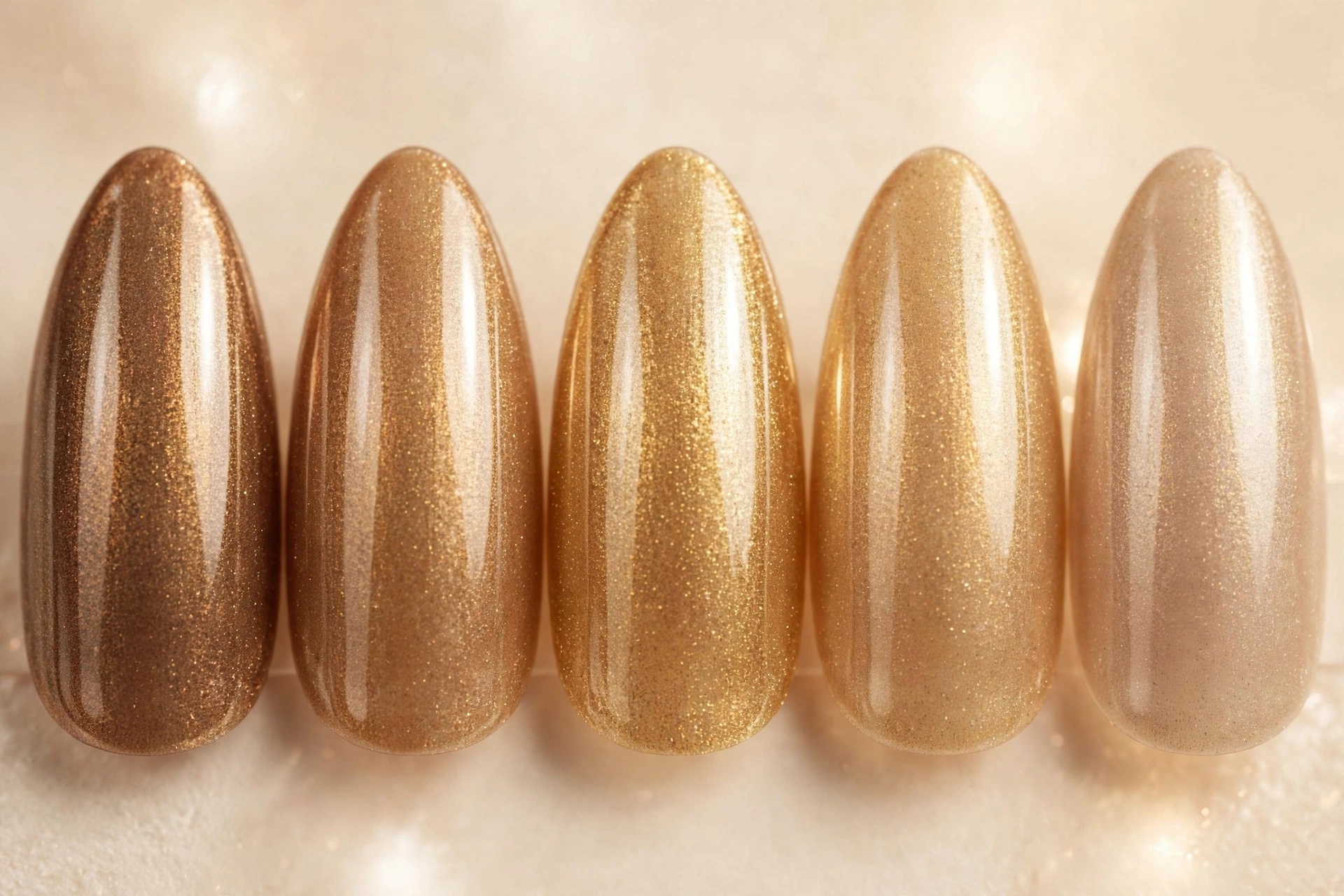
The deepest corner of the chart: caramel, bronze, and smoky amber champagnes with real depth. These are the shades that bridge autumn and winter — rich enough for evening, warm enough to feel cozy. They also have the best staying power of the chart in photos, since deeper tones read clearly even in dim party lighting.
Toasted Champagne #D2AE7A — Warm caramel-gold with genuine depth. A standout on deep skin tones, where the brown-gold undertone harmonizes instead of contrasting; it is equally strong on medium skin. The autumn-to-winter crossover shade — wear it from Thanksgiving straight through to New Year’s.
Deep Champagne #B8925A — The darkest gold here, borderline bronze. It reads as a bold statement neutral on fair skin and as rich, burnished warmth on deep skin. Use it on short nails for maximum impact without effort — the depth does all the work, so the shape does not have to.
Midnight Champagne #C4A066 — Smoky amber-gold with after-dark drama. Made for low light: it flatters every skin tone under warm lighting, which is exactly where New Year’s Eve happens. The shade to wear with a black dress when you want one warm detail that catches the eye.
The deep trio comparison: Toasted is the friendly one — warm, golden, approachable. Deep is the bold one, with enough bronze to function as a true statement shade. Midnight is the evening specialist, built for candlelight and camera flash. Together they form a ready-made ombré sequence: Toasted at the cuticle, Deep in the middle, Midnight at the tip.
Polish pick: a toasted-bronze shimmer polish.
Gel pick: a deep amber-gold gel with a glossy finish.
How to style champagne nails
Champagne is the most jewelry-friendly color on the nail chart, but a little matching goes a long way. Gold jewelry plus Golden or Vintage Champagne is a classic for a reason — it reads as intentional rather than matched, as long as you let either the rings or the nails be the star. Rose gold jewelry pairs best with the rosé corner (Rosé and Pink Champagne), while silver and white gold sit better against Icy Champagne or Champagne Pearl, where the cool tones echo each other.
Shape matters more than people expect. Almond and oval shapes flatter champagne shades best because the tapered tip catches light and shows off the shimmer gradient — this is the palette’s natural home. Coffin and long square shapes turn the deeper champagnes (Deep, Midnight) into a full evening statement, which is ideal for NYE but a lot for a Tuesday. On short nails, stay in the pale and rosé corner, or keep one deep accent nail per hand — the light shades elongate, while full deep metallics on every short nail can look heavy.
For a party look without a salon visit, try the one-nail rule: nine nails in a pale champagne, one ring-finger nail in Midnight or Deep Champagne. It costs one extra bottle and reads as a deliberate design. Another easy upgrade is a pearly chrome top coat over any champagne base — it gives the glassy, glazed finish from our pearly chrome glazed-donut chart, which turns even a flat crème champagne into something that looks salon-fresh. And if you want the festive feel without committing all ten nails, champagne french tips — a sheer nude base with a Classic or Rosé Champagne tip — are the most elegant entry point in the whole palette.
One styling caution: champagne plus heavy glitter is almost always too much. The champagne finish already does the light-catching work, so adding chunky glitter on top fights the shade instead of helping it. If you want more sparkle for NYE, go one step deeper in the chart (Classic to Golden, Rosé to Midnight) rather than adding glitter to a pale shade.
Best occasions for champagne nails
New Year’s Eve is champagne’s home turf — the name alone makes it the obvious pick, but the color earns it. Under warm party lighting, champagne shades glow where flat nudes disappear and where true golds can look harsh in photos. Golden Champagne or Midnight Champagne with an all-black outfit is the classic NYE formula: one warm metallic detail against a dark base. If your NYE runs from dinner to dancing, gel is worth it — champagne metallics show tip wear faster than crème nudes do.
Winter weddings are the second natural occasion. For brides, the pale corner (Classic, Icy, Pearl) and the rosé corner (Rosé, Pink Champagne) read bridal without competing with the dress — they photograph as luminous rather than metallic in daylight, which is exactly what wedding photos need. Guests have more freedom: Toasted and Vintage Champagne pair beautifully with jewel-toned dresses and velvet textures. If you are in the wedding party, check our winter wedding nail ideas to coordinate with the dress code before you commit to a deep metallic.
Holiday parties and office events sit in the middle: festive enough to feel intentional, restrained enough for the office party. Brut Champagne and Champagne Pearl were practically designed for this — champagne warmth that reads as polished from across the conference room. Save the full metallics (Golden, Deep) for the actual party, not the office version.
Two more occasions worth naming: date nights, where the rosé corner’s soft glow flatters hands across a candlelit table, and winter engagement season, where a ring photo in Rosé or Classic Champagne makes the diamond the star while the nails still look done. The one occasion to skip champagne is anything with a strict no-metallic dress code — rare, but some conservative workplaces and formal ceremonies prefer a plain crème.
Champagne finish, longevity, and application tips
Finish first: champagne comes in four personalities — sheer shimmer, satin pearl, full metallic, and chrome — and the finish changes the shade more than the hex code does. Sheer shimmers (Champagne Shimmer) are the most forgiving and the easiest to apply; full metallics (Golden, Deep) show every brushstroke and demand a steady hand; satin pearls (Champagne Pearl) hide imperfections best. If you are doing your own nails, pick your finish by your skill level, not just your favorite color.
For wear time, gel wins this palette by a clear margin. Metallic and shimmer polishes chip at the tips faster than crèmes because the reflective particles create a harder, more brittle film — expect five to seven days from regular polish, and reapply top coat around day three to seal the tips. In gel, champagne shades hold two to three weeks easily, and the cured finish keeps the shimmer suspended instead of settling. If you do go the regular-polish route, a ridge-filling base coat is non-negotiable: it is the difference between a streaky metallic and a smooth one.
Application technique for champagne, step by step: start with a ridge-filling base and let it go fully tacky. Apply the first color coat thin — thinner than you think — and do not go back over a stroke once it starts to set, because re-brushing a metallic drags the particles and leaves visible lines. The second coat can be slightly fuller. For the deepest shades (Deep, Midnight), a third thin coat evens out the coverage without bulk. Seal with a glossy top coat, cap the free edge, and finish with cuticle oil once everything is dry — oil on the cuticles keeps the whole manicure reading as fresh, which matters more with light-catching shades than with flat colors.
Removal needs a note too: metallic and shimmer polishes grip harder than crèmes. Use the foil method — soak a cotton pad in remover, press it on the nail, wrap in foil for five minutes — rather than scrubbing, which drags shimmer across the skin and stains cuticles. For gel champagne, have it soaked off properly; picking at a metallic gel leaves the nail plate rougher than picking at a crème does, and the next champagne manicure will show every bit of that damage.
One last practical tip: store champagne polishes upright and roll the bottle between your palms before use instead of shaking it. Shaking whips air into shimmer formulas and causes bubbles that read as texture on the nail; rolling redistributes the particles evenly. It is a small habit that makes a visible difference with every shade on this chart.
A note on color matching
Metallic and shimmer shades shift more on screen than flat colors do, so treat this chart as inspiration rather than an exact product match. Compare any bottle against these swatches in daylight, and test one nail before committing to all ten.
Frequently asked questions
What is the difference between champagne nails and gold nails?
Champagne is gold softened with beige, pink, or brown undertones — it reads as a warm neutral, while true gold reads as a metallic statement. If gold has ever felt too loud or too yellow on you, champagne is the same festive energy in a register that works for daytime, offices, and people who do not usually wear metallics.
Which champagne nail shade is best for New Year’s Eve?
Golden Champagne for maximum celebration, or Midnight Champagne if your outfit is dark and you want one warm focal point. Both catch party lighting beautifully. If you are doing your own nails, pick Golden in gel or a chrome-effect finish — it hides minor application flaws better than the paler shades under flash photography.
Can I wear champagne nails to a winter wedding?
Absolutely — the pale and rosé corners (Classic, Icy, Pearl, Rosé, Pink Champagne) are bridal-safe and photograph as luminous rather than metallic in daylight. As a guest, you have more room: Toasted and Vintage Champagne pair beautifully with velvet and jewel tones. Just keep the finish satin or pearl rather than full chrome if the dress code leans formal.
Do champagne nails work on short nails?
They do — in fact, the pale and rosé champagnes are some of the best shades for short nails because the light tones elongate the nail visually. Keep full metallics (Golden, Deep) to one or two accent nails on short lengths so they do not overwhelm, and check our short-nail color chart for more shades built around shorter lengths.