
Aurora nails are having a moment, and it is not hard to see why. The aurora nails trend takes the magic of the northern lights and shrinks it down to your fingertips: iridescent, color-shifting finishes that flip from teal to violet, green to blue, or magenta to gold depending on how the light catches them. One shade can look completely different in sunlight, indoor lighting, and a mirror selfie — which is exactly the point.
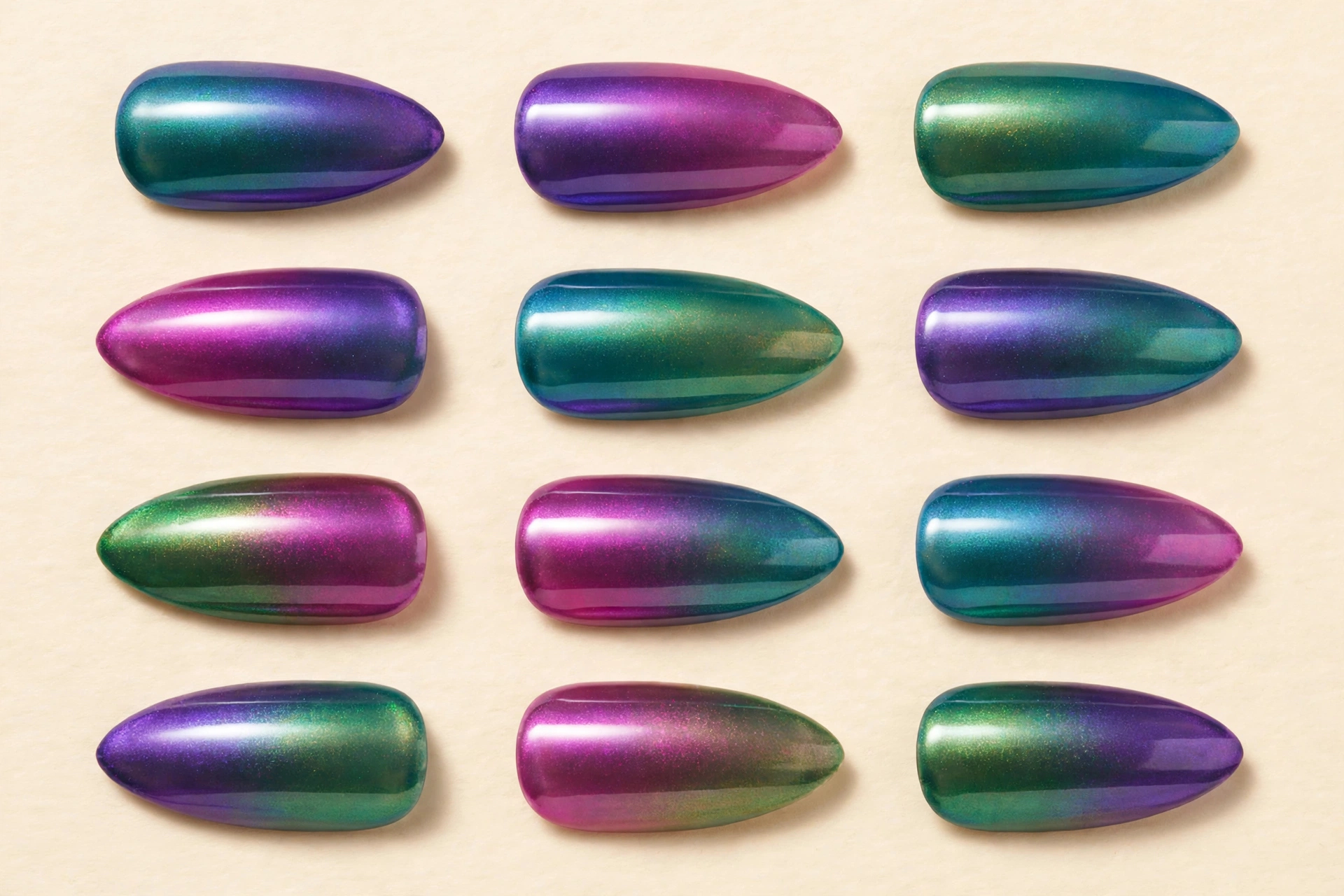
How to Use This Aurora Nails Palette
- Hold shades at an angle. Auroras only reveal their shift when light moves across them, so tilt the swatch chart (or your phone) side to side before picking a shade.
- Choose your shift direction. Decide whether you want a cool shift (teal→violet, green→blue) or a warm one (magenta→gold, copper→rose) — mixing both in one manicure usually fights for attention.
- Start with a dark base for drama. Most aurora pigments pop hardest over a black or deep plum base; over a milky base the same shade reads softer and more pearlescent.
- Go chrome powder for the strongest flip. Loose aurora chrome powder rubbed over a no-wipe gel top coat gives a far more dramatic color shift than shimmer polish alone.
- Keep the palette on one nail length. Shifting finishes look cleanest on a consistent almond or oval shape, where the light rolls evenly across every tip.
- Pair with one solid accent nail. One glossy black or deep plum accent nail grounds the iridescence and stops the whole set from looking busy.
1. Northern Teal — #2FA9A3
Northern Teal opens the palette with the shade most people picture when they hear “aurora nails.” The base is a cool teal — not quite green, not quite blue — finished with a duochrome shift that rolls into soft violet at the edges. It has a glassy, high-shine finish with fine shimmer rather than chunky glitter, so it reads expensive in person. On fair skin, the teal pops like a gemstone; on medium and deep skin tones, the violet edge adds warmth that keeps it from looking flat. Next to a plain teal polish it looks richer and more dimensional, because the shift gives it that extra color you can’t get from a creme. If you only try one aurora shade, make it this one — it’s the most flattering across skin tones and the most recognizable as the trend.
2. Violet Veil — #8B7FD8
Violet Veil leans into the purple side of the aurora, with a lavender-grey base that shifts toward icy blue in direct light and deep amethyst in shade. The finish is a sheer chrome — translucent enough that a nude base shows through, giving it that stained-glass depth the trend is known for. It flatters fair to medium skin tones beautifully, where the cool violet reads ethereal rather than grey. On deeper skin tones, layer it over a violet base instead of nude so the shift stays visible. Compared with Northern Teal, Violet Veil is quieter and more wearable day to day — less “statement,” more “mysterious.” It also photographs beautifully in golden hour, when the blue edge picks up the warm light.
3. Emerald Shift — #3EBE8E
Emerald Shift is the green-to-blue duochrome of the palette: a lively green base that flashes cerulean at the tips when the light moves. It has a metallic-mirror finish, more reflective than Northern Teal, so it reads like polished jade. Medium and deep skin tones get the best version of this shade — the green looks lush and jewel-like, with the blue flash adding a cool contrast. On fair skin it can pull slightly yellow in indoor light, so look for it over a white base to keep it bright. Compared with Northern Teal, Emerald Shift is bolder and more saturated, with the blue showing up as a sharp flash rather than a gradual melt. It’s the shade to pick when you want the color shift to be unmistakable.
4. Celestial Blue — #5E9BF2
Celestial Blue is the daytime aurora: a sky-blue base with a shift into seafoam green at the edges, finished like a polished opal. The finish is soft chrome with a pearly undertone, so it never looks harsh even though blue can be a strong nail color. Fair and light-medium skin tones wear this one best — the blue reads crisp and clean, like a bright winter sky. On deep skin tones, it needs a white or pale blue base underneath to keep its brightness, otherwise the blue sinks. Next to Emerald Shift, Celestial Blue is cooler and airier; where Emerald Shift is a jewel, Celestial Blue is a breeze. It’s also the most office-friendly shade in the cool half of the palette.
5. Magenta Mirage — #D6459B
Magenta Mirage starts the warm side of the palette with a hot magenta base that melts into gold at the edges — the classic sunset aurora. The finish is a molten chrome, fully opaque, with a warm undertone that glows under indoor lighting. It flatters warm and neutral undertones especially well; the magenta looks rich rather than garish, and the gold shift adds a sunset softness. On very fair skin, it reads bold and playful — pair it with shorter nails if you want to tone it down. Compared with Northern Teal, it’s the warm inverse: same drama, opposite temperature. If your wardrobe leans warm — golds, coppers, corals — this is your aurora.
6. Golden Hour — #E8A33D
Golden Hour is the softest warm shift in the palette: a honeyed copper base that drifts into rose pink at the edges, like the last ten minutes before sunset. The finish is a brushed chrome — slightly less mirror-like than the others, with a delicate grain that makes the shift feel organic. It flatters medium, olive, and deep skin tones especially, where the copper reads like a second skin and the rose edge adds a flattering flush. On fair skin, it can read more metallic-gold than aurora; keep it over a warm nude base to soften it. Compared with Magenta Mirage, Golden Hour is its calmer, older sister — same warm family, far more wearable with everyday outfits. It also layers beautifully under a sheer top coat for a glazed effect.
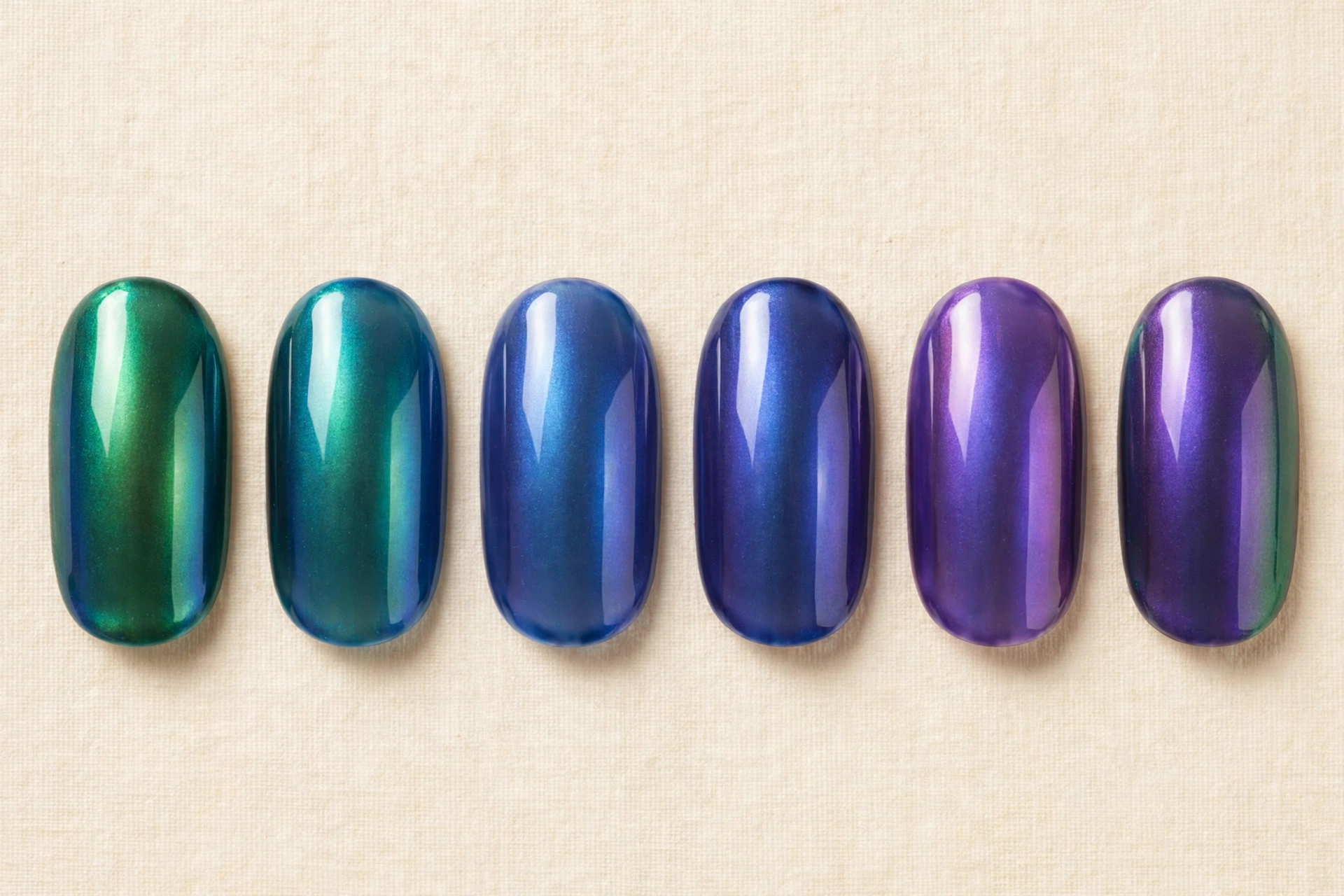
7. Icy Lavender Chrome — #C4B5F2
Icy Lavender Chrome is the lightest shade here: a frosted lavender with a chrome finish that flashes silver-white at the center of each nail and soft violet at the edges. It’s the closest thing in this palette to a pearl, with a cool undertone that stays neutral in any light. Fair skin tones get a delicate, icy look; on medium and deep skin tones, the silver flash stands out against the nail for a striking contrast. Compared with Violet Veil, it’s lighter, more reflective, and more forgiving — the kind of shade that looks good even on short nails. If you love the pearlescent glow of glazed donut nail colors, this is their aurora cousin: same shine, more dimension.
8. Deep Space Duochrome — #4A3F8C
Deep Space Duochrome goes dark: a midnight indigo base that shifts from sapphire to electric purple as it catches the light, finished like a polished stone. The dark base makes the shift the most dramatic in the palette — in dim light it reads almost black, then flashes color as you move. It flatters deep skin tones beautifully, where the dark base blends seamlessly and the purple shift glows, and medium skin tones get a bold, moody look. On fair skin it creates a striking contrast that reads edgy rather than elegant. Compared with Violet Veil, Deep Space Duochrome is its after-dark version — same family, far more intense. It’s also the longest-wearing look here, since regrowth and chips hide easily on dark finishes.
9. Rose Gold Flare — #E78FA0
Rose Gold Flare bridges the warm shifts with a pink-rose base that shifts toward coppery gold at the edges — the most classic of the aurora colors, and the easiest entry point for beginners. The finish is a soft chrome with a rosy undertone that flatters nearly every skin tone; on warm undertones the gold shift shines, and on cool undertones the pink stays rosy and sweet. Compared with Golden Hour, Rose Gold Flare is pinker and fresher, less sunset-bronze; compared with Magenta Mirage, it’s subtler and more everyday. It sits right in the middle of the warm aurora family, which makes it the safest first pick if you’re new to shifting finishes. It also doubles beautifully as a French-tip shade — aurora tips over a nude base are one of the prettiest ways to wear the trend.
10. Mint Aurora — #9FE8C9
Mint Aurora is the pastel of the palette: a cool mint base that shifts into pale aqua and then a whisper of violet at the very tips, finished with a glassy sheer chrome. It has a bright, fresh undertone that reads almost neon-adjacent in sunlight but stays soft indoors. Fair to medium skin tones wear it best, where the mint looks crisp and clean; on deep skin tones, it makes a stunning high-contrast statement, especially on almond or coffin shapes. Compared with Celestial Blue, Mint Aurora is lighter, greener, and more playful — where Celestial Blue is a clear sky, Mint Aurora is sea glass. It’s also the best shade here for spring and summer, when the icy coolness of winter auroras starts to feel too heavy.
11. Peacock Prism — #3E6FA0
Peacock Prism is the most complex shade in the chart: a deep teal-blue base with a multi-directional shift that flashes green, then violet, then a hint of magenta — three colors instead of two. The finish is a deep glass chrome, saturated and jewel-toned, with a cool undertone that stays sophisticated rather than costume-y. Medium and deep skin tones get the richest version, where the teal base looks like a peacock feather; on fair skin, the magenta edge keeps it from reading too blue. Compared with Northern Teal, Peacock Prism is deeper, darker, and more dramatic — Northern Teal is the daytime aurora, Peacock Prism is the midnight one. It’s also the most photogenic shade here for close-up nail shots, since the multi-shift gives every angle a different look.
12. Opalescent Mist — #DCD6EE
Opalescent Mist closes the palette with the sheerest shade: a translucent milky-lavender base with a faint rainbow shift that only appears at certain angles — more ghost of an aurora than a full one. The finish is a milky chrome, soft and diffused, with a cool-neutral undertone that works on every skin tone because it’s barely there. It flatters short nails and natural nail beds especially, where the sheerness keeps it elegant rather than flashy. Compared with Icy Lavender Chrome, Opalescent Mist is its shy sibling — same cool family, far less mirror, far more mist. It’s the perfect “my nails but better” aurora, and the best choice for anyone whose office, wedding, or interview calls for restraint.
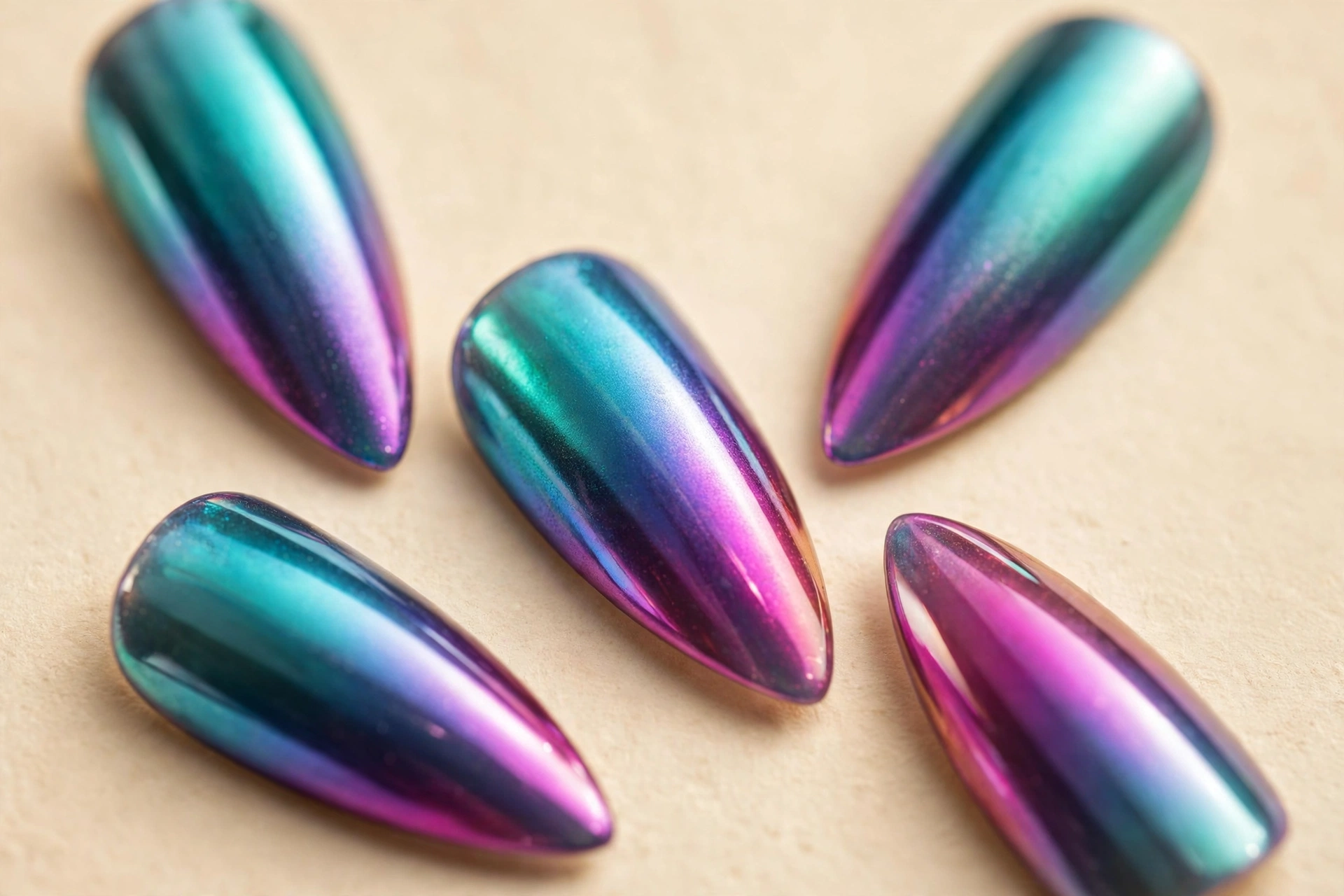
Aurora Chrome Powder vs. Aurora Polish: Which Gives the Real Shift?
If you’ve tried aurora nails and the shift felt underwhelming, the product type is usually the reason. Aurora chrome powders — the loose, fine-milled pigments you rub over a tacky or no-wipe gel top coat — give the strongest, most dramatic color flip, because the pigment particles align flat and catch light like a mirror. Aurora polishes (regular lacquer with duochrome shimmer) are easier to apply and remove, but the shift is softer and more glittery. For the deepest shades in this palette — Peacock Prism, Deep Space Duochrome, Magenta Mirage — powder is worth the extra step. For the sheers like Opalescent Mist and Icy Lavender Chrome, a good polish gets you 90% of the way there. Either way, a glossy gel top coat on top deepens the effect, since shine is what makes the shift visible.
How to Get the Aurora Effect With Chrome Powder
Start with your base color cured — black for maximum drama, or a mid-tone shade like the ones in galaxy nail colors if you want the shift to blend with the base. Apply a no-wipe gel top coat and cure it fully, then rub a small amount of aurora chrome powder over each nail with a sponge or silicone applicator using light, even pressure. Dust off the excess with a soft brush, then seal with another layer of no-wipe top coat and cure again — this sealing step is non-negotiable, since unsealed chrome powder chips within a day. The powder shifts most over curved nail tips, so almond and oval shapes show off the effect better than square. One jar of powder typically lasts dozens of manicures, making it the most economical way to wear the trend long-term.
Styling Tips: Wearing Aurora Nails Without Looking Overdone
- Match the shift to your jewelry. Cool auroras (Northern Teal, Violet Veil, Celestial Blue) pair with silver; warm ones (Magenta Mirage, Golden Hour, Rose Gold Flare) pair with gold.
- Keep one hand cohesive. Wearing three different shifts across five fingers looks busy; pick one shift direction per hand for a polished look.
- Try aurora tips. A nude or milky base with just the tips in an aurora shade (try Rose Gold Flare or Mint Aurora) gives you the trend in a wearable French-style format.
- Coordinate with your outfit’s metal. A silver-clutch evening look pairs with Deep Space Duochrome; a gold-accent outfit calls for Golden Hour.
- Short nails can do aurora too. The sheer shades — Opalescent Mist, Icy Lavender Chrome — look especially refined on short, rounded nails.
Best Occasions for Aurora Nails
Aurora nails shine brightest at evening events, where artificial lighting makes the shift dramatic — dinner parties, concerts, holiday gatherings, and nights out are their natural habitat. The bolder shades (Magenta Mirage, Peacock Prism, Deep Space Duochrome) also work beautifully for festival season and vacation photos, where the color shift reads as intentional glamour. For weddings and professional settings, stick to the sheers: Opalescent Mist and Icy Lavender Chrome read as polished rather than flashy in daylight. And if you’re choosing between an evening-ready chrome and a classic party shade, the pink chrome nail finishes in our other chart overlap nicely with the warmer auroras for festive occasions.
Finish and Longevity: How Long Do Aurora Nails Last?
Gel-based aurora manicures (polish or powder sealed under gel top coat) typically last two to three weeks with normal wear, the same as any gel manicure — the chrome effect doesn’t fade, though the shine can dull slightly if the top coat wears. Regular-lacquer aurora polishes behave like any lacquer: three to five days before tip wear shows, and the duochrome shimmer stays intact until the polish chips. To protect the finish, wear gloves for dishes and cleaning, reapply a clear top coat every three to four days, and avoid using your nails as tools — chrome finishes show scratches more than cremes do. Removal for powder-based auroras follows normal gel removal (soak-off), which is gentler on the nail than scraping. One caveat: very dark aurora shades like Deep Space Duochrome can stain the nail slightly on removal, so a good base coat matters underneath.
Polish and Gel Picks
For the look in this chart, look for a teal-to-violet duochrome gel polish as your Northern Teal base — it’s the shade you’ll reach for most. A loose aurora chrome powder in a blue-violet shift is the most versatile buy, since it works over any base color and delivers the strongest color flip of anything here. For the warm side, a magenta-to-gold duochrome polish covers Magenta Mirage, while a honeyed copper chrome powder handles Golden Hour and Rose Gold Flare. If you prefer regular lacquer, look for a sheer iridescent topper — a translucent polish with fine duochrome shimmer — which you can layer over any creme to fake the aurora effect in one step. For the darks, an indigo-to-purple magnetic-free duochrome gel gives you Deep Space Duochrome and Peacock Prism without any powder mess. And for the sheers, a milky lavender chrome gel polish or an opal-effect sheer topper finishes Opalescent Mist and Icy Lavender Chrome. Finally, a no-wipe gel top coat is essential if you’re using powders — it’s what locks the chrome down for a two-week wear.
These are curated inspiration palettes for planning your manicure, not an official shade line from any nail brand — use the names and hex codes as a guide when shopping for similar aurora and duochrome finishes.
Aurora Nails FAQ
What are aurora nails?
Aurora nails are a nail trend inspired by the northern lights, using iridescent duochrome or chrome finishes that shift between two or more colors as light moves across the nail — think teal shifting to violet, or magenta melting into gold. The effect comes from fine light-reflecting pigments in polish or loose chrome powder, usually applied over gel and sealed with a glossy top coat.
Which aurora nails shade is best for beginners?
Rose Gold Flare and Icy Lavender Chrome are the safest starting points. Rose Gold Flare’s pink-to-gold shift is flattering on nearly every skin tone and reads polished rather than dramatic, while Icy Lavender Chrome’s pale chrome finish is forgiving on short nails and easy to wear daily. If you want the full dramatic shift, start with a teal-to-violet duochrome polish like Northern Teal over a dark base.
Do aurora nails work on short nails?
Yes — the sheerer aurora shades like Opalescent Mist and Icy Lavender Chrome look especially refined on short, rounded nails, where the subtle shift reads as elegant shine. Bolder dark shifts like Deep Space Duochrome can also work on short nails, since the dark base makes the color flip the star of the show rather than nail length. Longer almond shapes show off multi-color shifts like Peacock Prism best, but length is a preference, not a requirement.
How do aurora nails differ from chrome nails?
Chrome nails are typically a single mirror-like metallic color, while aurora nails use duochrome or multichrome pigments that shift between two or more colors depending on the viewing angle. A chrome nail looks the same color from every angle; an aurora nail can look teal from one side and violet from another. If you like the shine of classic chrome but want more dimension, our white chrome nail chart covers the softer, single-tone side of the trend.