
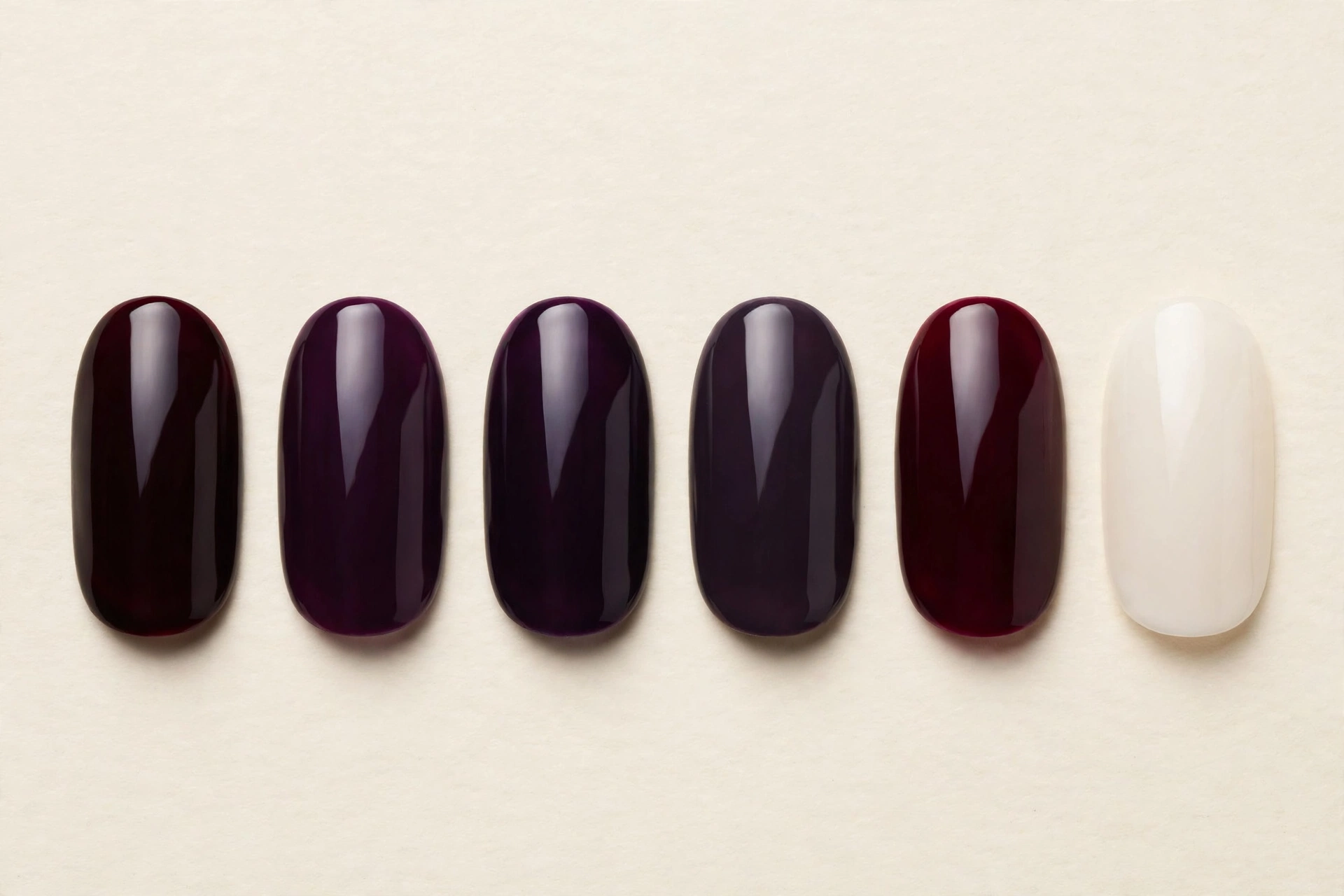
Winter lace nails are what happens when a dark winter manicure grows up a little. Instead of a flat block of dark polish, you get depth: a deep plum or wine base, softened by a cream lace detail that keeps the whole look romantic rather than severe. It is a combination that suits the season perfectly, because winter clothes already lean dark and textured, and a lace accent echoes knitwear, velvet, and evening fabrics without needing any complicated nail art. This palette brings together six shades built around that idea — five deep romance bases and one cream lace shade to tie them together — so you can wear a single dark shade on its own, add one lace accent nail, or build a full tonal set across the week.
How to use this palette
- Choose one dark base for the whole manicure, then paint one or two accent nails in the cream lace shade. A single lace accent on each ring finger is the easiest version of this look and the hardest to get wrong.
- Keep the lace detail small. A thin lace strip along the tip, a half-moon at the base, or one delicate lace panel on an accent nail reads as elegant; covering every nail in lace pattern quickly turns busy.
- Match the base to the occasion first, then decide on the lace. The darkest shades suit evening and formal settings, while the slightly lighter wine and plum tones work better for everyday winter wear.
- Shape matters with dark polish. Short almond, squoval, or neatly rounded nails keep dark romance shades looking polished, while very long points can push the same colours into dramatic territory.
- Always use a base coat under the dark shades. Deep plum, berry, and wine pigments stain bare nails more readily than light shades, and a base coat makes removal far simpler.
- Finish with a glossy top coat over both the dark base and the cream lace accent. Gloss unifies the two finishes, protects the lace detail, and stops the cream shade from looking chalky next to a shiny dark base.
The 6 winter lace nails shades
1. Midnight Veil — #231826
Midnight Veil is the darkest shade in this palette, a near-black plum with a cool undertone that only shows its purple character in good light. In a dim room it reads as a polished dark neutral, which makes it one of the most versatile evening shades you can own, and in daylight the plum comes forward just enough to keep it from looking like plain black polish. Its finish is a high-gloss creme, so it stays sleek rather than flat, and that shine is what stops such a dark shade from feeling heavy on the nail. On fair skin, Midnight Veil gives a striking, evening-ready contrast that makes hands look deliberately styled even with no nail art at all, while on medium skin it sits richly and evenly, and on deep skin it reads as a deep, glossy extension of the skin’s own richness. This is the shade to reach for for winter weddings, formal dinners, and nights out when you want your nails to look expensive without competing with your outfit. It also makes a superb base for lace: a cream lace tip or a thin lace panel stands out beautifully against it, because the contrast is strong but the colours still belong to the same romantic family. Apply it in two thin coats rather than one thick coat, since very dark shades show streaks and uneven edges more easily, and seal the free edge with top coat to slow tip wear. If dark polish usually feels too severe for you, pairing Midnight Veil with a single cream lace accent is the gentlest way to wear it, because the lace softens the whole manicure at a glance.
2. Heirloom Plum — #4B2334
Heirloom Plum is the heart of this palette: a deep, muted plum with a warm undertone and a soft creme finish that feels like something passed down rather than bought on impulse. It is dark enough for winter, but it never disappears into black, so the plum stays visible indoors, in photographs, and under the low light of restaurants and winter evenings. That visibility matters, because it is what separates a considered dark manicure from one that simply looks black in every photo. On warm and neutral skin tones, the warm undertone harmonises beautifully, giving a rich, even result with no ashy cast, while on cool skin it still reads as a true plum rather than drifting into brown. On deep skin tones it looks especially luxurious, sitting like a dark berry stain rather than a coat sitting on top of the nail. Heirloom Plum is the workhorse of the set: polished enough for the office, romantic enough for a dinner date, and dark enough to hide minor chips between manicures. It pairs naturally with gold jewellery, a camel coat, cream knitwear, and a berry lip, and it takes a lace accent gracefully, whether that means a cream lace French tip or a single lace-detailed ring finger. Two coats give full, even coverage, and because the finish is a classic creme, it grows out gracefully and touches up easily. If you only buy one shade from this palette, make it this one, and keep the cream lace shade beside it for the days you want something a little more special.
3. Blackberry Lace — #3A1E2B
Blackberry Lace is a dark berry shade with a blue-purple undertone, the colour of blackberries at their ripest, and it is the shade in this palette that photographs most dramatically. Its undertone leans cool, which keeps it looking like a berry rather than a brown or a red, and its glossy creme finish gives it a wet, lacquered shine that suits winter evenings particularly well. On fair skin, Blackberry Lace creates a bold contrast that draws the eye to the hands, so keep the shape neat and the cuticles tidy, because a shade this dark shows every rough edge. On medium skin it looks deep and jewel-like, and on deep skin it glows, with the cool undertone preventing it from looking muddy or flat. This is a wonderful choice for parties, holiday gatherings, and any occasion where you want colour that still reads as a colour after dark. It also works brilliantly as the base for lace detailing: the cool berry base makes cream lace look crisp and intentional, almost like embroidery on dark fabric, which is exactly the effect this palette is named for. Try it with a lace accent on the ring fingers and plain Blackberry Lace everywhere else, and the set will look designed rather than decorated. Because berry shades can stain, a good base coat is not optional here, and a top-coat refresh every two or three days will keep the gloss alive for a full week. Readers who love this end of the colour family may also enjoy the deep plum shades in our deep plum post, which explore the same mulled-wine territory in more depth.
4. Wine-Stained Lace — #5C1A2E
Wine-Stained Lace is the warmest dark shade in the set, a deep wine red with a plum depth that keeps it firmly in winter territory rather than drifting into bright cherry. Its undertone is warm and red-leaning, which makes it one of the most flattering shades in the palette for warm and medium skin tones, where it harmonises with the skin instead of fighting it. On cool skin it still works, because the plum depth cools the red just enough to stop it clashing, and on deep skin it looks rich and celebratory, like a glass of red wine held up to the light. The finish is a glossy creme with a very fine depth that only shows in direct light, so the nails look dimensional without any glitter or shimmer. This is the shade to choose when the occasion calls for romance rather than drama: date nights, anniversary dinners, winter weddings, and festive evenings where you want to look warm rather than severe. It is also the most forgiving dark shade for shorter nails, because its warmth draws the eye to the colour rather than the length, and it pairs beautifully with a cream lace accent, which lightens the overall effect without changing the mood. Wear it with a berry or plum lip rather than a true red, since a bright red lip next to a wine-red nail can clash, and let gold or rose-gold jewellery warm the whole look. Two thin coats give the truest colour, and a glossy top coat deepens the wine tone further, so skip matte finishes here unless you deliberately want a softer, more muted version of the shade.
5. Smoked Rosewood — #5E2B33
Smoked Rosewood sits between plum and brown, a deep rose-brown with a muted, smoky quality that makes it the quietest shade in this palette, and often the most wearable. It is the shade to reach for when the darker berries feel too dramatic for the day ahead but plain brown feels too plain: it has the depth of a dark shade and the softness of a rose, which means it works in offices, at family gatherings, and on ordinary winter days when you still want to look polished. Its undertone is balanced, leaning neither strongly warm nor cool, which is why it suits such a wide range of skin tones. On fair skin it looks like a deep, muted rose that adds warmth without shouting, on medium skin it looks rich and even, and on deep skin it reads as a soft, smoky neutral with just enough colour to notice. The finish is a satin-leaning creme, glossier than matte but softer than a high-shine lacquer, and that restrained finish is part of its charm. Smoked Rosewood takes lace detailing in a subtler way than the darker shades: instead of a high-contrast cream panel, try a tone-on-tone lace effect, or a single cream lace tip, so the accent whispers rather than shouts. It pairs with almost everything in a winter wardrobe — grey tailoring, black coats, cream scarves, brown boots — and it is an excellent choice for a manicure you plan to wear for a full week, since its muted tone hides regrowth and small chips better than brighter shades. If you are new to dark nails, start here, and add the lace accent only when you feel like it.
6. Ivory Lace — #F3EAD8
Ivory Lace is the shade that makes this palette a lace palette rather than simply a dark palette: a soft, warm cream with a milky, opaque finish that reads as fabric rather than as white polish. Pure white can look stark next to dark plum and wine, but Ivory Lace has just enough warmth to sit comfortably against every dark base in this set, like cream lace laid over dark velvet. Its undertone is warm and neutral, which means it flatters all skin tones as an accent, though it is best used on one or two nails rather than all ten, since a full cream manicure is a different look entirely. On fair skin it gives a soft, bridal contrast, on medium skin it looks clean and deliberate, and on deep skin it pops beautifully as an accent against a dark base. The finish is a smooth creme, opaque in two coats, and it is the shade you will use for every lace effect in this post: French-style lace tips, thin lace strips, half-moons, and full lace panels on accent nails. Because light shades show streaks and unevenness more readily than dark ones, apply Ivory Lace in two thin coats and let each coat dry fully before the next, and seal it with the same glossy top coat you use on the dark base so the two finishes match. Keep the bottle for touch-ups, since cream accents show chips sooner than dark bases, and a quick top-coat refresh mid-week will keep the lace detail looking fresh. Used sparingly, Ivory Lace is what turns five dark polishes into a complete winter lace manicure.
How to wear winter lace nails
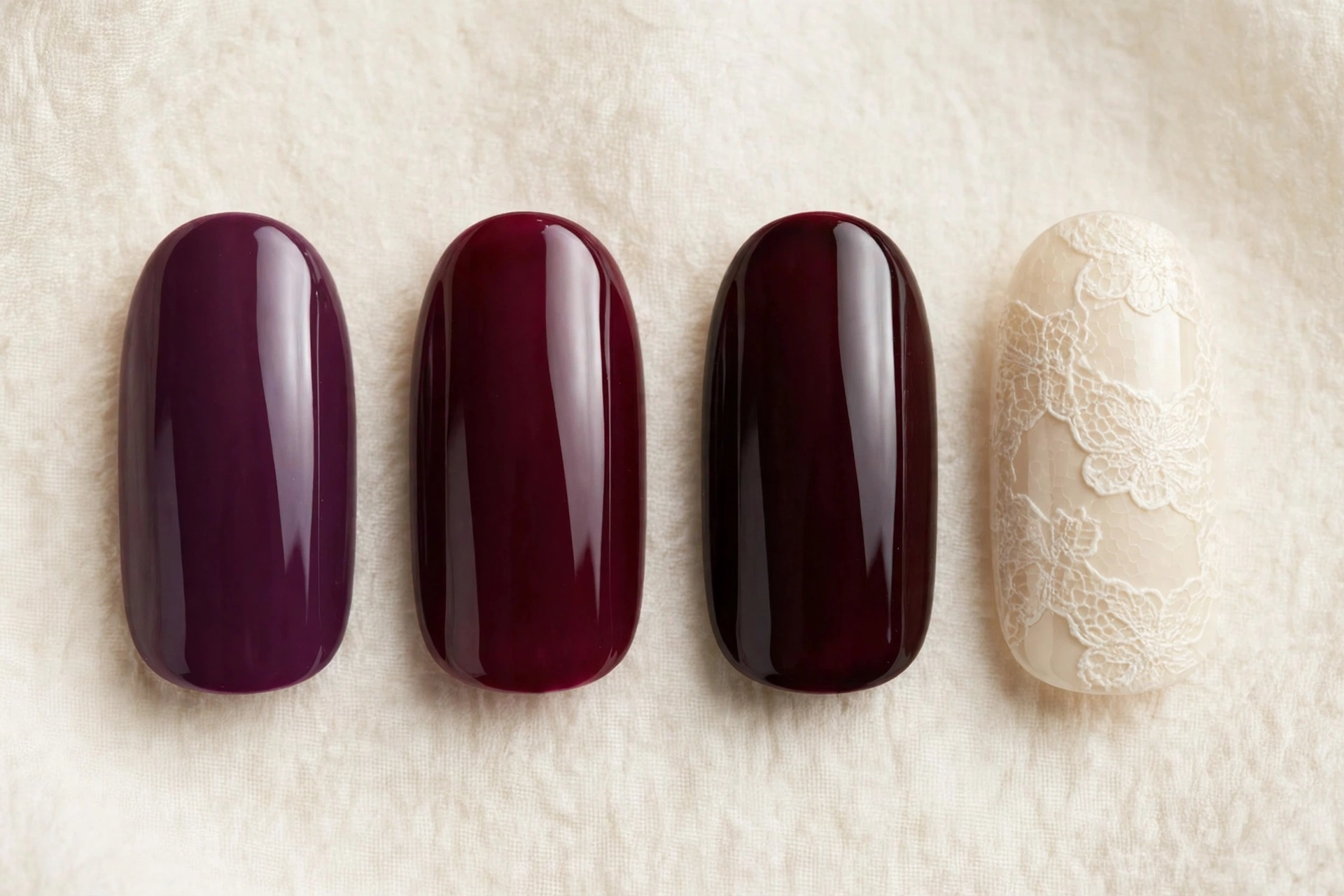
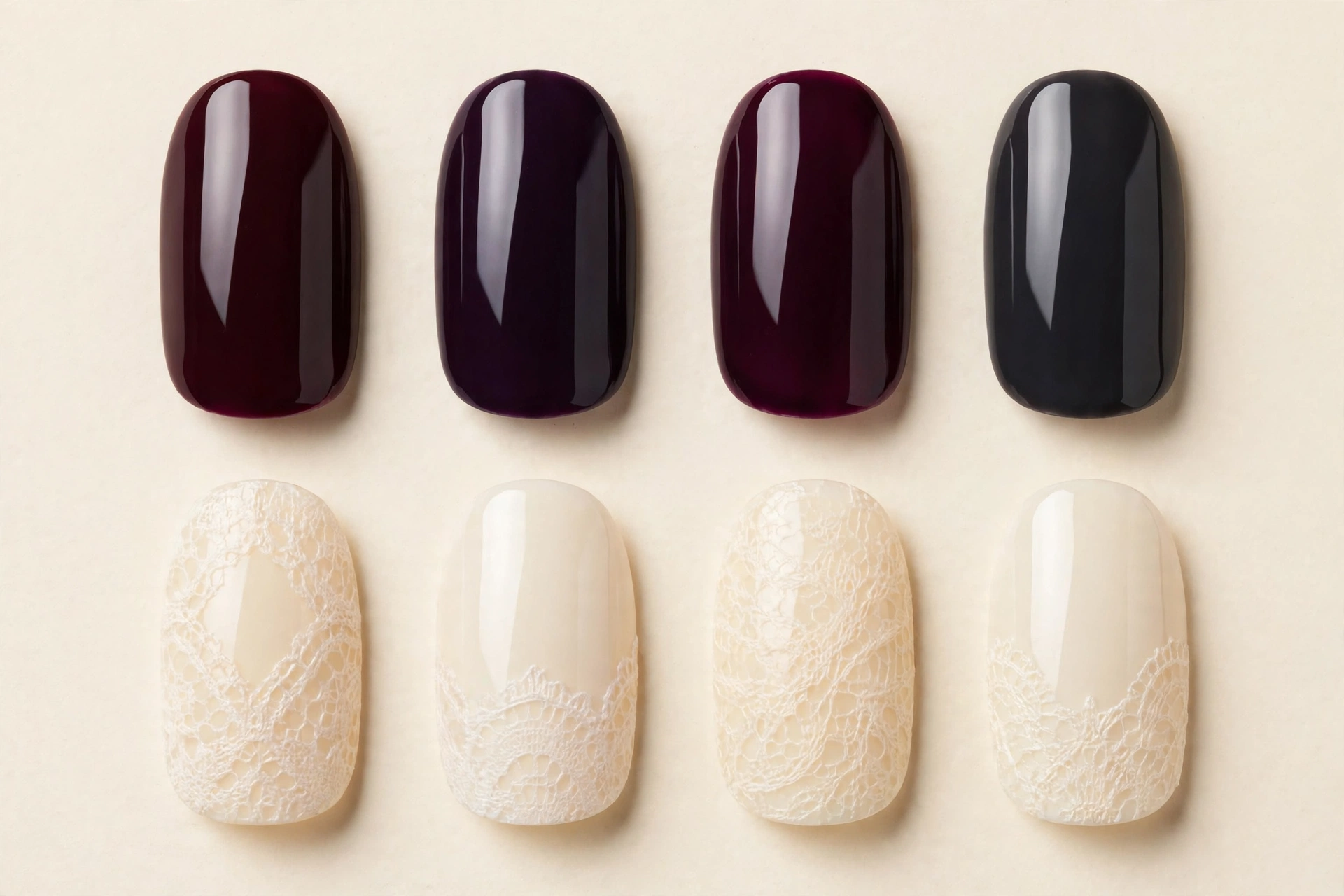
The lace in winter lace nails is an accent, not a full pattern, and that restraint is what keeps the look elegant. The simplest version is a cream lace French tip: paint the nail in a dark base, let it dry fully, then add a thin cream tip, either as a clean line or with a delicate scalloped edge that suggests lace without needing a stamp or sticker. A second easy version is the lace panel: one accent nail, usually the ring finger, painted in Ivory Lace with a thin dark stripe or a small dark dot pattern over it, reversing the usual dark-base-cream-lace arrangement. A third version needs no tools at all: paint four nails dark and one nail cream, and let the single cream nail act as the lace note in the set, especially when the rest of the manicure is glossy and neat.
If you do own lace nail stickers or a stamping plate, this palette is the ideal place to use them, because the dark-to-cream contrast does most of the work. Apply the lace design over a fully dry dark base, press it gently, and seal it with top coat, taking care not to drag the brush, which can smudge fine lace lines. If you are painting lace freehand, keep the design to one motif per nail — a single flower, a small scallop, a thin border — and repeat that motif rather than inventing a new one on each nail. Consistency is what makes hand-painted lace look professional. And if the lace goes wrong, there is no need to start over: wipe the accent nail, repaint it in the dark base, and try a simpler version, such as a cream tip, which is far more forgiving than a full lace panel.
How to style winter lace nails
Dark romance shades are strong colours, so the rest of your styling works best when it supports rather than competes with them. Gold jewellery is the classic pairing: a thin gold ring or bracelet warms up the cool plum and berry tones and gives the whole look a jewellery-box feel, which is exactly why dark shades photograph so well in winter light. Rose gold suits the warmer shades, Wine-Stained Lace and Smoked Rosewood, particularly well, while silver suits the cooler shades, Midnight Veil and Blackberry Lace, and gives a more modern, minimal finish. When it comes to clothing, this palette sits happily next to black, charcoal, cream, navy, camel, and grey, and it can hold its own against velvet, wool, and knitwear, which echo the lace and texture of the manicure itself.
Avoid pairing dark lace nails with too many other bold patterns at once. A lace dress plus lace nails plus a patterned scarf can tip the whole outfit into costume, so choose one lace note — the nails or the clothing — and keep the rest simple. The same restraint applies to nail length and extra decoration: a neat almond or squoval shape with one lace accent looks more expensive than very long nails covered in lace, glitter, and gems. For a softer, romantic take on the same idea, the soft romantic shades in our coquette post offer pinker, lighter versions of this mood, while this palette stays firmly in dark winter territory. If you want to extend the palette beyond a single manicure, think in tones rather than exact matches: a plum lipstick, a wine-coloured bag, or a cream scarf can echo the nails without matching them shade for shade, and that near-match looks far more intentional than a perfect match.
Shade-to-shade comparisons
Choosing between five dark shades can feel harder than choosing between light and dark, so it helps to compare them directly. Midnight Veil is the darkest and coolest, the closest to black, and the best choice when you want a dark neutral that only reveals its plum character up close. Blackberry Lace is the next darkest, but it is more obviously purple and more obviously a colour, so choose it when you want the manicure to read as berry rather than as black. Heirloom Plum sits in the middle of the dark range, warmer and more muted than Blackberry Lace, and it is the safest all-rounder in the set. Wine-Stained Lace is the warmest and reddest, the most romantic, and the best choice for date nights and celebrations. Smoked Rosewood is the lightest and softest, the most muted, and the best choice for work and everyday wear.
Finish matters as much as colour here. The high-gloss cremes — Midnight Veil, Blackberry Lace, and Wine-Stained Lace — look their best in evening light and at events, because gloss deepens dark colour and catches the light. The softer finishes — Heirloom Plum and Smoked Rosewood — look their best in daylight and at work, because they read as polished rather than dramatic. Ivory Lace changes every comparison it touches: against Midnight Veil it looks crisp and high-contrast, against Smoked Rosewood it looks soft and tonal, and against Wine-Stained Lace it looks warm and bridal. If you are buying only two bottles, buy Heirloom Plum and Ivory Lace, since that pair covers everyday wear and the full lace effect on its own. If you are buying three, add Midnight Veil for evenings, or Wine-Stained Lace for romance, depending on which kind of occasion fills your calendar.
Best occasions for winter lace nails
Few winter manicures cover as many occasions as this palette, because the lace accent lets you tune the same dark base up or down. For everyday wear, Smoked Rosewood and Heirloom Plum are the safest choices: they are polished enough for work, interesting enough for weekends, and dark enough to hide minor chips between manicures. For formal events, Midnight Veil and Blackberry Lace come into their own, because their depth reads as evening colour without needing any embellishment beyond a single lace accent. For romantic occasions, Wine-Stained Lace with a cream lace tip is the obvious pick, since the wine and cream combination reads as deliberate and celebratory without any glitter or gems.
Winter weddings deserve a special mention, because this palette solves a common wedding-guest problem: how to look festive without wearing bright colour. A guest in a dark dress can wear Heirloom Plum with a lace accent and look entirely appropriate, while a bridesmaid party can each wear a different dark shade from the same family for a tonal effect, with matching cream lace tips to tie the set together. Our elegant winter wedding guest shades roundup offers more options in the same spirit if you are choosing for a whole party. Seasonal occasions suit winter lace nails particularly well: holiday parties, New Year gatherings, winter birthdays, and anniversary dinners all give the lace detail a reason to exist, and the dark bases pair with festive metallics without looking like a Christmas-only manicure. The palette also works for occasions that have nothing to do with the calendar: a job interview where you want to look polished but not plain, a dinner where you want one confident detail, or a weekend away where you only pack two bottles.
Application and longevity tips
Dark polish rewards a little patience, and the difference between a good and a great dark manicure usually comes down to preparation. Start with clean, dry nails, push back the cuticles gently, and file in one direction to avoid splitting. A ridge-filling base coat is worth using under these shades, because it smooths the nail surface, stops the colour from settling into ridges, and protects against staining. Apply the first coat thinly, leaving a tiny gap at the cuticle, and let it dry for at least two minutes before the second coat. Two thin coats will always look smoother than one thick coat, and they dry faster and chip less, which matters more with dark shades, since chips show more clearly against the nail.
Top coat is not optional with winter lace nails. A good glossy top coat deepens the dark colour, protects the lace detail from scratches, and makes the manicure look freshly done for longer. Reapply a thin layer every two to three days, wrapping it over the free edge, and you can easily stretch a dark manicure to a full week. For the cream lace accent, the same top coat keeps the cream from looking chalky and stops fine lace lines from lifting at the edges. When it is time to remove dark polish, soak a cotton pad in remover, press it onto the nail for thirty seconds before wiping, and wipe towards the tip rather than scrubbing side to side, which spreads pigment onto the skin. A little cuticle oil after removal restores moisture, and waiting a day before your next dark shade gives nails a brief rest. If you love dark plum but want a softer finish on some days, the velvet plum finish in our velvet plum post gives the same colour family with a muted, velvety texture instead of high gloss.
Polish and gel picks
For a classic at-home manicure, look for a near-black plum creme polish for the darkest option, a deep muted plum polish for everyday wear, a dark berry polish with a cool undertone for parties, a deep wine polish for romantic occasions, and a muted rose-brown polish for work. Add a warm cream polish with an opaque finish for the lace accents, and keep a thin nail art brush beside it if you plan to paint lace tips freehand. A ridge-filling base coat will improve every shade in this palette, and a glossy top coat is essential for unifying the dark and cream finishes. For gel, choose a deep plum gel polish for long wear, a dark berry gel shade for evenings, a wine gel shade for special occasions, and a cream gel polish for lace details, and cure each layer fully according to your lamp’s instructions. A peel-off base coat is a practical extra if you change shades often, since dark plum and berry can stain bare nails. Keep a bottle of cuticle oil beside your polish collection, because well-moisturised cuticles make dark colours look far more polished. No single brand owns this colour family, so pick formulas you already trust for coverage and wear, and test one dark shade before buying the whole range.
Please note that these are inspiration palettes: the shades above are suggestions to guide your choice, not exact matches to any one polish, so check the polish shade in store or on a swatch before buying.
Frequently asked questions
What are winter lace nails?
Winter lace nails are a dark winter manicure softened with a cream lace detail. The usual version is a deep plum, berry, or wine base with one or two accent nails carrying a cream lace tip, panel, or strip, so the overall effect is romantic and textured rather than simply dark. You can achieve the look with lace stickers, a stamping plate, a thin brush for freehand lace, or simply a single cream accent nail next to dark nails. The key is restraint: one or two lace accents per hand keep the manicure elegant, while lace on every nail tends to look busy.
Which skin tones suit dark romance nail shades?
Dark romance shades suit all skin tones, but the most flattering shade depends on your undertone. Cool, blue-leaning shades like Midnight Veil and Blackberry Lace look striking on cool and fair skin, while warmer shades like Wine-Stained Lace and Heirloom Plum harmonise beautifully with warm and medium skin. Deep skin tones can wear the whole palette, with the darkest plums looking especially rich and the wine shades looking especially celebratory. If you are unsure, start with a balanced shade like Smoked Rosewood, which sits in the middle and suits almost everyone, and add the cream lace accent to lighten the overall effect.
How do I add a lace accent without nail art tools?
The easiest no-tool lace effect is a cream French tip over a dark base: paint the nail dark, let it dry fully, then paint a thin cream line across the tip, either straight or with a gentle scalloped edge. A second easy option is the single cream accent nail, which reads as a lace note without any pattern work at all. A third option is a cream half-moon at the base of one nail, painted with the brush from the cream polish bottle and tidied with a cotton bud dipped in remover. All three versions need only the two polishes and a steady hand, and all three look intentional when the dark base is glossy and the shape is neat.
How do I stop dark plum and wine polish from staining my nails?
Always wear a base coat, and make it a good one. A ridge-filling or stain-blocking base coat creates a barrier between the pigment and the nail plate, which is the single most effective step against staining. Two thin coats of colour, rather than one thick coat, also reduce staining, because less pigment sits on the nail for longer. When removing the polish, soak rather than scrub, and follow up with cuticle oil to restore moisture. If staining has already happened, a gentle buff and a few days without dark polish will usually fade it, and wearing the cream lace shade on its own for one manicure gives nails a visible break from dark pigment.