
A winter wedding asks for a different kind of manicure than a summer one. The light is lower, the fabrics are heavier, and the photographs tend to be warmer and more formal, so a bright, sheer summer shade can look washed out next to velvet, satin, and wool. The best winter wedding guest nails solve that problem quietly: they are deep enough to hold their own in a photograph, polished enough for a formal room, and restrained enough that they never compete with the couple or with your outfit. This palette keeps to six shades for exactly that reason. Each one works on its own, each one pairs well with the rest of the palette, and none of them needs nail art, glitter overload, or a complicated design to look finished. Whether you are heading to a church ceremony, a hotel ballroom, or a small winter registry dinner, you can pick one shade from this list, wear it with confidence, and forget about your nails for the rest of the evening.
How to use this palette
- Start with the dress, not the polish. A deep shade works best with a lighter dress, while a soft neutral like champagne or dusty rose balances a dark velvet or heavily embellished gown.
- Pick one shade for all ten nails if the wedding is formal. A single, well-applied colour always reads more elegant in photographs than a different shade on every nail.
- If you want a little contrast, use your main shade on eight nails and a second shade from this palette as an accent on your ring fingers. Champagne over burgundy, or frosted silver over emerald, gives interest without looking busy.
- Match your finish to the setting. Cream and satin finishes suit daytime ceremonies and religious venues, while shimmer and metallic finishes come into their own under evening reception lighting.
- Do your manicure the day before the wedding, not the morning of it. Polish needs time to harden fully, and a day-old manicure is far less likely to dent while you are getting dressed, fastening jewellery, or handling a clutch.
- Carry the polish with you, or at least a matching top coat. A single chip is easy to fix in a bathroom in two minutes, but only if you have the bottle to hand.
The 6 winter wedding guest nails shades
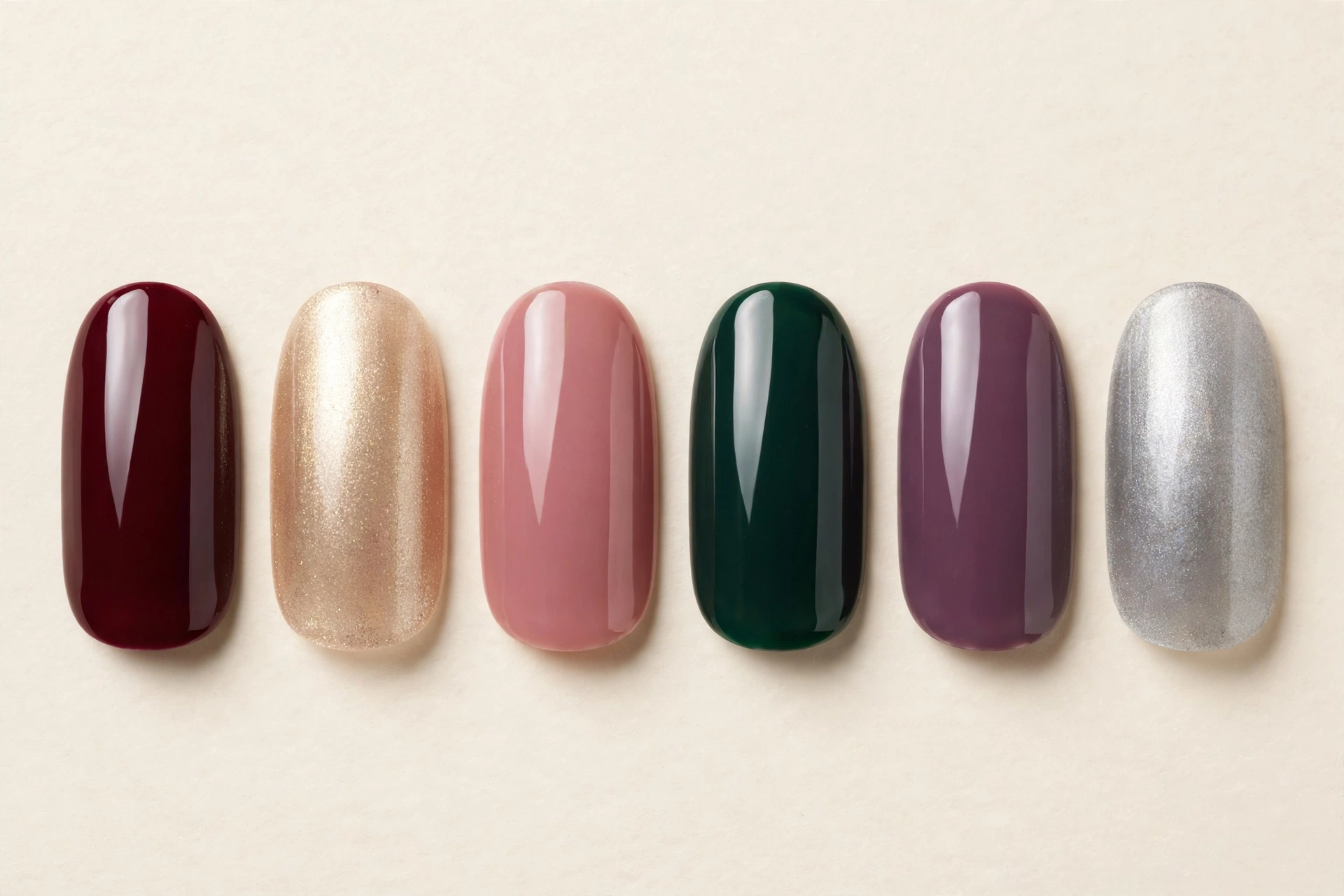
1. Black Cherry Burgundy — #5C1A24
Black cherry burgundy is the shade to reach for when you want your nails to look expensive without saying very much at all. It is a deep, blue-red wine with a dark, almost blackened base, which is what keeps it from reading as a straightforward bright red. In daylight it looks like a rich burgundy; under warm reception lighting it deepens further, and that shift is part of its appeal at a winter wedding, where the light changes from afternoon ceremony to evening dancing. The finish here is a high-gloss cream, with no shimmer, so the colour itself does all the work and the surface stays smooth and reflective in photographs.
This shade flatters almost every skin tone, which is one reason it appears on so many winter guest lists. On fair skin it provides a clear, elegant contrast without overwhelming the hand, while on medium and deep skin tones it reads as a deep, jewel-toned wine that looks intentional rather than stark. It is particularly good with gold jewellery, dark green or navy dresses, and black-tie dress codes, and it holds up well over a long day because small chips are far less visible in a dark shade than in a pale one. Wear it to evening ceremonies, winter ballroom receptions, and any wedding where the dress code leans formal. If your dress is already heavily patterned or embellished, this is the shade that will ground the whole outfit.
2. Champagne Gold Shimmer — #C9A86A
Champagne gold shimmer is the quiet answer to the question of how to wear metallic nails to a wedding without looking like you are heading to a party. The base is a soft, warm champagne, and the shimmer is fine rather than chunky, so it catches candlelight and camera flash in a gentle, diffused way instead of throwing back hard sparkle. Applied in two thin coats, it looks like polished metal from a distance and like a refined, luminous neutral up close. It is the most forgiving shade in this palette for anyone who is not confident with dark polish, because uneven edges and tiny imperfections are much harder to spot in a light shimmer.
On fair skin, champagne gold adds warmth without looking yellow, especially when the undertone of the polish leans warm rather than cool silver. On medium skin it reads as a true gold-neutral, and on deep skin tones it becomes a soft, glowing metallic that pairs beautifully with both gold and rose-gold jewellery. It suits blush, cream, champagne, and soft grey dresses particularly well, and it is an excellent choice for daytime winter weddings, where a dark shade might feel too heavy. If you love the look of champagne shades but want something specifically suited to a guest outfit rather than a party look, this restrained version is the one to try. Wear it to afternoon ceremonies, winter garden weddings held indoors, and receptions where you want your nails to look polished rather than dramatic.
3. Dusty Rose — #A96A73
Dusty rose sits exactly between pink and mauve, muted by a grey-brown undertone that stops it from reading as bubblegum or as overly sweet. That muting is what makes it a winter shade rather than a spring one: it has the softness of a pink, but the depth to stand next to wool, velvet, and heavier winter fabrics. The finish is a satin cream, not fully matte and not high gloss, which gives it a soft, almost powdery look in photographs while still reflecting enough light to look freshly done. It is the shade in this palette most likely to suit someone who rarely wears colour on their nails but wants to look deliberately put together for a wedding.
Dusty rose is genuinely versatile across skin tones, though the reason changes with each one. On fair skin it adds a gentle flush of colour that does not wash the hand out, which paler pinks sometimes do. On medium skin it reads as a true muted rose, and on deep skin tones it becomes a soft, dusky mauve-pink that looks refined rather than pale. It pairs well with grey, navy, burgundy, and soft green dresses, and it works with both silver and gold jewellery, which makes it a safe choice when you have not yet decided on accessories. The wider family of dusty rose shades is worth exploring if this one feels right but you want a slightly deeper or lighter version. Wear dusty rose to daytime ceremonies, semi-formal winter weddings, and any occasion where you want to look elegant without drawing attention to your hands.
4. Deep Emerald — #0F4D3A
Deep emerald is the boldest shade in this palette, and it earns its place because winter is the one season when a dark green feels completely natural rather than decorative. This is a true forest emerald with a cool, blue-green base, dark enough to read as almost black in low light and unmistakably green when the light catches it. The finish is a high-gloss cream, which matters here: a matte emerald can look flat in photographs, while a glossy one keeps the depth of the colour visible and gives the nail a smooth, lacquered surface. It is a shade that photographs exceptionally well against both dark and light dresses, because the green provides a clear point of contrast without clashing.
Emerald flatters medium and deep skin tones especially well, where the contrast between the dark green and the skin brings out the richness of the colour. On fair skin it is a striking choice that works best when the rest of the outfit is kept simple, so the nails become a deliberate accent rather than one more competing element. It pairs naturally with black, cream, gold, and burgundy, and it is a particularly good match for a dark green or black velvet dress, where the nails echo the fabric without matching it exactly. Wear deep emerald to evening winter weddings, New Year season celebrations, and formal receptions where a classic red or nude would feel too predictable. If you are wearing gold jewellery, this is the shade that will make it look its best.
5. Muted Plum — #5B3A4E
Muted plum is a purple that has been quietened down with grey and brown undertones until it reads as a sophisticated neutral rather than a fashion colour. It is darker than lavender and softer than a true aubergine, which puts it in a useful middle ground: it has the depth needed for a winter evening, but it does not dominate the hand the way a very dark purple can. The finish is a cream with a very slight satin sheen, so it looks soft rather than shiny, and that softness is what makes it work so well with winter fabrics like velvet, cashmere, and heavy satin. In photographs it reads as a deep, dusky purple-grey, which is flattering next to almost any dress colour.
This shade is particularly good on medium and deep skin tones, where its muted quality keeps it from looking harsh, and on fair skin it provides a clear, elegant contrast that is softer than black cherry but more interesting than a plain nude. It works with silver jewellery especially well, and it pairs with grey, navy, plum, and black dresses without ever clashing. Muted plum is also one of the easiest dark shades to wear to a wedding that spans both a religious ceremony and an evening reception, because it is formal enough for the first and rich enough for the second. Wear it to winter weddings with a smart or black-tie dress code, to evening ceremonies in colder months, and whenever you want a dark nail that is not red, black, or navy. If you are choosing between this and burgundy, pick plum when your dress has cool undertones and burgundy when it has warm ones.
6. Frosted Silver Grey — #B8BCC0
Frosted silver grey is the lightest shade in this palette, and it is included because not every winter wedding guest wants a dark nail. This is a cool, pale grey with a fine frosted shimmer running through it, like frost on a window rather than glitter on a card. The shimmer is subtle enough that the shade still reads as a grey from a normal distance, but up close it has a luminous, icy quality that suits winter perfectly. The finish is best described as a frosted metallic: smoother than a chunky glitter, more reflective than a plain cream, and very forgiving of small application mistakes because the shimmer disguises them.
On fair skin, frosted silver grey looks clean and modern, especially with silver jewellery and cool-toned dresses in grey, navy, or icy blue. On medium skin it provides a crisp, bright contrast, and on deep skin tones it becomes a striking, icy accent that stands out beautifully in photographs. It is the best choice in this palette for a winter wedding with a modern or minimalist dress code, for a daytime ceremony where a dark shade would feel too heavy, and for anyone wearing a silver or white-gold outfit. It also works well as an accent shade: a single frosted silver nail alongside a deep emerald or muted plum manicure gives a wintery, frosted effect without turning the whole manicure into nail art. Wear it on its own for a clean, polished look, or use it as the accent that lifts one of the darker shades in this palette.
How to style winter wedding guest nails with your outfit
Styling winter wedding guest nails is mostly a matter of letting one element lead and keeping the rest quiet. If your dress is the statement piece, with heavy embellishment, a bold print, or a strong colour, your nails should step back, and that is where dusty rose, champagne, or frosted silver grey do their best work. They finish the look without adding another visual idea. If your dress is simple, a dark shade like black cherry burgundy or deep emerald can become the accent, especially when it is echoed by a lip colour, a clutch, or a piece of jewellery in a similar tone. The mistake to avoid is matching everything exactly: nails, lips, shoes, and bag all in the same red can look costumey, while one repeated tone across two elements looks considered.
Jewellery is the easiest bridge between your nails and your outfit. Gold jewellery warms up burgundy, emerald, and champagne; silver jewellery cools down plum and frosted silver grey and sharpens dusty rose. If you wear both metals, champagne is the safest shade, because its warm-neutral base sits comfortably with either. Consider your coat as well, since a winter wedding guest spends a meaningful part of the day in outerwear. A dark manicure survives the transition from coat to dress without a visual jolt, while a very pale shade can look lost against a dark wool coat in arrival photographs. Finally, think about your hands in the photographs you will actually keep: holding a bouquet, a glass, or a partner’s hand. A shade with some depth photographs more reliably in those close, warm-lit shots than a very sheer or very pale one, which is why this palette leans deep even in its lighter shades.
For guests who are part of the wedding party rather than simply attending, the same shades work with a small adjustment in mind. Bridesmaids usually need to coordinate with each other and with the bride, so a single shared shade from this palette, rather than six different ones, is the safer route. The existing guide to winter bridesmaid shades covers that coordination question in more detail, including how to pick one shade that suits different skin tones within the same party. As a guest, you have more freedom, but the principle still helps: pick the shade that suits your own dress and skin tone, and let the rest of the palette be a source of ideas rather than a set of rules.
Best occasions for these shades
Not every shade in this palette suits every kind of winter wedding, and choosing by occasion is often more useful than choosing by favourite colour alone. For a formal evening wedding in a hotel or ballroom, black cherry burgundy, deep emerald, and muted plum are the strongest choices, because they hold their depth under artificial light and look intentional next to evening dress. For a daytime ceremony, especially one in a church or registry office, dusty rose, champagne gold shimmer, and frosted silver grey are better, since they read as polished without feeling heavy in natural light. For a wedding that runs from afternoon into evening, which most winter weddings do, any shade in this palette works, but the darker creams and the champagne shimmer transition most smoothly, because they do not change character dramatically as the light changes.
The venue matters too. A rustic winter wedding in a barn or a countryside house suits dusty rose and muted plum, which sit naturally with wood, candlelight, and softer styling. A city wedding with a modern venue suits frosted silver grey and deep emerald, which look sharp against clean lines and contemporary decor. A traditional, formal wedding suits black cherry burgundy above all, because it is the closest thing this palette has to a classic. If you are attending more than one winter wedding this season, consider rotating shades rather than repeating one: wear champagne to the daytime wedding, burgundy to the evening one, and emerald to the most formal one, and you will look deliberately different each time without buying a whole new wardrobe.
Application and longevity tips for a wedding day
A wedding day is long, and a manicure that looks perfect at the ceremony can look tired by the dancing if it was rushed. The single most useful habit is to apply thin coats. Two thin coats of colour, with a few minutes of drying time between them, will always outlast one thick coat, which stays soft underneath and dents easily. Start with a base coat, even if you normally skip it, because a base coat grips the colour, prevents dark shades like burgundy and plum from staining the nail, and gives the whole manicure a smoother surface to sit on. Finish with a top coat, and add a second layer of top coat to the tips of the nails, where chips start, by running the brush lightly across the free edge.
Preparation matters as much as the polish itself. Push cuticles back gently rather than cutting them, file nails to a single consistent shape before you start, and wipe each nail with a little polish remover or a nail cleanser just before the base coat, so no hand cream or oil interferes with adhesion. Shape is worth a moment of thought for a wedding: a rounded or soft squoval shape suits every shade in this palette and looks elegant in photographs, while a very sharp stiletto can make a dark shade look severe. If you are having your nails done professionally, book the appointment for the day before the wedding, and ask for a gel finish only if you are confident about removal afterwards; regular polish with a good top coat is easier to fix on the day if it chips. Finally, keep your hands moisturised but keep cream off the nail plate itself on the day you polish, and avoid very hot water for the first few hours after application, since heat softens fresh polish and invites dents.
Polish and gel picks
For this palette, look for a deep burgundy cream with a blue-red base rather than an orange-red one, since the cooler base is what keeps the shade elegant in winter light. A fine champagne gold shimmer, rather than a chunky gold glitter, will give the luminous effect described above without looking festive in the wrong way. For dusty rose, choose a muted rose with a grey undertone, and test it against your skin in natural light before committing, since dusty roses vary more between brands than most shades. A true deep emerald cream, a muted plum cream with grey undertones, and a frosted silver grey with fine shimmer complete the set. In gel, the same shade families apply, with the added benefit that gel will easily last through a full wedding weekend, including travel and dancing, though it needs proper removal afterwards rather than peeling. If you are buying just one shade for the season, make it the burgundy or the dusty rose, since those two cover the widest range of dresses and occasions in this palette.
These palettes are for inspiration, and the shades here are suggestions to take to the polish shelf rather than exact matches. Check the shade in store under natural light before you buy, since screen colours shift, and try one nail first if you are unsure how a dark or shimmer shade will look on you.
Frequently asked questions
What colour nails should a wedding guest wear in winter?
A wedding guest in winter should wear a shade that suits the formality of the wedding and the weight of winter fabrics. Deep shades like burgundy, emerald, and plum suit formal evening weddings, while dusty rose, champagne, and frosted silver grey suit daytime or semi-formal weddings. The safest all-round choice is a deep, polished cream or a soft shimmer neutral, because both photograph well and suit most dresses. Avoid very bright summer colours, neon shades, and heavy glitter, which can look out of place next to velvet, satin, and formal winter styling.
Can wedding guests wear dark nail polish?
Yes, wedding guests can absolutely wear dark nail polish, provided the shade is polished and the occasion suits it. Dark burgundy, plum, emerald, and even very dark green are all appropriate for winter weddings, especially in the evening, and they are often more flattering in photographs than a pale shade that washes out under artificial light. The key is finish: a smooth cream or fine shimmer reads as elegant, while a chipped or uneven dark manicure is more noticeable than a chipped pale one, so apply carefully and carry a top coat for touch-ups. Very dark shades are best kept to a single colour across all nails for a formal wedding, rather than mixed with nail art.
Which winter wedding guest shade lasts longest through a long wedding day?
Dark cream shades tend to last longest in appearance, because small chips and tip wear are less visible in burgundy, plum, and emerald than in pale or sheer shades. Champagne shimmer is also forgiving, since its fine shimmer disguises minor imperfections. For the longest wear, apply two thin coats over a base coat, seal the tips with top coat, and do the manicure the day before the wedding so the polish hardens fully. Gel polish will outlast regular polish over a whole wedding weekend, but regular polish with a good top coat is easier to repair quickly if it does chip during the reception.
Should wedding guest nails match the dress?
Wedding guest nails do not need to match the dress exactly, and an exact match can sometimes look too coordinated. A better approach is to complement the dress: pair a dark dress with a soft neutral like champagne or dusty rose, pair a light dress with a deeper shade like burgundy or plum, and use jewellery as the bridge between the two. If your dress has a strong colour, pick a nail shade from a different but harmonious family, such as emerald with a black dress or dusty rose with a navy dress, so the nails add interest rather than repeating the same note.