
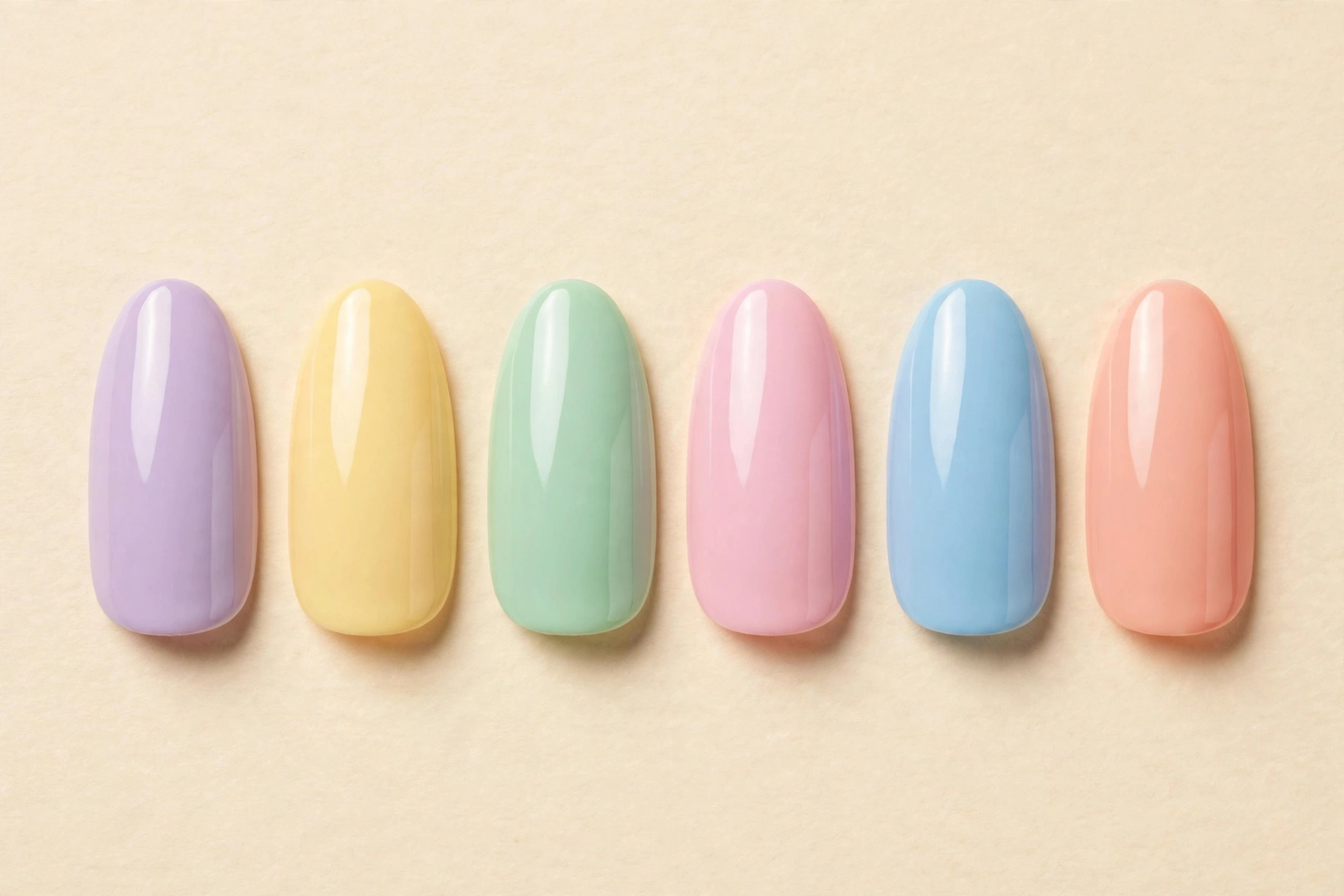
Easter nail colors 2027 are all about softness with intent: pastels that feel fresh rather than washed out, cheerful rather than childish, and polished enough for a family lunch yet relaxed enough for a long weekend at home. This palette gathers six pastel shades that each carry a different part of Easter — the lilac of spring flowers, the yellow of a newly hatched chick, the green of fresh leaves, the pink of a blush egg, the blue of a robin’s egg, and the peach of early blossom — so you can wear one shade all weekend or mix them into a set that looks like a basket of dyed eggs, without any nail art skill at all.
How to use this palette
- Start with one hero shade for a full manicure, then use a second pastel as an accent on the ring fingers. Two pastels together read as Easter immediately, while a single shade reads as a clean spring manicure.
- Keep the shape neat and fairly short. Pastels look best on short almond, squoval, or gently rounded nails, where the soft color can shine and the edges stay tidy.
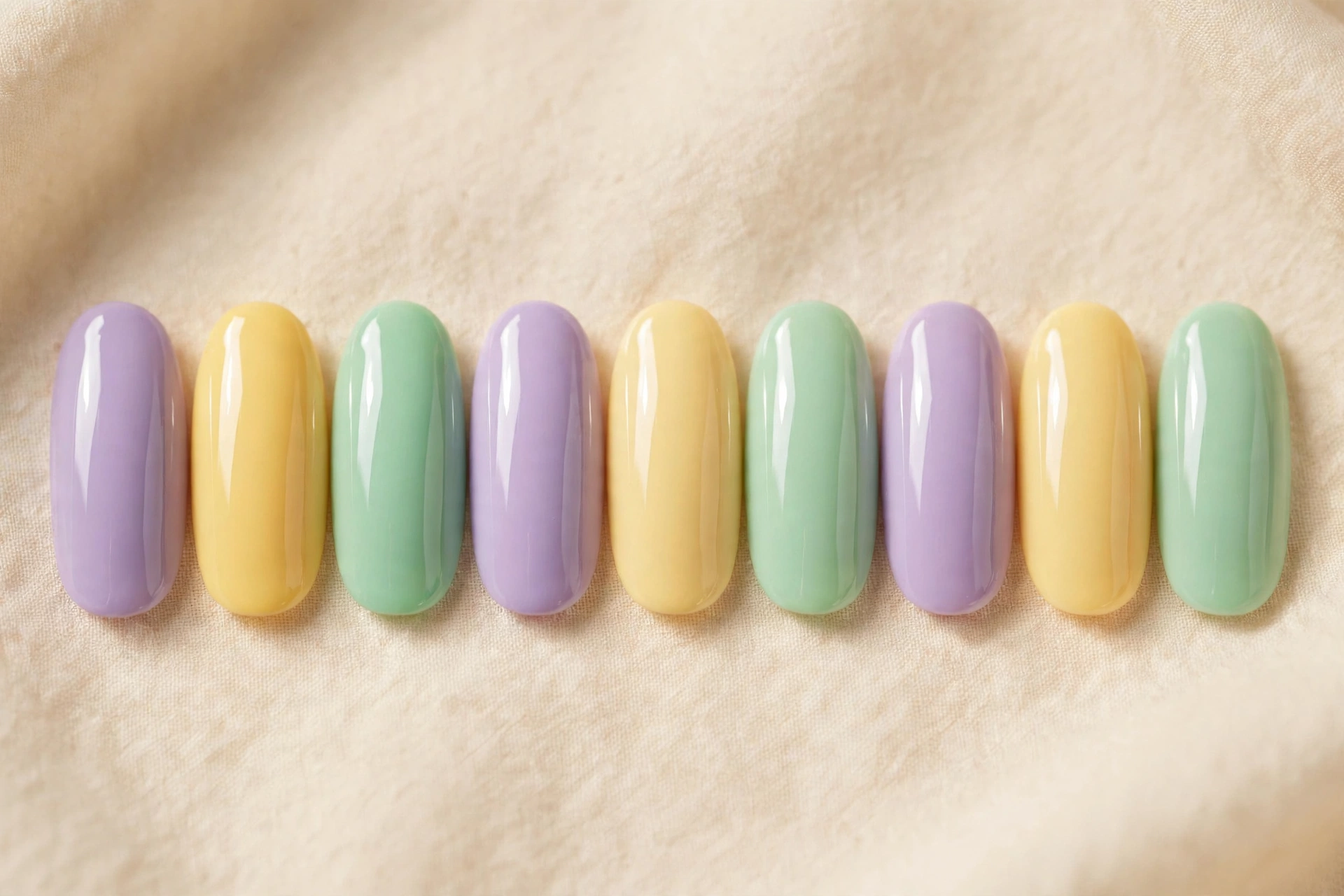
- For a dyed-egg effect, paint each nail a different shade from this palette in order from thumb to pinky. No blending, sponging, or art is needed; the color change alone does the work.
- If you want a quieter take, wear one pastel on the hands and a deeper version of the same family on the toes, so the pedicure echoes the manicure without matching it exactly.
- Always use a base coat under pastels. Light shades show ridges and stains more easily than dark ones, and a good base keeps the color smooth and even.
- Finish with a glossy top coat. Pastels can look chalky without shine, and a glossy finish is what turns a pale color from flat to fresh.
- Keep cuticles tidy and moisturized. Light polish draws the eye to the edge of the nail, so neat cuticles matter more with pastels than they do with a sheer nude.
The 6 Easter nail colors 2027 shades
1. Hyacinth Haze — #CDBFEA
Hyacinth Haze is a soft, cool lilac with a creamy finish, the color of hyacinth petals just as they open. Its undertone leans cool and slightly blue, which keeps it from turning grey on the nail, and its opaque creme finish gives full coverage in two thin coats. This is the most versatile shade in the palette, and the easiest one to wear if you are new to pastels, because lilac sits comfortably between pink and blue and flatters almost everyone.
On fair skin, Hyacinth Haze looks delicate and fresh, with the cool undertone harmonizing rather than clashing with pink undertones in the skin. On medium skin tones, it reads as a clear, pretty lilac that stands out without shouting, and it pairs beautifully with silver jewelry and white or pale blue clothing. On deep skin tones, it creates a lovely contrast that makes the color pop, and the creamy finish keeps it from looking chalky, which is the main risk with very pale purples. If your skin has warm undertones, the cool lilac still works, because its softness stops it from feeling icy; it simply reads a little more lavender than violet.
Wear Hyacinth Haze on its own for Easter Sunday lunch, a spring brunch, or a family gathering where you want to look polished but not overdressed. It also works as the base for simple Easter touches: a single white dot at the base of each nail, a thin gold stripe on one accent nail, or a tiny daisy decal if you like nail art. For everyday spring wear after Easter, it is one of the most wearable pastels you can own, because it goes with denim, white shirts, floral dresses, and soft knits alike. Two thin coats give even coverage, and a glossy top coat is essential here, since a matte finish can push lilac toward grey. If you only buy one shade from this palette, this is the safest and most flattering choice.
2. Chickadee Yellow — #F7E08B
Chickadee Yellow is a warm butter yellow with a creamy finish, the color of a chick fresh from the shell and of the first daffodils of the season. Its undertone is warm and golden, which is what stops it from looking like a highlighter shade, and its opaque creme finish gives it a soft, buttery look rather than a neon edge. Yellow is the shade people hesitate over most, and this is the version that wins them over, because it is warm, gentle, and genuinely wearable.
On fair skin, Chickadee Yellow looks sunny and cheerful, especially when paired with white, cream, or light denim. It can wash out very pale skin if the finish is matte, so keep it glossy and let the warmth do the work. On medium skin tones, it glows beautifully and reads as a true butter yellow, warm without turning orange. On deep skin tones, it is one of the most striking shades in this palette, because the contrast between the soft yellow and rich skin is bright and joyful, and the creamy finish keeps it looking polished rather than stark. Warm and neutral undertones suit this shade best, but cool skin tones can wear it too, especially as an accent nail paired with lilac or mint, where the yellow acts as a pop rather than a full manicure.
This is the Easter shade to reach for when you want your nails to feel like the holiday itself: bright, optimistic, and a little bit playful. It is perfect for an Easter egg hunt, a spring picnic, or a casual family weekend, and it also works for the weeks after Easter as a general spring color. Pair it with gold jewelry, a white dress, or a floral print, and keep the rest of your styling simple so the yellow can lead. For readers who want to explore this family further, our butter yellow shades cover twelve pale yellows in more depth. Apply Chickadee Yellow in two thin coats, since yellow polish can streak if applied too thickly, and seal the free edge with top coat, because light shades show tip wear sooner than dark ones.
3. Spearmint Sprout — #B8E6C8
Spearmint Sprout is a fresh, cool mint green with a creamy finish, the color of new leaves and spring grass after rain. Its undertone leans cool and slightly blue-green, which keeps it crisp rather than sage or muddy, and its opaque creme finish gives it a clean, even look. Mint is the shade in this palette that feels most like spring itself, and it is a wonderful choice if you want an Easter manicure that does not rely on pink or purple.
On fair skin, Spearmint Sprout looks fresh and clean, with the cool green harmonizing with cool undertones and giving a gentle contrast on warm skin. On medium skin tones, it reads as a clear, pretty mint that stands out against both light and dark clothing. On deep skin tones, it pops beautifully, and the creamy finish stops it from looking chalky, which can be a problem with very pale greens. Cool undertones suit mint best, but warm skin can wear it well too, especially when it is paired with peach or butter yellow in a mixed set, where the warmth of the neighboring shades balances the coolness of the mint.
Wear Spearmint Sprout for Easter brunch, a garden party, or a spring wedding guest look, where its freshness feels intentional rather than casual. It pairs with white, cream, pale pink, and light denim, and it looks especially good with silver jewelry. For a simple Easter design, paint four nails in Spearmint Sprout and leave the ring fingers in Hyacinth Haze or Chickadee Yellow, which gives a spring bouquet effect without any art. It is also a strong everyday spring shade after Easter, because mint works with so many outfits and never feels seasonal in a limiting way. Two thin coats give full coverage, and a glossy top coat keeps the green looking fresh rather than flat. Readers who love this family can find more in our mint green shades post.
4. Blush Bunny — #F8C8D8
Blush Bunny is a soft baby pink with a creamy finish, the color of a blush egg and of early cherry blossom. Its undertone is warm and rosy, which keeps it from looking white or grey on the nail, and its opaque creme finish gives it a gentle, polished glow. Pink is the most classic Easter shade, and this is the version that feels grown-up rather than bubblegum, because its softness is balanced by enough pigment to read as a real color.
On fair skin, Blush Bunny looks romantic and delicate, almost like a tinted nude with a pink lift. On medium skin tones, it reads as a true baby pink, pretty without being childish, and it pairs beautifully with gold jewelry and floral prints. On deep skin tones, it creates a soft, pretty contrast that looks especially lovely on shorter nails, where the pink reads as a deliberate pastel rather than a wash. Warm, cool, and neutral undertones can all wear this shade, because its rosy warmth is gentle enough not to clash with cool skin, while its lightness keeps it from turning orange on warm skin.
This is the shade to choose for Easter Sunday itself, for a spring wedding, or for any occasion when you want your nails to look soft, feminine, and polished without drawing too much attention. It is also the best shade in this palette for a French-style manicure with a twist: use Blush Bunny as the base and add a thin white or lilac tip, which reads as Easter without any complicated art. For a mixed set, pair it with Hyacinth Haze on alternating nails for a lilac-and-pink combination that feels like spring flowers. Apply it in two thin coats over a ridge-filling base coat, since baby pink can show ridges more than deeper pinks, and finish with a glossy top coat to keep it looking fresh. If you love pink but want a shade that works well beyond Easter, Blush Bunny will stay in rotation all spring.
5. Robin’s Egg Blue — #A8D8EA
Robin’s Egg Blue is a pale sky blue with a creamy finish, the exact color of a robin’s egg and of a clear spring sky. Its undertone is cool and clean, with just enough warmth in its lightness to stop it from feeling icy, and its opaque creme finish gives it a smooth, even look. Blue is the shade in this palette that feels most surprising for Easter, because people expect pink and yellow, but a soft blue is what makes a mixed pastel set feel complete, and it is the color that ties the whole basket together.
On fair skin, Robin’s Egg Blue looks fresh and crisp, with the cool blue harmonizing with cool undertones and giving a pretty contrast on warm skin. On medium skin tones, it reads as a clear, pretty sky blue that photographs beautifully and pairs well with white, denim, and silver. On deep skin tones, it pops in the best way, because the pale blue against rich skin is bright and cheerful, and the creamy finish keeps it from looking chalky. Cool undertones suit this shade most naturally, but warm skin tones can wear it as an accent nail, where its coolness acts as a refreshing contrast to warmer shades like peach and butter yellow.
Wear Robin’s Egg Blue for an Easter egg hunt, a spring picnic, or a casual Easter weekend, where its cheerfulness feels right at home. It is also a wonderful shade for a mixed set: paint each nail a different pastel, and let the blue sit between pink and mint, where it bridges the warm and cool sides of the palette. For a simple design, add a single white dot or a tiny speckled effect on one accent nail to echo a real robin’s egg, which is easy to do with the tip of a dotting tool or a toothpick. Two thin coats give even coverage, and a glossy top coat is important here, since a matte finish can push sky blue toward grey. If you want a blue that feels like spring rather than winter, this is the one.
6. Apricot Blossom — #FBC9A8
Apricot Blossom is a soft peach with a creamy finish, the color of apricot flesh and of early blossom warmed by the sun. Its undertone is warm and golden-peach, which gives it a gentle glow that flatters a wide range of skin tones, and its opaque creme finish keeps it looking polished rather than sheer. Peach is the shade in this palette that bridges the gap between pink and yellow, and it is often the one people reach for again once they have tried it, because it is warm, flattering, and easy to wear.
On fair skin, Apricot Blossom looks like a warm, glowing nude-pink, close enough to a natural shade to wear every day but with enough color to feel like spring. On medium skin tones, it warms up beautifully and reads as a true soft peach, especially pretty with gold jewelry and cream or white clothing. On deep skin tones, it sits as a luminous peach highlight, soft against rich skin without washing out, and it looks especially lovely on almond-shaped nails. Warm and neutral undertones suit peach best, but cool skin can wear it too, especially in a mixed set where lilac or sky blue balances the warmth.
This is the shade to choose when you want an Easter manicure that feels warm and romantic rather than bright, or when the rest of the palette feels a little too cool for your skin or your outfit. It is perfect for Easter lunch, a spring brunch, or a garden gathering, and it works beautifully as a pedicure shade too, because peach looks fresh on toes all spring and summer. Pair it with gold jewelry, a floral dress, or a cream knit, and keep the rest of your styling soft so the peach can glow. Apply it in two thin coats, since peach polish can look streaky if applied too thickly, and seal with a glossy top coat to keep the warmth looking fresh rather than flat. Apricot Blossom is also the best shade in this palette for transitioning into summer, because peach works just as well in May and June as it does at Easter.
How to style Easter pastels
Pastels are gentle colors, so the rest of your styling works best when it supports them rather than competing with them. White, cream, and light denim are the easiest partners for every shade in this palette, because they let the pastel lead without adding another strong color. Floral prints work beautifully too, especially when the print contains one of the pastel shades, which ties the whole outfit together without matching exactly. For jewelry, silver suits the cooler shades — lilac, mint, and sky blue — while gold suits the warmer ones — butter yellow, blush pink, and peach. If you are wearing a mixed set with both warm and cool pastels, choose one metal and stick with it, so the jewelry does not fight the nails.
For nail art, less is genuinely more with Easter pastels. A single white dot at the base of each nail, a thin gold stripe on one accent nail, a tiny flower decal, or a speckled effect on a robin’s egg accent are all enough, and each one reads as Easter without turning the manicure into a craft project. If you prefer a plain manicure, the shade itself is the design, and a well-shaped, glossy set in one pastel will look more expensive than a busy design in a weaker color. The same restraint applies to length: very long, pointed nails in pale pastels can look fragile, while a neat almond or squoval shape keeps the color elegant and wearable. Readers planning a wider spring wardrobe may enjoy our spring pastel shades, which cover the broader spring family beyond Easter.
If you want to extend the palette beyond a single manicure, think in tones rather than exact matches. A lilac scarf, a butter-yellow bag, a mint cardigan, or a peach lip can echo the nails without matching them shade for shade, and that near-match looks far more intentional than a perfect match. The one place to be careful is with too many pastels at once in clothing, because the whole outfit can start to feel washed out; a single deeper element, such as a denim jacket, a tan bag, or a navy shoe, grounds the look immediately. With jewelry, keep it simple: pastels already make a soft statement, so one or two pieces are enough, and a single delicate ring often looks better than a full set of stacked jewelry competing for attention.
Best occasions for Easter pastels
Easter weekend itself is the obvious occasion, but each shade in this palette earns its keep in different settings. For Easter Sunday lunch or church, Blush Bunny and Hyacinth Haze are the safest choices: they are polished, pretty, and appropriate for a family gathering. For an Easter egg hunt or a casual family weekend, Chickadee Yellow and Robin’s Egg Blue are the most fun, because their brightness matches the playful mood. For a spring brunch or garden party, Spearmint Sprout and Apricot Blossom feel fresh and intentional, especially when paired with floral clothing.
Beyond Easter, these shades cover a surprising range of spring occasions. They work for spring weddings, both as a guest and as a bridesmaid, because pastels photograph softly and do not compete with the bride. They work for baby showers, christenings, and family celebrations, where a soft manicure feels right. They work for workdays too, especially Blush Bunny, Apricot Blossom, and Hyacinth Haze, which read as polished neutrals from a distance and only show their pastel character up close. And they work for everyday spring wear, because a pastel manicure lifts a simple outfit of jeans and a white shirt without requiring any other effort.
If you are choosing between shades for a specific event, match the mood as well as the color. A formal lunch calls for a single shade worn neatly, while a casual weekend calls for a mixed set that feels playful. A garden party calls for mint or peach, while a family dinner calls for lilac or blush pink. For a spring wedding, consider the dress code: a single pastel is safest for a formal wedding, while a mixed pastel set is perfect for a relaxed outdoor celebration. The beauty of this palette is that no choice is wrong, because every shade belongs to the same soft family, so even a last-minute change of mind will still look coordinated.
Shade-to-shade comparisons
Choosing between six pastels can feel harder than choosing between six bright colors, because the differences are soft until you see them side by side. Hyacinth Haze is the most versatile and the best all-rounder; if you are unsure, start there. Chickadee Yellow is the brightest and the most cheerful, and the one to pick if you want your nails to feel like Easter itself. Spearmint Sprout is the freshest and the most spring-like, and the best choice if you want a green that does not feel sage or muted. Blush Bunny is the softest and the most romantic, and the one that works best for formal spring occasions. Robin’s Egg Blue is the crispest and the most surprising, and the shade that completes a mixed set. Apricot Blossom is the warmest and the most flattering across skin tones, and the best bridge between pink and yellow.
A useful way to decide is to hold the bottle against your Easter outfit. Against white or cream, every shade in this palette works, which is why pastels are such a safe Easter choice. Against a floral dress, pick the pastel that appears in the print, or the one that contrasts most gently with it. Against denim, lilac, mint, and sky blue look especially fresh, while butter yellow and peach add warmth. Against navy, which some people wear for Easter lunch, sky blue and lilac are the obvious matches, while blush pink gives a softer contrast. If you still cannot decide, paint one nail in each of two contenders and live with them for a day; pastels reveal their undertone in daylight, under indoor light, and in the evening, and a day of real wear tells you more than a bottle in a shop ever will. For a blue-violet alternative in the same soft family, our periwinkle shades explore that neighboring color in full.
Application and longevity tips
Pastel polish rewards a little patience, and the difference between a good and a great pastel manicure usually comes down to preparation. Start with clean, dry nails, push back the cuticles gently, and file in one direction to avoid splitting. A ridge-filling base coat is worth using under these shades, because it smooths the nail surface and stops the color from settling into ridges, which pastels show more readily than dark shades. Apply the first coat thinly, leaving a tiny gap at the cuticle, and let it dry for at least two minutes before the second coat. Two thin coats will always look smoother than one thick coat, and they dry faster and chip less. With pale shades, a thin first coat can look streaky; that is normal, and the second coat is what evens it out, so resist the urge to load the brush.
Top coat is not optional with pastels. A good glossy top coat deepens the color, protects it from scratches, and makes the manicure look freshly done for longer, and it is what stops a pastel from looking chalky. Reapply a thin layer every two to three days, wrapping it over the free edge, and you can easily stretch a pastel manicure to a full week. Pastels show tip wear sooner than dark shades, because the contrast between the pale polish and the bare nail tip is more visible, so sealing the free edge matters more here than with most colors. When it is time to remove pastel polish, soak a cotton pad in remover and press it onto the nail for thirty seconds before wiping, which lifts the color cleanly without scrubbing. A little cuticle oil after removal restores moisture, and waiting a day before your next pastel shade gives nails a brief rest.
For gel versions of these shades, the same color logic applies, but the wear is longer. Gel pastels typically last two to three weeks without chipping, which makes them a good choice if you want one Easter manicure to carry you through the whole spring break. The trade-off is removal: gel needs proper soaking, not peeling, and peeling gel off can damage the nail surface. If you are choosing between regular polish and gel for Easter, consider how long you want the color to last and how soon you plan to change it; a mixed pastel set is easier to change in regular polish, while a single favorite shade is worth doing in gel.
Wear, chipping, and finish guidance
Pastel polish shows wear in specific ways, and knowing what to expect makes it easier to keep an Easter manicure looking good. Tip wear is the first sign: the very edge of the nail loses polish first, especially if you type a lot, garden, cook, or work with your hands over Easter weekend. Wrapping the top coat over the free edge, and reapplying top coat midweek, slows this down more than any other single step. Chips at the corners usually mean the polish was applied too thickly or the nails were not fully dry between coats, so thin coats and proper drying time are worth the patience. Lighter shades hide small chips less well than dark ones, because the bare nail shows through, so carry your bottle for a quick touch-up if you are wearing pastels for a special event.
Finish matters more with pastels than with most colors. A glossy finish is almost always the right choice, because it gives pale shades depth and prevents them from looking flat or chalky. A matte finish can work on lilac or mint for a softer, more modern look, but it tends to mute butter yellow and sky blue toward grey, so test it on one nail before committing to a full matte set. A shimmer or pearl top coat over a pastel base is another easy Easter option: it adds a subtle glow without changing the color, and it is especially pretty over Blush Bunny and Apricot Blossom. If you want a little sparkle for Easter Sunday, a fine glitter top coat on just the ring fingers gives a festive touch while keeping the rest of the set soft.
Staining is less of a worry with pastels than with dark shades, but yellowing can be an issue if you skip base coat or leave polish on for too long. Always use a base coat, remove polish after a week or so rather than letting it grow out indefinitely, and give nails a day of rest with cuticle oil between manicures. If a pastel does stain slightly, a gentle buff and a hydrating nail treatment usually restore the nail surface quickly. With a little care, these six shades will carry you from Easter weekend through the whole of spring, and they are gentle enough to wear again and again without tiring of them.
Polish and gel picks
For Hyacinth Haze, look for a lilac creme polish in a regular or gel formula, with an opaque finish that covers in two coats. For Chickadee Yellow, choose a butter yellow creme with a warm undertone, and test it on one nail first, since yellow shades vary more between brands than most pastels. For Spearmint Sprout, a mint creme polish with a cool undertone gives the freshest result, in either regular or gel form. For Blush Bunny, a baby pink creme with a rosy undertone is the most flattering choice, and a ridge-filling base coat underneath helps it apply smoothly. For Robin’s Egg Blue, a sky blue creme with a clean, cool undertone works best, finished with a glossy top coat. For Apricot Blossom, a soft peach creme with a warm undertone gives the most glowing result, and it also makes a lovely pedicure shade in gel form for longer wear.
When shopping for pastels, check the finish on the bottle rather than the color alone. A creme finish is the safest choice for all six shades, because it gives even, opaque coverage. A jelly finish can look pretty over a white base, but it needs more coats to reach the same opacity. A shimmer finish adds glow but can change how the pastel reads on different skin tones, so try it on one nail before committing. Whatever formula you choose, buy from a brand whose brush you like, since a good brush makes thin, even coats much easier, and that matters more with pastels than with forgiving dark shades.
This palette is intended as color inspiration. Shade names are descriptive, and the closest match in any brand may vary slightly in tone and finish.
Frequently asked questions
What are the best Easter nail colors for 2027?
The best Easter nail colors for 2027 are soft pastels with enough pigment to read as real color: lilac, butter yellow, mint, baby pink, sky blue, and peach. These six shades cover the whole Easter palette, from flowers and eggs to new leaves and spring skies, and they work together as a mixed set or on their own. Choose one hero shade for a classic look, or paint each nail a different pastel for a dyed-egg effect that needs no nail art.
Do pastel Easter nails suit all skin tones?
Yes, pastels suit all skin tones when the undertone is right. Cool lilac, mint, and sky blue flatter cool undertones and create a pretty contrast on deep skin, while warm butter yellow, blush pink, and peach flatter warm undertones and glow on medium skin. The key is finish: a glossy, opaque creme keeps pastels from looking chalky on any skin tone, while a matte finish can mute them. If one pastel washes you out, try it as an accent nail next to a warmer or cooler shade from the same palette.
How long do Easter pastel nails last?
Regular pastel polish typically lasts five to seven days with a good base coat, two thin coats of color, and a glossy top coat reapplied every two to three days. Gel pastels last two to three weeks without chipping, which makes them a good choice for Easter week if you want the color to last through the holiday and beyond. Tip wear shows sooner on pastels than on dark shades, so seal the free edge with top coat and carry the bottle for quick touch-ups at special events.
Can I wear Easter pastels after Easter?
Absolutely. Every shade in this palette works well beyond Easter weekend and through the whole of spring. Lilac, mint, and sky blue are classic spring shades, while butter yellow, blush pink, and peach carry easily into early summer. A single pastel worn neatly reads as a spring manicure rather than a holiday-only color, so there is no need to remove them on Monday. If you want to move on from Easter, drop the mixed dyed-egg set and wear one favorite shade on its own for a cleaner spring look.