
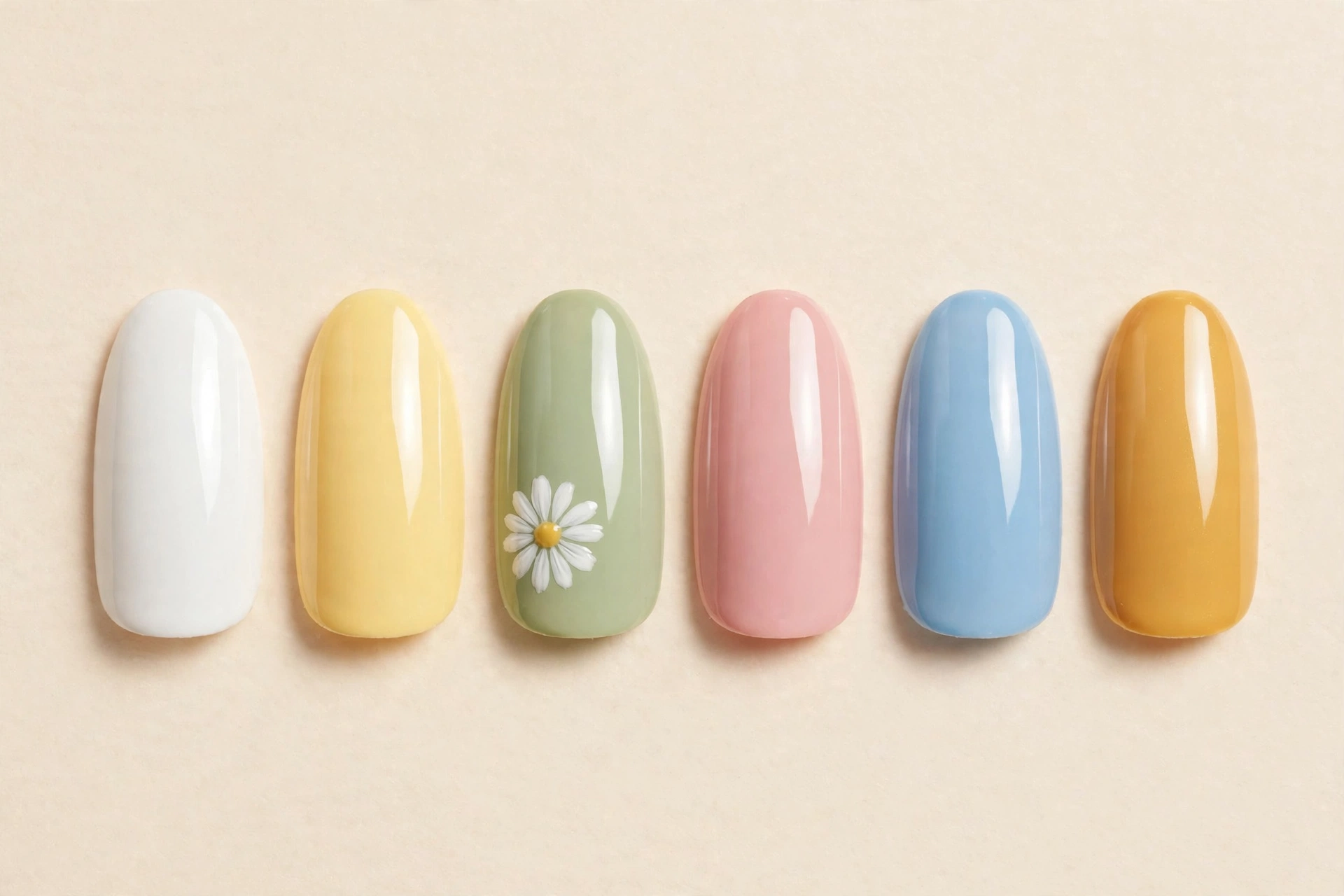
Daisy nails are spring in its simplest form. A daisy is the least fussy flower there is — white petals, a yellow centre, a green stem — and that simplicity is exactly why the look works so well on nails. It is fresh without being fussy, floral without being busy, and it suits the season when the light changes and the heavy winter colours finally come off. This palette gathers six shades taken straight from the flower itself, from crisp daisy white to honey gold, so you can wear the whole daisy or just the part of it you like best.
The daisy manicure has been quietly building for a few springs now, and the 2027 version is cleaner than the ones that came before it. The older daisy looks were often covered in hand-painted flowers on every nail, which is pretty but slow to do and hard to keep neat. This palette takes a different approach: the colours do the floral work, and the flowers appear only as small accents — one painted daisy on a ring finger, a single petal on a thumb, or no flowers at all if you prefer a plain colour manicure in a daisy shade. The result is a manicure that reads as daisy-inspired from across the room and looks intentional up close, and it works just as well on short nails as on long ones.
The six shades below are chosen to work as a set. Each one is a colour you would find on a real daisy or in the field around it: the white of the petals, the yellow of the centre, the sage green of the leaves, the blush of a pink daisy variety, the blue of a spring sky, and the warm gold of late-afternoon sun. You can wear one shade on its own all spring, mix two in an accent-nail combination, or move from the lightest to the warmest as the weather warms up. Every shade is described in full — undertone, finish, skin tones, occasions, and how it wears — so you can pick with confidence instead of guessing from a bottle.
How to Use This Daisy Nails 2027 Palette
- Start with the shade that matches your usual spring palette. If you always reach for white, begin with Daisy White. If you prefer soft colour, start with Blush Petal or Buttercup Yellow. The daisy theme runs through every shade, so your favourite colour family is the best entry point.
- Wear one shade on all ten nails for the most polished result. Pale colours like these show uneven application more than dark ones do, so take your time with thin, even coats rather than rushing through a thick one.
- Use a single daisy accent nail to make the theme clear. One small hand-painted daisy on the ring finger — five white petals and a yellow dot for the centre — turns a plain white or blush manicure into a daisy manicure without any extra effort on the other nine nails.
- Try a daisy French tip on a sheer nude or milky base. A thin white tip with a tiny yellow dot at the smile line reads as a daisy without any painting at all, and it suits short nails particularly well because the tip stays slim and the look stays clean.
- Pair the yellow and the white together for the classic daisy combination. Buttercup Yellow on eight nails with Daisy White on the ring fingers, or the reverse, gives you the flower’s own colour pairing in a way that looks fresh rather than themed.
- Match your jewellery loosely, not exactly. Gold warms up the yellows and the honey gold in this palette, silver suits the sky blue and the crisp white, and either metal works with the blush and the sage because both shades are soft enough to sit with anything.
- Keep cuticles neat and moisturised. Pale polish catches the light, and it also catches the eye, so dry edges and chips show more than they would in a darker colour. A drop of cuticle oil each evening makes a real difference, and it stops pale polish from looking chalky around the edges.
Daisy Nails 2027: The 6 Shades
1. Daisy White — #FDFBF7
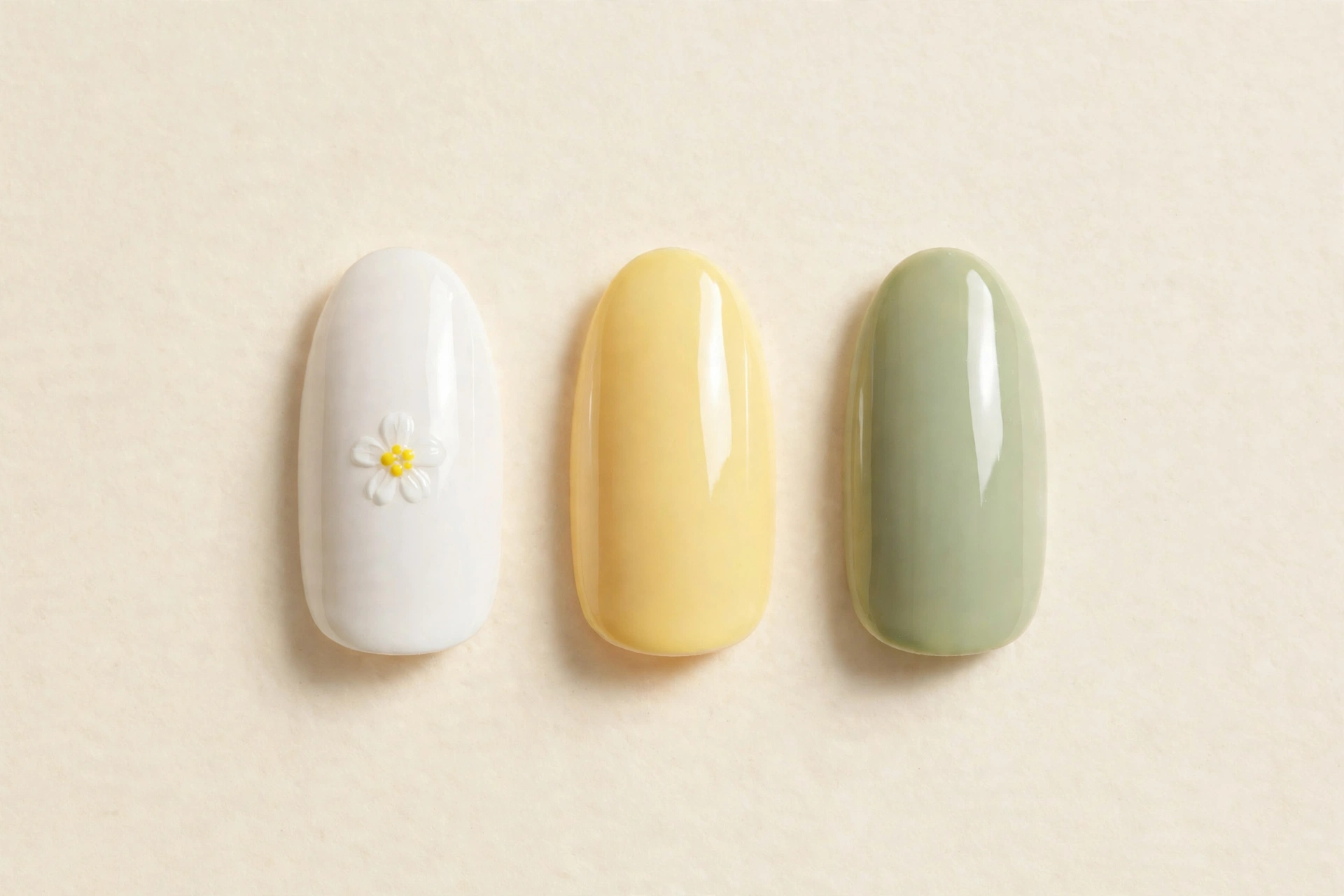
Daisy White is the shade the whole palette is built around, and it is the one to choose if you only pick one. It is a crisp, clean white with the faintest warmth, the colour of a fresh daisy petal in morning light. In the bottle it looks almost pure white, but on the nail it has a soft, milky warmth that stops it from looking stark or clinical, which is the difference between a white that flatters and a white that washes you out.
The undertone is a warm white, with a creamy ivory base and just enough warmth to keep it from going blue. That warmth makes it flattering across skin tones. On fair skin it is bright and clean, a colour that looks fresh and polished without shouting. On medium skin it gives a crisp, high-contrast finish that looks especially good with gold jewellery and warm neutrals like cream and camel. On deep skin it is striking and luminous, with the white standing out beautifully against the skin, and it pairs well with both gold and silver. It is also a strong choice for anyone who loves a white manicure but has found pure whites too harsh — the faint warmth in this shade softens the whole effect.
The finish is a high-gloss cream, smooth and opaque with no shimmer and no glitter. That matters with a white, because shimmer in a white polish can read as frosty or dated, while a clean cream reads as modern and deliberate. In daylight it looks bright and fresh; in softer light it looks softer and more milky. A glossy top coat is essential here, because a white without shine can look chalky, and the gloss is what gives the shade its petal-like smoothness. Two thin coats are usually enough for full opacity, though a third coat will even out any streaks on the first pass.
Wear it anywhere spring happens. It is formal enough for a spring wedding or a garden party, and relaxed enough for a weekend of errands in jeans and a linen shirt. It suits short nails, long nails, almond, square, and oval shapes alike, though it looks particularly good on a short almond or a neat square, where the pale colour keeps the shape looking clean and the nail looking longer than it is. For a daisy touch, add a single small yellow dot at the base of one nail, or a tiny painted daisy on the ring finger. Keep the rest plain and let the white do the work.
Next to its sibling shades, Daisy White is the reference point for the pale end of the palette. It is lighter and cleaner than every other shade here, and it is the one the other colours are measured against. If you hold the six together, Daisy White is the lightest, the brightest, and the most versatile: the shade you reach for when you want a daisy manicure without any colour commitment. If you want more whites to compare it with, our white nail polish shades guide covers twelve whites from milky to chrome, and it is a useful companion to this palette.
For longevity, expect a good gel version to last two to three weeks with a proper top coat, and a regular polish version to last five to seven days before tip wear shows. White is the least forgiving colour for chips, because the contrast with the bare nail is sharp, so a good base coat and a sealed free edge matter more here than with any other shade in the palette. Staining is not a worry with a white, but yellowing can be if the polish sits in sunlight, so store the bottle away from windows. A quick-dry top coat seals the gloss, but give the layers underneath time to dry properly, because white polish looks dry on the surface long before it is dry underneath, and a dent in a white is impossible to hide.
2. Buttercup Yellow — #F6D878
Buttercup Yellow is the sunshine of the palette, and the most cheerful colour in the set. It is a soft, buttery yellow, the colour of a daisy’s centre and of the first warm days of spring. It is not a neon yellow and not a mustard yellow; it sits in the middle, pale enough to feel gentle and warm enough to read clearly as yellow. If Daisy White is the petal, Buttercup Yellow is the heart of the flower.
The undertone is a warm yellow with a creamy, buttery base and a touch of gold in bright light. That warmth makes it flattering on most skin tones. On fair skin it gives a soft, sunny glow, and it looks particularly good with gold jewellery and warm neutrals like cream, camel, and soft denim. On medium skin it looks warm and seamless, almost like a deeper version of the skin’s own warmth, and it pairs beautifully with both gold and silver. On deep skin it glows — the yellow comes forward, the cream recedes, and the result is a bright, happy finish that looks especially striking with a glossy top coat. Yellow is a colour some people hesitate over, but a soft buttercup yellow is one of the easiest yellows to wear, because the creaminess keeps it gentle and the warmth keeps it flattering.
The finish is a high-gloss cream, smooth and opaque with no shimmer. In low light it reads as a soft, creamy yellow; in bright light it looks warmer and more golden, like sunlight on a petal. That changeability is part of its charm, and it is why the shade looks different — and good — in photographs, in daylight, and indoors. Two coats are usually enough for full opacity, though a third thin coat will deepen the colour and even out any patchiness, which yellows are prone to on the first pass. A ridge-filling base coat helps here, because yellow shows every ridge and bump in the nail underneath.
This is a daytime shade first and an evening shade second. It is perfect for spring picnics, garden parties, brunches, and any daytime occasion where you want your nails to feel like part of the season. It also works beautifully for Easter, for spring weddings, and for the first warm weekends of the year, when the colour feels like a small celebration. For the office, it is bolder than a nude but restrained enough for most workplaces, especially on short nails, where the pale colour covers less surface and feels less intense.
Compared with its closest sibling, Buttercup Yellow is the warmest shade in the palette, and the one most likely to be mistaken for a pastel yellow in a photograph. Next to Daisy White it looks warm and sunny; next to Honey Gold it looks lighter and softer, with a creaminess the gold does not have. If you love this end of the scale, our butter yellow nails palette explores twelve pale yellow shades in the same soft family, including more buttery and creamy options. In this palette, Buttercup Yellow is the shade to reach for when you want spring colour without committing to pink or blue.
Wear notes matter with a shade this pale. Staining is not a risk with a light yellow, but patchiness is, so thin coats and patience are the whole game. Paint in thin layers, let each one dry fully before the next, and do not try to get full coverage in one coat — that is how yellow goes streaky. In gel, this shade is a good performer, and you can expect a full two to three weeks. In regular polish, plan on a top coat refresh around day four to keep the gloss alive and the tips sealed.
3. Sage Leaf Green — #A8BFA0
Sage Leaf Green is the quiet shade of the palette, and the most sophisticated colour in the set. It is a soft, muted sage green, the colour of daisy leaves and of new spring growth. It is not a bright green and not a dark forest green; it sits in the middle, pale enough to feel gentle and grey enough to feel grown-up. If Buttercup Yellow is the sunshine, Sage Leaf Green is the garden it grows in.
The undertone is a cool sage with a grey-green base and a faint warmth in bright light. It is deeper than a mint green and softer than an olive green, with enough colour to read clearly as green rather than grey. That coolness makes it especially flattering on cool and neutral skin tones, where it picks up the pink in the skin and looks harmonious rather than clashing. On warm skin it still works, but it reads as a cooler contrast, which some people love for the way it makes gold jewellery stand out. On fair skin it is soft and understated, the kind of manicure that gets noticed quietly. On deep skin it is gentle and elegant, with the green glowing against the skin in a way that looks natural rather than loud.
The finish is a high-gloss cream, smooth and opaque with no shimmer. In low light it looks like a soft grey-green cream; in bright light it looks fresher and more clearly green, like a leaf in sunlight. That softness is what makes it feel so spring-like, and it is why it pairs so well with silver jewellery and with cool-toned outfits in grey, white, and soft denim. It also photographs well, which is worth knowing if you like sharing manicure photos, because the muted tone reads clearly in a still image without washing out.
Occasions for Sage Leaf Green lean relaxed and a little elegant. It is lovely for spring lunches, garden visits, and afternoons where you want colour without brightness. It also works well in the daytime with white, cream, and soft grey outfits, where its muted tones pick up the colours in the clothes. It is less of a party shade than Buttercup Yellow, which is exactly its appeal: it feels seasonal and calm without being obvious about it. Try it with silver jewellery, or with a white linen shirt and light denim for a quiet, polished spring look.
Against its siblings, Sage Leaf Green is the most muted shade in the palette, and the one most likely to be mistaken for a grey polish in a photograph. Next to Buttercup Yellow it looks cool and calm; next to Sky Blue it looks warmer and more natural. That in-between position is its strength: it gives you a way to wear green without committing to a bright or dark shade, and a way to wear spring colour with a softer, more grown-up feel.
For wear, Sage Leaf Green is a good all-rounder. It needs two coats for full depth, and a third coat will deepen the sage without making it muddy. It wears about as well as Daisy White in both gel and regular polish, with tip wear showing first on the dominant hand. Because the colour is pale, chips are slightly more visible against warm skin, so keep a bottle handy for a quick tip touch-up, or choose gel if you want a full two weeks without thinking about it. It also layers well: a single coat over Daisy White gives a very pale sage wash, and a single coat over a sheer nude base gives a softer, milkier green for daytime.
4. Blush Petal Pink — #F2C4C7
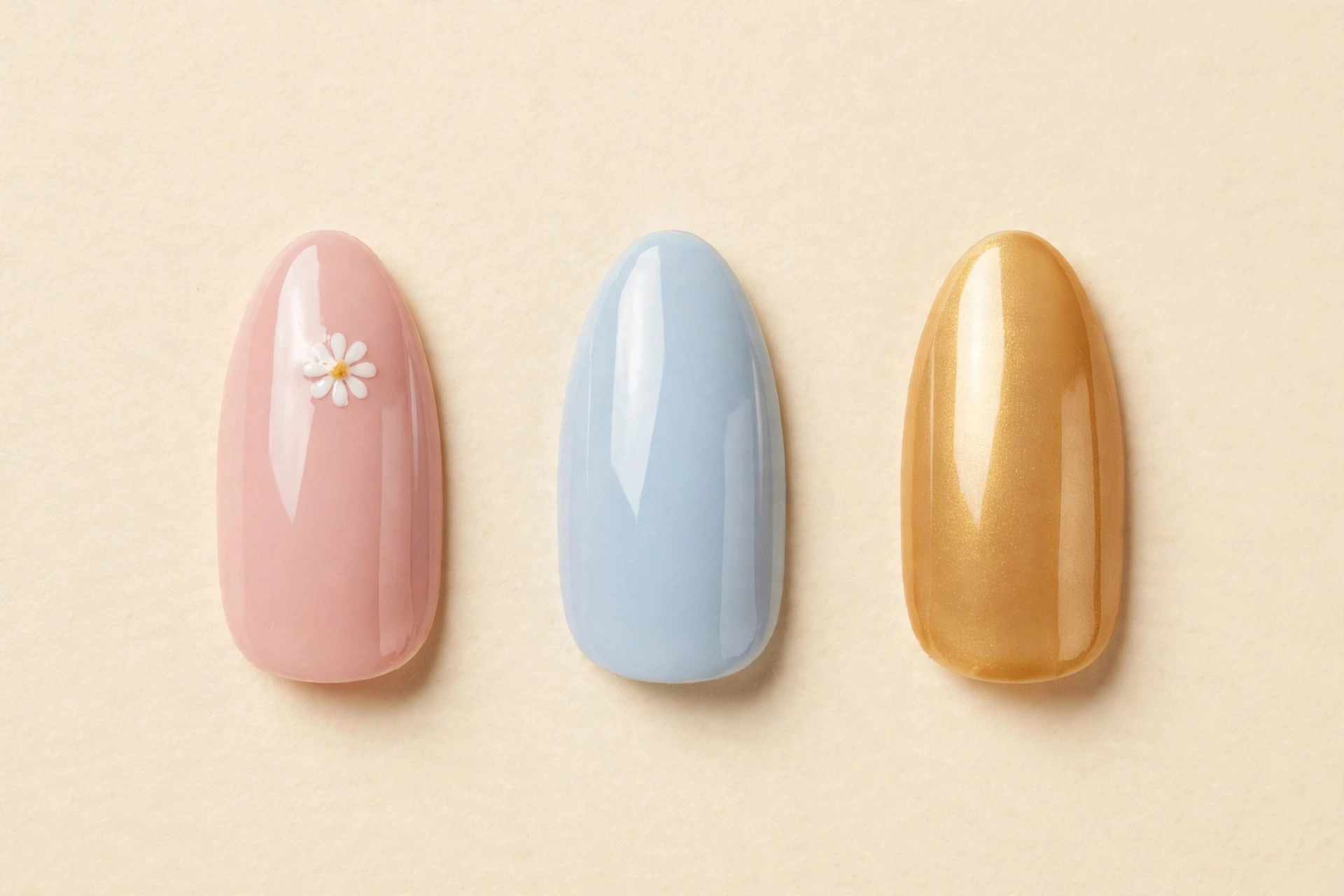
Blush Petal Pink is the softest shade in the palette, and the one that keeps daisy nails from feeling too crisp or too cool. It is a gentle blush pink, the colour of a pink daisy variety and of the first petals of spring. It has the softness of a ballet pink but a little more warmth, which makes it feel like a spring colour rather than a year-round neutral. It is the shade for people who want daisy nails that read as pretty first and floral second.
The undertone is a warm blush pink, with a soft rose heart and a creamy edge that stops it from becoming a bright pink. That warmth makes it flattering on warm and golden skin tones, where it looks soft and healthy, and on olive skin, where it brings out the warmth without clashing. On fair skin it is gentle and barely-there, because the pink sits close to the skin’s own tone, which makes it a good choice for people who want colour that does not shout. On deep skin it is soft and luminous, a true blush with a spring twist. If you love pink nails but want something more seasonal than a classic ballet pink, this is your shade — the daisy theme is what makes it spring rather than everyday.
The finish is a high-gloss cream, smooth and opaque with no shimmer, and it is the glossiest-looking shade in the palette alongside Daisy White. The colour stays true in different lights, shifting from a soft blush indoors to a slightly warmer pink in daylight, but never turning orange or purple. It also photographs well, which is worth knowing if you like sharing manicure photos, because the soft pink reads clearly without washing out.
Wear Blush Petal Pink everywhere spring happens. It is the most versatile shade here for daily wear: office days, school runs, lunch with friends, a spring wedding, a family gathering. It suits every nail length, but it is especially good on short nails, where a soft colour can otherwise feel too plain — the warmth in this pink keeps it interesting. It also suits every nail shape, and it is a good choice for a French tip base or for a half-moon design, where the soft pink gives the design definition without darkness.
Compared with Daisy White, Blush Petal Pink is warmer, softer, and pinker, and it reads as a colour first and a neutral second. Next to Buttercup Yellow, it is cooler and gentler, with less of the sunny warmth. If you already own a classic pink polish, Blush Petal Pink is the spring upgrade: same softness, more warmth, and a shade that feels current rather than generic. For more shades in this pink family, our pink nail polish shades guide covers eighteen pinks from ballet to hot pink, and it is a useful place to compare.
Longevity is strong for a pale shade. Pale pinks tend to show tip wear sooner than the deeper shades, because the contrast with the bare nail is sharper, so a good top coat and a thin seal over the free edge help a lot. In gel, expect two to three weeks. In regular polish, five to seven days is realistic, with a top coat refresh at day three or four. Staining is not a worry with a shade this light, and the creamy finish hides small ridges well, which makes it a forgiving choice if you are doing your own nails at home.
5. Sky Blue — #A9CDE8
Sky Blue is the freshest shade in the palette, and the most spring-sky colour in the set. It is a pale, clear sky blue, the colour of a cloudless April morning. It is not a baby blue and not a bright blue; it sits in the middle, pale enough to feel gentle and blue enough to read clearly as blue. It is the shade for people who want daisy nails that feel like open air.
The undertone is a cool sky blue with a clean, clear base and a faint warmth in bright light. That coolness makes it especially flattering on cool and neutral skin tones, where it picks up the pink in the skin and looks harmonious rather than clashing. On warm skin it still works, but it reads as a cooler contrast, which some people love for the way it makes gold jewellery stand out. On fair skin it is soft and fresh, the kind of manicure that looks like spring itself. On deep skin it is bright and luminous, with the blue glowing against the skin in a way that looks cheerful rather than loud.
The finish is a high-gloss cream, smooth and opaque with no shimmer. In low light it looks like a soft powder blue; in bright light it looks clearer and more sky-like, like the colour of the sky at midday. That clarity is what makes it feel so spring-like, and it is why it pairs so well with silver jewellery and with white, cream, and soft denim outfits. It also photographs well, because the pale blue reads clearly in a still image without washing out.
Occasions for Sky Blue lean bright and daytime. It is lovely for spring picnics, outdoor lunches, and afternoons where you want colour that feels like fresh air. It also works well with white, cream, and light denim outfits, where its cool tones pick up the colours in the clothes. It is less of an evening shade than Honey Gold, which is exactly its appeal: it feels light and daytime without being plain. Try it with silver jewellery, or with a white linen dress and sandals for a clean, polished spring look.
Against its siblings, Sky Blue is the coolest shade in the palette, and the one most likely to be mistaken for a powder blue in a photograph. Next to Sage Leaf Green it looks cooler and clearer; next to Daisy White it looks bluer and more obviously coloured, with a freshness the white does not have. That in-between position is its strength: it gives you a way to wear blue without committing to a bright or dark shade, and a way to wear spring colour with a cool, airy feel.
For wear, Sky Blue is a good all-rounder. It needs two coats for full depth, and a third coat will deepen the blue without making it chalky. It wears about as well as Blush Petal Pink in both gel and regular polish, with tip wear showing first on the dominant hand. Because the colour is pale, chips are slightly more visible against warm skin, so keep a bottle handy for a quick tip touch-up, or choose gel if you want a full two weeks without thinking about it. It also layers well: a single coat over Daisy White gives a very pale blue wash, and a single coat over a sheer nude base gives a softer, milkier blue for daytime.
6. Honey Gold — #D9A441
Honey Gold is the warmest shade in the palette, and the most golden. It is a warm, rich honey gold, the colour of late-afternoon sun and of the golden centre of a daisy held up to the light. It is not a metallic gold and not a bronze; it is a warm, honeyed yellow-gold that reads as a colour rather than a metal. It is the shade for people who love the yellow end of the daisy but want something deeper and warmer than Buttercup Yellow.
The undertone is a warm gold with a honey-amber base and a touch of orange in bright light. That warmth makes it especially flattering on warm and golden skin tones, where it looks rich and glowing, and on olive skin, where it brings out the warmth without clashing. On fair skin it is bold but not overwhelming, because the honey depth keeps it grounded. On deep skin it is rich and vivid, a true golden shade with a spring twist. If you love yellow nails but want something more grown-up than a pastel yellow, this is your shade — the honey depth is what makes it feel like late spring rather than early spring.
The finish is a high-gloss cream with a very fine golden shimmer, the only shade in the palette with any shimmer at all. The shimmer is subtle — a soft, warm glow rather than a visible sparkle — and it is what gives the shade its honeyed, sunlit quality. In low light it looks like a warm amber cream; in bright light the shimmer appears and the nails look like they are catching the sun. A glossy top coat is essential here, because the shimmer needs shine to show, and a matte top coat would flatten the gold into a dull mustard.
This is a late-spring shade first and an early-spring shade second. It is perfect for May afternoons, garden parties, and any occasion where you want your nails to feel warm and golden. It also works beautifully for spring weddings, especially with gold jewellery, and it carries well into early summer, when the warm gold still suits sunlit clothes even after the daisies have faded. For the office, it is bolder than a nude but restrained enough for most workplaces, especially on short nails, where the warm colour covers less surface and feels less intense.
Compared with its closest sibling, Honey Gold is darker, warmer, and richer than Buttercup Yellow. Side by side, Buttercup Yellow looks pale and creamy, while Honey Gold looks like its grown-up version. It is also warmer and deeper than every other shade here. For readers who love this end of the scale, our spring nail colors 2027 palette covers thirty-six pastel and fresh spring shades, including more warm golds and yellows in the same spring family.
Wear notes matter with a shade this warm. Staining is a real risk with warm golds and yellows, so never skip base coat, and use a double layer of base on the thumbnails if you are prone to staining. Removal takes a little patience: hold a remover-soaked cotton pad on each nail for ten seconds before wiping, rather than scrubbing, which pushes pigment into the cuticles. In gel, this shade is a strong performer — warm golds cure well and resist chipping, and you can expect a full two to three weeks. In regular polish, plan on a top coat refresh around day four to keep the gloss alive.
How to Style Daisy Nails
Daisy nails are easy to style because the colours already do the work. The simplest rule is to let the nails be the freshest colour in the outfit, and keep everything else in the same light, spring family. White is the obvious partner, and it works every time — a white linen shirt, light denim, daisy white nails, and a soft neutral lip is a complete spring look. Cream and soft beige are softer partners, and they let the daisy colours stand out without the starkness of pure white. Pale blue and soft grey also work, especially with Sky Blue, where the cool tones match. Warm neutrals like camel and tan soften the whole look and make daisy nails feel daytime-appropriate, which is useful if you want to wear a pale nail to work without feeling underdressed.
Jewellery is straightforward. Gold warms up Buttercup Yellow, Honey Gold, and Blush Petal Pink, and it suits the warm side of the family. Silver suits Sky Blue, Sage Leaf Green, and Daisy White, where the cooler tones match. If you wear mixed metals, pale spring colours sit comfortably with both, because they have both warm and cool notes. Keep rings simple when the nails are pale — a thin band or a single stone reads better than a cluster of chunky rings, which can fight with a delicate daisy accent.
For clothes, think light fabrics. Daisy nails look best against linen, cotton, light denim, and soft knits — the fabrics of spring. A white linen shirt with blush petal nails is a classic warm-weather combination. A pale blue dress with sky blue nails is a fresh look that needs nothing else. A soft sage knit with sage leaf nails is a quieter, tonal version. Avoid pairing daisy nails with very dark, heavy winter clothes, where the pale colours can look washed out; instead, reach for white, cream, pale blue, soft green, and blush, which sit in the same light family and make the manicure look intentional.
Makeup should stay light and fresh. A soft brown eye, a little mascara, and a nude or soft pink lip let the nails lead. If you want a coloured lip as well, choose a lip colour one step softer than the nail shade, so the two do not compete. Blush in a soft peach or warm rose ties the look together. Keep the base natural and the skin glowing rather than matte, because pale nails against very matte skin can look flat, while a soft glow balances the lightness.
Best Occasions for Daisy Nails
Daisy nails suit the whole spring calendar, but some occasions suit them especially well. Spring weddings are the peak season for this palette. The daisy theme is romantic without being a bright floral, and it works with garden venues, outdoor ceremonies, and light dresses. Blush Petal Pink is the obvious wedding-guest pick, and Daisy White is a close second. For brides, Daisy White with a single daisy accent is a fresh and modern choice — floral, without being a full floral manicure.
Easter is a natural fit, for hosts, guests, and everyone in between. A soft pastel nail is elegant in photographs, it does not clash with a spring dress or a linen suit, and it looks good holding a cup of tea or a bunch of flowers. For the day itself, Buttercup Yellow or Blush Petal Pink on short nails is a tasteful choice; for the evening, Honey Gold adds warmth without losing the spring feel.
Garden parties and spring picnics are the other peak occasion. The daisy theme suits outdoor light beautifully, and the pale colours look fresh in sunshine. Sky Blue with a white dress is a natural garden-party combination, and Sage Leaf Green works just as well with a cream outfit. For spring birthdays, Buttercup Yellow is a cheerful choice because it is sunny without being loud.
Date days and afternoons out are also ideal. Daisy nails read as fresh and cheerful, and they suit daylight and open air, where the pale colours glow and the daisy accent shows. Blush Petal Pink is a good daytime date shade because it is pretty without being loud. For everyday wear, daisy nails work for work, for lunch, and for everyday errands, especially in the lighter and softer shades. The warmest shade, Honey Gold, is better saved for afternoons and weekends, or worn on short nails in the daytime.
Application Tips for a Flawless Daisy Manicure
Pale polish is less forgiving than a dark cream, so the preparation matters. Start with clean, dry nails. Push the cuticles back gently, shape the nails with a file, and buff the surface lightly so the polish has a smooth base. Wipe each nail with a little polish remover or a nail cleanser to remove oils — this one step makes a real difference to how long a pale manicure lasts, because pale polish shows every bump and ridge underneath.
Apply a ridge-filling base coat and let it dry fully. Then paint in thin coats: load the brush, wipe one side, and paint the centre of the nail first, then the sides, keeping a tiny gap at the cuticle so the polish does not pool. The first coat can look streaky — that is normal with pale polish, and the second coat fixes it. The third coat, if you need one, should be thinner still, and it should be used to even out the colour rather than to add depth. Patience is the whole technique with pale shades.
Clean up as you go. Keep a small brush dipped in remover nearby, and tidy the edges after each coat, while the polish is still slightly wet. Pale polish on the skin is less obvious than dark polish, but it still shows, and it is much easier to clean now than after it has dried. Finish with a glossy top coat, and seal the free edge by running the top coat brush lightly along the tip of the nail. That sealed edge is what stops chips starting at the tip, which is where most pale manicures fail first. Apply the top coat in one smooth stroke and do not go back over it once it starts to set, because going back over a pale top coat can drag the colour underneath.
If you want to paint a daisy accent, do it after the base colour has dried fully. Use a dotting tool or the tip of a bobby pin for the centre — one small yellow dot — and a thin brush or a toothpick for the petals, five small white strokes around the dot. Keep the daisy small, no bigger than a third of the nail, and place it near the cuticle or in one corner rather than in the centre, which looks more modern. Let the flower dry for a few minutes before the top coat, or the petals will smear.
Let the manicure dry properly. Pale polish looks dry on the surface long before it is dry underneath, and pressing a nail into fabric or a bag too soon leaves a dent that is hard to fix. Give it at least fifteen minutes before you do anything with your hands, and avoid hot water for the first few hours. If you are using a quick-dry top coat or drops, they help the surface, but the layers underneath still need time.
Finish and Longevity: Gloss, Matte, and Cream
The finish changes a daisy manicure more than most people expect, so it is worth choosing deliberately. A high-gloss finish is the default for this palette, and it is the right choice for most shades. Gloss makes the pale colour look fresh, clean, and freshly painted, and it brings out the petal-like smoothness of the creams. It also makes the nails look longer and more polished. Use a good glossy top coat, and refresh it after three or four days if the shine starts to dull.
A matte finish is a different look entirely. On Daisy White and Sage Leaf Green, matte turns the colour soft and powdery, and it looks striking for daytime events. Matte shows fingerprints and wear more quickly, though, and it can make a pale colour look chalky in daylight, so it is best reserved for short wear — a lunch, a garden party, an afternoon out — rather than a full week. If you want to try matte, use a matte top coat over a gloss manicure, so you can remove the matte layer and go back to gloss without redoing the colour.
Cream sits between gloss and matte in how it wears. A smooth cream finish hides small imperfections reasonably well: tiny ridges and small chips are less obvious than they are in a high-shine metallic, though more obvious than in a dark colour. That makes cream a forgiving finish for pale shades, and a good choice if you are hard on your nails or if you do your own manicure at home. A cream top coat over a sheer base can also give you a softer version of any shade here: one coat of Daisy White over a sheer nude base gives you a milky white for daytime.
Longevity depends on the formula. Gel daisy manicures last two to three weeks with good preparation, and they hold their gloss well. Regular polish lasts five to seven days for most people, with tip wear showing first. To get the longest wear from regular polish, use a base coat, two thin colour coats, a top coat, and a top coat refresh at day three or four. Wear gloves for washing up and cleaning, and use cuticle oil daily — hydrated nails flex rather than chip, and the oil keeps the cuticles looking neat against a pale colour.
Shade-to-Shade Comparisons
If you are choosing between two shades, the differences are clearer side by side. Daisy White versus Blush Petal Pink is crisp versus soft. Daisy White is brighter, cleaner, and more striking; Blush Petal Pink is warmer, softer, and more romantic. If you wear a lot of white and cream, Daisy White will blend in beautifully. If you wear blush, rose, and soft neutrals, Blush Petal Pink will stand out in a good way.
Buttercup Yellow versus Honey Gold is pale versus deep gold. Buttercup Yellow is lighter, creamier, and gentler; Honey Gold is darker, warmer, and richer, with a fine shimmer the buttercup shade does not have. If you want a soft spring yellow, Buttercup Yellow is the one. If you want a warm, golden yellow for late spring, Honey Gold is the one.
Sage Leaf Green versus Sky Blue is muted versus fresh. Sage Leaf Green is softer, greyer, and more understated; Sky Blue is clearer, cooler, and more obviously coloured. Cool skin tones will usually prefer Sky Blue; anyone who loves a quiet, natural manicure will usually prefer Sage Leaf Green. If you are neutral, the choice comes down to whether you want calm or freshness.
Blush Petal Pink versus Buttercup Yellow is the classic spring choice, pink versus yellow. Blush Petal Pink is softer and more romantic; Buttercup Yellow is sunnier and more cheerful. If you can only pick one for the whole of spring, Blush Petal Pink is the safer choice. If you want a manicure that says spring the moment someone sees it, Buttercup Yellow is the one.
Daisy White versus Sky Blue is the closest pairing in the palette for an accent combination, because they share a similar lightness. The difference is temperature and colour: Daisy White is warm and neutral, Sky Blue is cool and clearly blue. One or two Sky Blue accent nails with Daisy White on the rest gives you freshness and contrast without a full blue manicure, and the two pale creams sit together in a way two bright colours never would.
Polish and Gel Picks
Daisy White polish: OPI Alpine Snow, Essie Blanc, Sally Hansen White On. Daisy White gel: OPI Alpine Snow Gel, Essie Gel Couture Blanc, DND Daisy White.
Buttercup Yellow polish: OPI Sun, Sea and Sand in My Pants, Essie Hay There, China Glaze Lemon Fizz. Buttercup Yellow gel: OPI Sun, Sea and Sand in My Pants Gel, Essie Gel Couture Hay There, DND Buttercup Yellow.
Sage Leaf Green polish: OPI This Isn’t Greenland, Essie Sage You Love Me, Sally Hansen Sage. Sage Leaf Green gel: OPI This Isn’t Greenland Gel, Essie Gel Couture Sage, DND Sage Leaf.
Blush Petal Pink polish: OPI Bubble Bath, Essie Ballet Slippers, Sally Hansen Pink a Card. Blush Petal Pink gel: OPI Bubble Bath Gel, Essie Gel Couture Ballet Slippers, DND Blush Petal.
Sky Blue polish: OPI Gelato On My Mind, Essie Borrowed and Blue, China Glaze Sky High. Sky Blue gel: OPI Gelato On My Mind Gel, Essie Gel Couture Borrowed and Blue, DND Sky Blue.
Honey Gold polish: OPI Glitzerland, Essie Golden Nuggets, Sally Hansen Golden. Honey Gold gel: OPI Glitzerland Gel, Essie Gel Couture Golden, DND Honey Gold.
These shades are inspiration picks to help you find the colours in the palette. Exact shade names vary by brand and season, so check the bottle in daylight before you buy, and swatch on one nail first if you are unsure.
Frequently Asked Questions
What are daisy nails?
Daisy nails are a spring manicure inspired by the daisy flower — crisp white petals, a yellow centre, sage green leaves, and the soft colours of the field around it. The look can be as simple as a plain manicure in a daisy shade like Daisy White or Buttercup Yellow, or as detailed as a small hand-painted daisy on one or two accent nails. The 2027 version keeps the flowers small and the colours clean, so the manicure reads as daisy-inspired without looking busy.
When should I wear daisy nails?
Daisy nails suit the whole spring season, from March through May. They are at their best from the first warm days of spring, for Easter, spring weddings, garden parties, and picnics. The lighter shades, like Daisy White and Blush Petal Pink, also work well in late winter, and the warmer shades, like Honey Gold and Buttercup Yellow, carry into early summer, when they still suit sunlit clothes after the spring flowers have faded.
Which daisy nail shade suits fair skin best?
Daisy White and Blush Petal Pink suit fair skin particularly well, because they give a fresh, polished finish without looking harsh. Buttercup Yellow is also a good choice if you want a sunny spring colour, and it looks especially good with gold jewellery. The coolest shade, Sky Blue, suits fair skin with cool undertones, while Honey Gold suits fair skin with warm undertones.
Do daisy nails need hand-painted flowers?
No, the flowers are optional. The colours in this palette — white, butter yellow, sage, blush, sky blue, and honey gold — already carry the daisy theme on their own, so a plain manicure in any of these shades reads as daisy-inspired. If you do want a flower, one small daisy on a single accent nail is enough: five white petals and a yellow dot for the centre. Painting a daisy on every nail looks busy and is much harder to keep neat, so the single accent is the cleaner choice.