
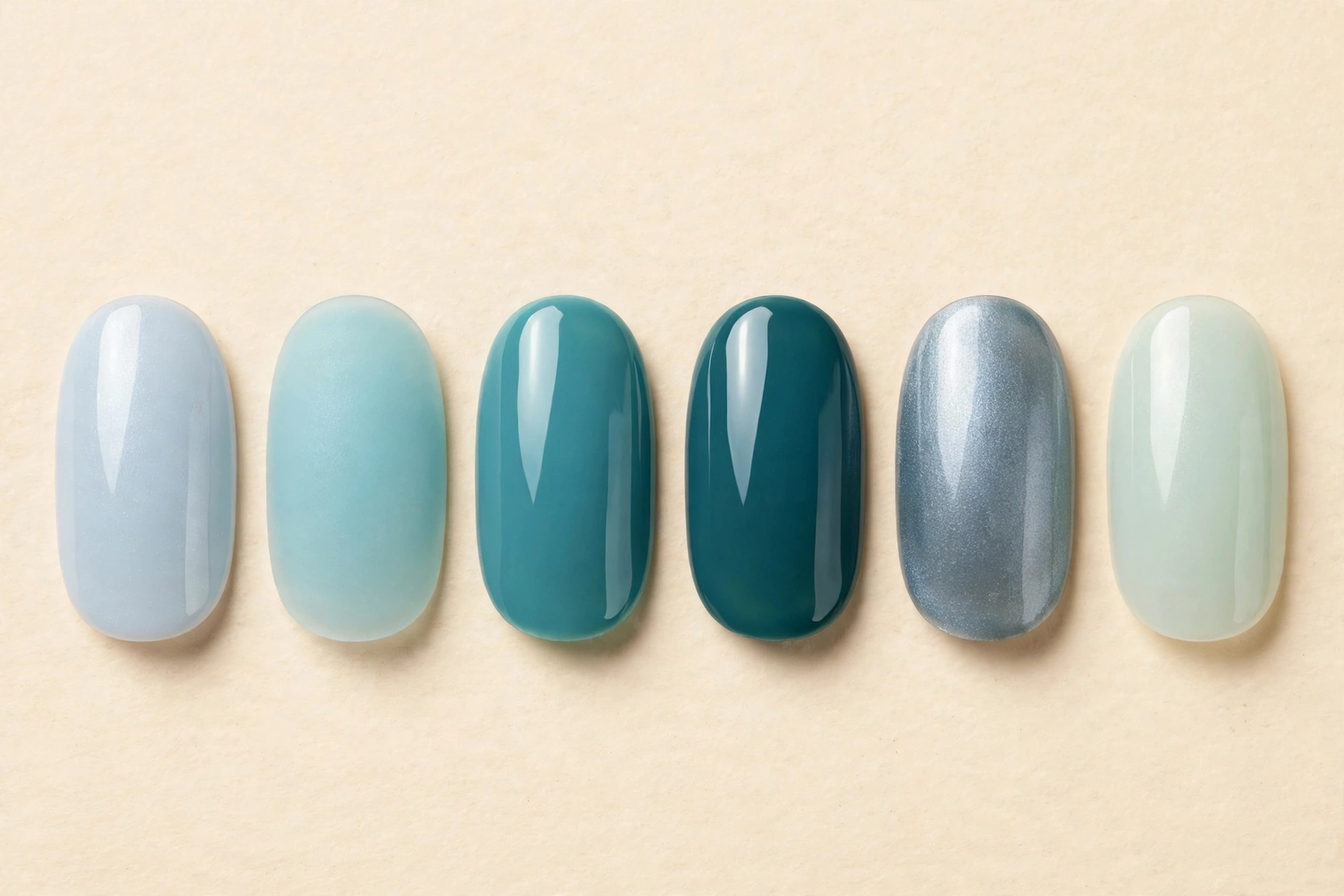
Glacier nails take their colour from ice itself: the pale blue of a frozen lake, the green-blue of deep glacial water, the silver-grey of frost on stone. Where most winter manicures lean warm and cosy, glacier nails stay cool and clear, and that coolness is exactly what makes them stand out in a season full of burgundy, chocolate, and deep red. The six shades below move from the palest icy blue to a deep sea green-blue, so the palette works whether you want a barely-there frost or a bold, jewel-toned statement.
What holds the palette together is the frosted finish. Every shade here has a cool, slightly luminous quality, like light passing through ice rather than sitting on top of it. That shared coolness means the shades blend beautifully with each other: a pale glacier blue next to a deep teal looks intentional, not mismatched, and a silver-grey accent ties the whole set together. Wear one shade alone for a clean winter manicure, alternate two or three across your nails, or build a gradient from palest to deepest across one hand for a look that genuinely resembles a glacier’s layers.
How to Use This Glacier Nails Palette
- Start with the range, not a single shade. The palette is designed to move from pale to deep, so pick your lightest and darkest shades first, then fill in the middle.
- Wear a single shade for a polished, low-effort winter manicure. Glacier Ice and Deep Fjord both look complete on their own, with no nail art needed.
- Try a gradient across one hand: Glacier Ice on the thumb, Frosted Aqua and Mint Frost in the middle, Crevasse Teal and Deep Fjord on the outer nails. The cool tones make gradients look smooth rather than stripey.
- Keep one accent nail in Silver Mist if the rest of the manicure is blue or green. The grey-silver tone acts like a neutral and stops the look from feeling too matchy.
- Match the shade depth to your skin tone. Paler frosted shades flatter fair and medium skin most easily, while deeper teals and sea blues glow on medium and deep skin.
- Keep the shape neat and the length short to medium. Frosted blue-green shades look crispest on almond, oval, or squoval shapes, where the cool colour stays clean at the edges.
- Pair the palette with winter neutrals: white, cream, charcoal, navy, silver jewellery, and soft grey knitwear. Cool shades sit happily next to all of them, and silver jewellery in particular brings out the frosted quality.
- Finish with a high-shine top coat. Gloss is what makes frosted shades look like ice rather than flat pastel paint, and it keeps pale blues from looking chalky.
1. Glacier Ice — #D8EAF2
Glacier Ice is the palest shade in the palette, a sheer-looking icy blue with a cool undertone and a high-gloss finish. It looks like the surface of a frozen lake on a bright morning: almost white, but with a definite blue cast that keeps it from reading as plain white. On the nail it is fresh, clean, and quietly striking, the kind of shade people notice without quite being able to name.
This is the shade to reach for when you want the glacier idea in its softest form. On fair skin, Glacier Ice gives a bright, frosty finish that looks polished and wintry, especially with a glossy top coat that keeps it luminous rather than flat. On medium skin, it provides a clean contrast that still reads clearly as blue, and it lengthens the fingers when worn on a neat almond shape. On deep skin, it stands out as a luminous pale accent, and it is especially striking as a single accent nail among deeper teals, or as the base for a thin silver stripe.
Wear Glacier Ice alone when you want a quiet, snowy manicure with a cool edge, or use it as the lightest shade in a gradient. It also makes an excellent base for a French tip with a teal tip, for a half-moon design, or for a simple silver dot accent at the cuticle. Because it is cool rather than warm, it flatters cool and neutral undertones best, but a glossy finish keeps it wearable for warm skin too, especially as an accent rather than a full set. If you usually wear white or milky shades in winter, Glacier Ice is the cooler, more distinctive cousin to try next.
2. Frosted Aqua — #A8D8D8
Frosted Aqua is a soft, mid-tone aqua with a balanced blue-green undertone and a frosted, satin-gloss finish. It sits right in the middle of the blue-green family: clearly green enough to feel different from a plain blue, clearly blue enough to stay icy rather than minty. On the nail it reads fresh, calm, and modern, like shallow glacial water over pale stone.
The balance of blue and green is what makes Frosted Aqua so wearable. It does not pull strongly warm or cool, so it suits more skin tones than most shades in this family. On fair skin, it gives a gentle wash of colour that looks fresh without overwhelming, and it pairs beautifully with silver jewellery and white knitwear. On medium skin, it sits as a clear, flattering aqua that brightens the hands and works well for everyday winter wear. On deep skin, it glows softly, a frosted aqua that shows up clearly and looks luminous rather than washed out, especially on a short, neat shape.
Wear Frosted Aqua to the office, to a winter lunch, or as an everyday shade when you want colour without a statement. It pairs beautifully with navy, charcoal, cream, and denim, and it looks especially good with a silver ring or bracelet. For a simple glacier gradient, try Frosted Aqua on most nails with Glacier Ice on the ring finger, or add a single Deep Fjord accent nail for depth. Readers who love this frosty, icy end of the winter palette will also enjoy our snowflake nails, which explore frosty white and icy blue shades in more depth, while Frosted Aqua stays firmly in the blue-green glacier story.
3. Crevasse Teal — #3F8F8B
Crevasse Teal is the true teal of the palette, a rich, mid-depth blue-green with a cool undertone and a glossy crème finish. It takes its name from the deep blue-green cracks in glacier ice, where the colour intensifies as the ice gets thicker, and on the nail it has that same depth: not a flat teal, but a shade with visible richness that shifts slightly between indoor and natural light.
This is the shade for anyone who wants the glacier palette to make a statement without going dark. On fair skin, Crevasse Teal gives a bold contrast that looks confident and polished, especially on a short squoval shape where the colour stays crisp at the edges. On medium skin, it reads as a jewel-toned teal that flatters beautifully and suits both daytime and evening wear. On deep skin, it is rich and harmonious, a teal that looks like it belongs in a winter wardrobe of navy, charcoal, and silver.
Save Crevasse Teal for occasions when you want your nails to carry the look: winter dinners, evening gatherings, a day out when the rest of your outfit is neutral. It pairs beautifully with silver and white gold jewellery, black, navy, and cream knitwear. It is also the best shade in the palette for a French tip over a Glacier Ice base, since the contrast between the pale base and the rich teal tip is sharp and clean. If you only buy one shade from this palette, and you like colour that still feels grown-up, make it this one.
4. Deep Fjord — #1F5F6B
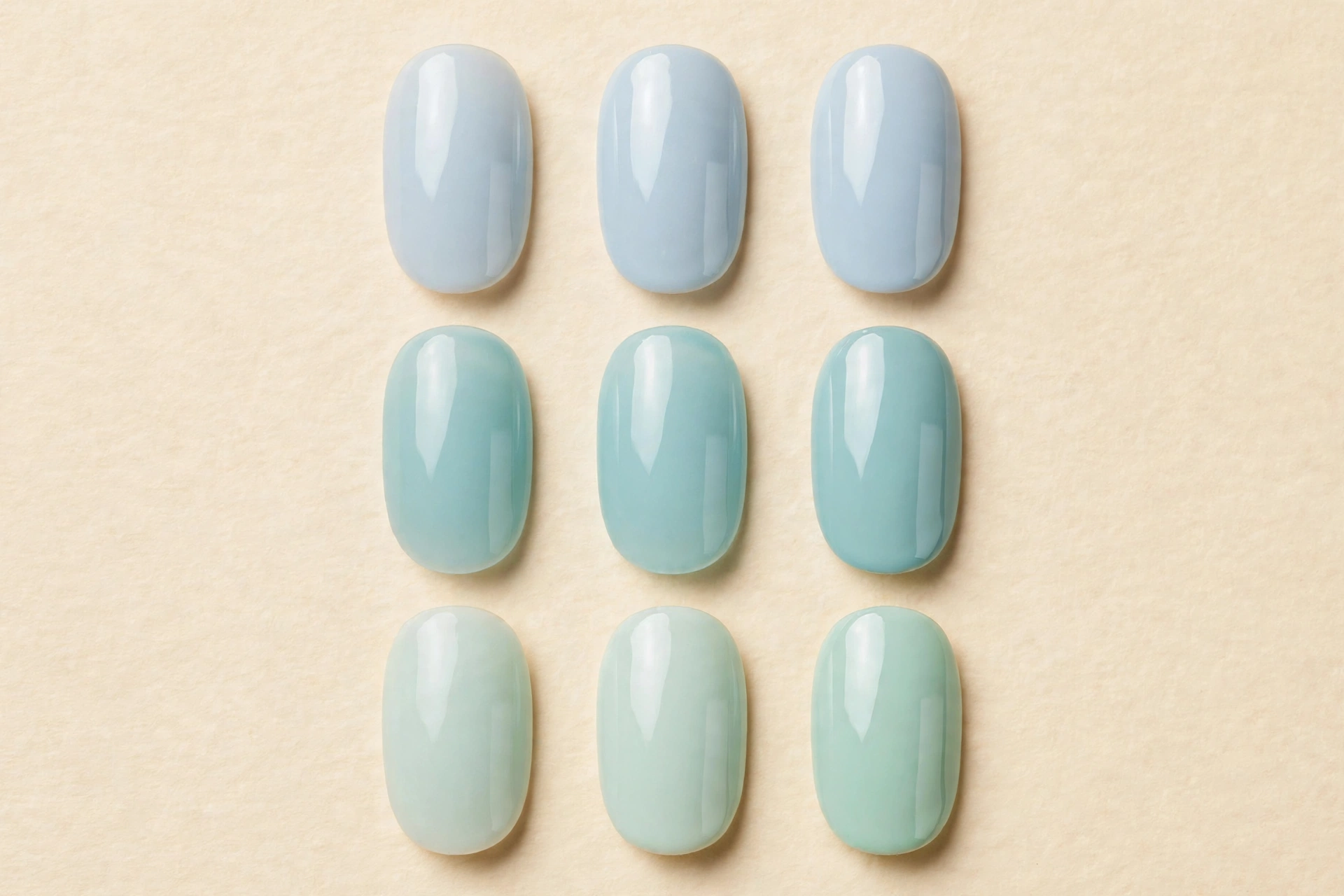
Deep Fjord is the darkest shade in the palette, a deep sea green-blue with a cool undertone and a high-gloss crème finish. It looks like the water in a Norwegian fjord in winter: dark, still, and green-blue rather than navy, with enough depth to read as a near-neutral from a distance and enough colour to surprise up close. On the nail it is sophisticated, moody, and quietly dramatic.
This is the shade for anyone who loves dark winter manicures but wants something beyond the usual burgundy or black. On fair skin, Deep Fjord gives depth and drama without the heaviness of black, and it looks especially elegant on a short almond shape. On medium skin, it reads as a deep, luxurious jewel tone that suits evening occasions beautifully. On deep skin, it is rich and glowing, a dark teal that stands out clearly and looks expensive rather than flat.
Wear Deep Fjord for winter evenings, for formal occasions, for a winter wedding guest look, and for any occasion where you want dark nails with more personality than black. It pairs beautifully with silver jewellery, black velvet, charcoal wool, and cream. It is also the most forgiving shade in the palette when it comes to chips, since a small chip on a dark shade shows less than on a pale frost. Readers drawn to this deeper, moodier end of the blue-green family will also enjoy our frosted nails, which explore sparkly winter shades in a similar cool direction, while Deep Fjord stays firmly in the smooth, glossy glacier story.
5. Silver Mist — #B9C9CC
Silver Mist is the palette’s neutral: a soft, silvery blue-grey with a cool undertone and a satin-gloss finish. It looks like frost settling on stone, or mist over cold water, and on the nail it reads calm, polished, and quietly elegant. It is the shade that ties the whole glacier palette together, because grey sits comfortably next to every blue and green here.
The grey undertone is what makes Silver Mist so useful. Pure blues and greens can feel like a commitment, but a blue-grey reads as a neutral with personality, and it suits almost everyone. On fair skin, it gives a soft, smoky finish that looks refined and modern, especially with silver jewellery. On medium skin, it blends into a polished grey-blue that lengthens the fingers and looks lovely with both silver and white gold. On deep skin, it works as a luminous cool grey that shows up clearly and looks fresh rather than dull, especially with a glossy top coat.
This is the shade to choose when you want the glacier idea without the colour commitment of a full blue-green set. Wear it alone for a polished winter neutral, pair it with Crevasse Teal as an accent nail for a balanced blue-grey look, or use it as the base for a thin teal stripe. It is also a lovely choice for the office, for a winter wedding, and for anyone who usually wears greys and taupes but wants something with a seasonal, frosty feel.
6. Mint Frost — #CDE8DC
Mint Frost is the softest green in the palette, a pale mint with a cool, frosted undertone and a glossy finish. It looks like mint leaves dusted with frost, or the palest green ice at the edge of a glacier, and on the nail it reads gentle, fresh, and quietly pretty. It is the shade that softens the whole palette, bringing a touch of green lightness to a family that could otherwise feel very blue.
What sets Mint Frost apart from a regular pastel mint is its coolness. A warm mint can look spring-like, but Mint Frost has a frosted, icy quality that keeps it firmly in winter. On fair skin, it gives a fresh, delicate finish that looks lovely with white and cream knitwear. On medium skin, it reads as a soft, flattering green that brightens the hands without shouting. On deep skin, it works as a luminous pale green accent, especially striking next to Deep Fjord or Crevasse Teal, where the contrast between pale and deep green is the whole point.
Wear Mint Frost alone when you want a gentle winter manicure, or use it as the lightest green in a gradient with Frosted Aqua and Crevasse Teal. It is also a beautiful choice for a French tip base, for a spring-transition manicure in late winter, and for anyone who loves green nails but finds deep greens too heavy for everyday wear. If the rest of the palette feels bold, Mint Frost is the easy entry point.
Glacier Nails for Every Skin Tone
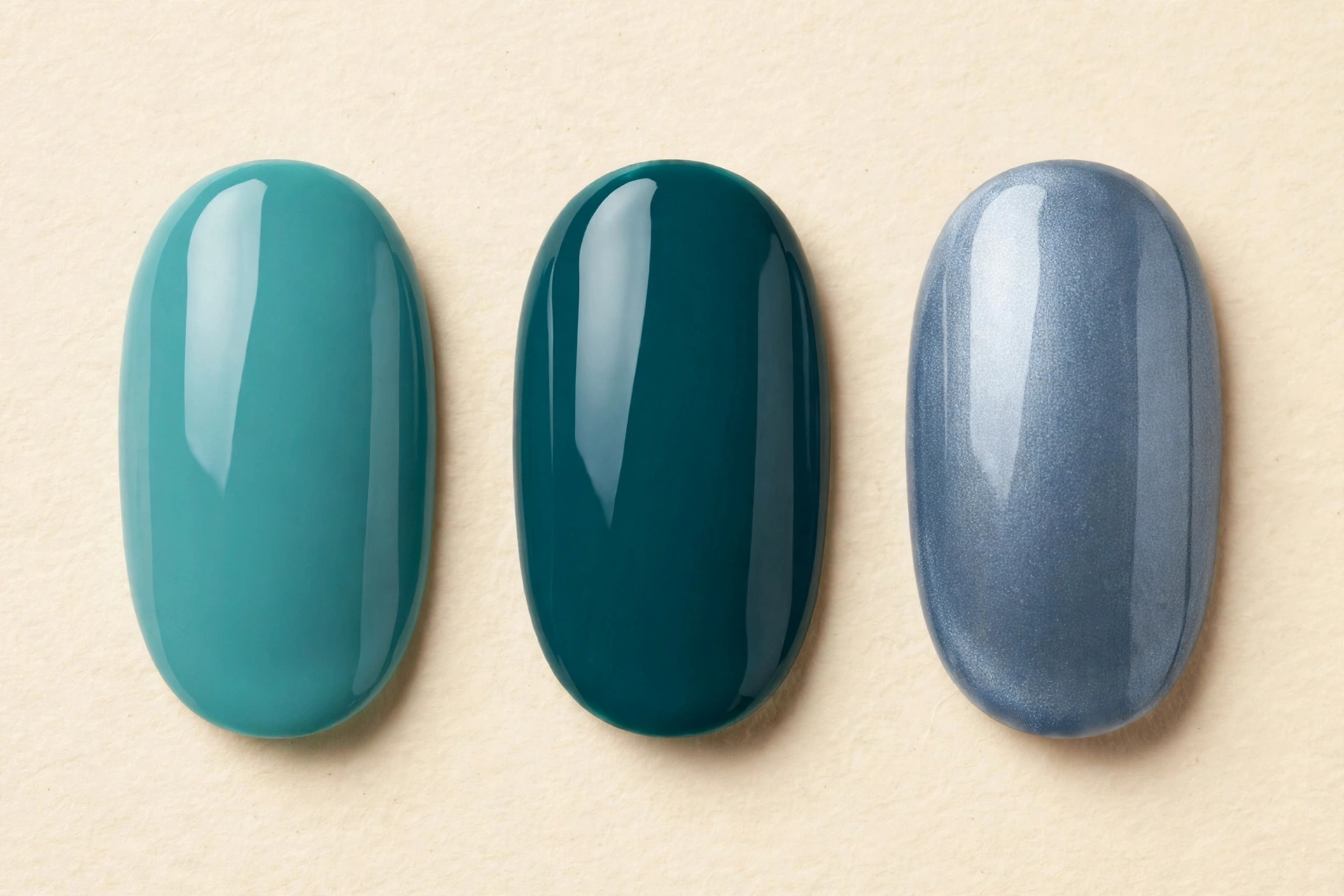
The advantage of a six-shade glacier palette is that nobody has to force a single icy blue or a single deep teal to work. Fair skin tends to shine in Glacier Ice, Frosted Aqua, and Mint Frost, where the frosted lightness is bright but balanced, with Silver Mist as the softer neutral option. Medium skin has the widest choice: Frosted Aqua, Crevasse Teal, and Deep Fjord all sit beautifully, with Silver Mist as the clean partner shade. Deep skin looks stunning across the whole range, but Crevasse Teal, Deep Fjord, and Glacier Ice as an accent are the standouts, offering colour that still reads clearly on the nail.
Undertone matters more than depth when you choose your glacier shade. If your veins look blue and silver jewellery suits you, you are cool-toned, and the entire palette is built for you, from Glacier Ice to Deep Fjord. If your veins look green and gold suits you, lean towards the greener shades: Frosted Aqua, Mint Frost, and Crevasse Teal, which have enough green to flatter warm skin. If you suit both metals, you are neutral, and the whole palette is open to you. When in doubt, hold the bottle against your hand in natural daylight rather than under shop lighting, which can make every blue-green look warmer or cooler than it really is.
Depth matters too. Pale frosted shades show chips and uneven application more easily, so they reward careful preparation, while deeper shades are more forgiving and more dramatic. If you are new to blue-green nails, start with Frosted Aqua or Silver Mist, which are the most forgiving middle shades, and work towards the palest and deepest ends of the palette as you get comfortable with the colour family.
Styling Ideas for Glacier Nails
Glacier nails are at their easiest when the rest of your look stays in the same cool winter world. White, cream, charcoal, navy, silver, and soft grey are natural partners, and silver jewellery works across the whole palette in a way gold sometimes does not with cool shades. A cream sweater with Crevasse Teal nails is a winter look that never fails. A charcoal coat with Deep Fjord nails looks intentional and polished. A white shirt with Glacier Ice nails is the clean, minimal outfit that still feels seasonal.
For texture, think knitwear, wool, cashmere, and satin. A chunky grey knit with Silver Mist nails looks soft and wintry. A satin blouse with Deep Fjord nails and silver earrings looks polished in a way that needs nothing else. And a navy coat with Frosted Aqua nails is the everyday winter outfit that still feels considered.
If you like nail art, glacier nails reward a light touch. A thin silver stripe on one or two accent nails is the design that suits this palette best, since silver echoes the frosted quality without competing with the colour. A teal French tip over a Glacier Ice base is a cool twist on a classic manicure. A single silver dot at the cuticle of a teal nail, or a delicate snowflake drawn on one accent nail, gives a hint of winter without turning the whole manicure into a craft project. Heavy glitter or busy patterns fight the clean, icy quality of blue-green shades, so let the colour be the statement and keep everything else quiet around it. Readers who love the jewel-toned end of this family will also enjoy our teal nails, which explore jewel teal shades beyond the frosted glacier palette.
Best Occasions for Glacier Nails
Glacier nails are genuinely hard to get wrong in winter, which is why they work across so many occasions. For everyday winter wear, Frosted Aqua and Silver Mist are the safest, most polished choices. For the office, Silver Mist on a short shape reads professional but interesting, provided the finish is glossy and the length is neat.
For winter evenings and parties, Crevasse Teal and Deep Fjord bring the drama, and Glacier Ice brings the frost. For winter weddings, whether you are a guest or in the wedding party, Silver Mist and Glacier Ice are elegant choices that photograph beautifully and do not compete with the outfit. For cosy weekends, Mint Frost and Frosted Aqua feel relaxed and fresh without trying too hard. And for the stretch between Christmas and New Year, when festive reds start to feel tired, a glacier manicure is the clean, cool reset that still feels seasonal. If you want a shade that carries from December straight through February, Deep Fjord is the one that never looks out of place.
Application and Longevity: Making Glacier Nails Last
Blue-green shades are among the least forgiving colours when it comes to application, so preparation matters. Start with clean, dry nails and a good base coat. Pale shades in particular show ridges and unevenness, so a ridge-filling base coat is worth using if your nail surface is uneven. A smooth base is what lets both pale frost and deep teal lie flat and look even, instead of pooling or streaking.
Apply two thin coats rather than one thick one, letting the first coat dry properly before the second. Thin coats level out more smoothly and are far less likely to bubble, which is the most common problem with pale polish. For gradients, work quickly while the polish is still slightly tacky at the edges, or use a makeup sponge for a smoother blend, and clean up the skin around the nail before the top coat. For stripes, wait until the base colour is fully dry before adding the stripe colour, and use a thin striping brush rather than the polish brush itself, which is too wide for a neat stripe.
A glossy top coat is essential for this palette: it deepens the teal, brightens the pale frost, adds the shine that makes frosted shades look like ice, and protects the manicure for longer. Reapply top coat every two to three days to keep the shine alive and delay chipping. Blue-green polish can also stain the nail slightly, so never skip the base coat, and remove dark shades with a soak rather than scrubbing. With those habits, a glacier manicure should comfortably last a full week, and a gel version two to three weeks.
Glacier Nails vs Other Icy Palettes: How to Choose
It is worth knowing how glacier nails differ from their icy neighbours, because cool winter shades are a crowded family. A plain icy blue manicure is a single colour story, usually pale blue alone, with no green depth to it. A frosted manicure leans on shimmer and sparkle for its winter feel, while glacier shades get their frost from cool undertones and glossy finishes rather than glitter. A mermaid manicure is iridescent and shifting, with pearl and chrome effects, while glacier nails stay smooth, creamy, and grounded in real ice colours.
Glacier nails are defined by the blue-green range and the frosted coolness across all six shades. That range is also what makes them so versatile: you can lean pale and icy with Glacier Ice and Mint Frost, soft and neutral with Silver Mist, or deep and jewel-toned with Crevasse Teal and Deep Fjord, all from the same six shades. When shopping, look for shade names that mention glacier, frost, ice, fjord, or aqua, and check the swatch in daylight before committing, since blue-greens shift more than most colours between shop lighting and natural light. Readers planning a full winter shade wardrobe will also enjoy our winter nail colors 2027, which round up the season’s wider winter shades alongside this palette’s frosted blue-green approach.
Polish and Gel Picks for Glacier Nails
For a classic glossy manicure, look for crème polishes in icy blue, aqua, and teal families: a pale icy blue polish for the lightest shades, a soft aqua polish for the middle of the palette, and a deep teal polish for the darkest end. Brands with strong blue-green ranges tend to label these as ice blue, aqua, glacier, fjord, or deep teal, so check the undertone description rather than the name alone, and choose a cool-toned shade rather than a warm turquoise for the glacier effect.
For gel, choose blue-green gel polishes in a similar range, applied over a clear gel base with a high-shine gel top coat. Gel is the better choice if you want two to three weeks of wear without chipping, especially in winter when hands are washed more often, and it is also the better choice for gradients, since gel gradients blend smoothly and do not drag the way wet polish gradients sometimes can. For a softer, more forgiving option, a sheer blue-tinted gel base gives a wash of icy colour that grows out gracefully, though it will not give the full glacier depth.
Whatever format you choose, keep a matching glossy top coat and a good base coat on hand. Glacier nails live or die by their shine and their clean edges, and a fresh top coat every few days is the simplest way to keep the colour looking salon-fresh between manicures. Avoid matte top coats on this palette unless you are deliberately going for a frosted-ice effect, since matte dulls the gloss that makes blue-green shades look like ice.
Frequently Asked Questions About Glacier Nails
What are glacier nails?
Glacier nails are a winter manicure built around frosted blue-green shades inspired by glacier ice: pale icy blue, frosted aqua, teal, deep sea green-blue, silvery grey, and pale mint frost. They can be as simple as a single shade worn alone, or as detailed as a gradient from palest to deepest across one hand.
When should I wear glacier nails?
Glacier nails are best worn through the winter months, from late autumn right through February. They are cool enough for everyday winter wear, elegant enough for winter weddings and evening occasions, and they make a clean, refreshing change from festive reds in the stretch between Christmas and New Year.
Which glacier shade suits my skin tone?
Pale frosted shades like Glacier Ice and Mint Frost suit fair skin beautifully, medium skin has the widest choice across Frosted Aqua, Crevasse Teal, and Deep Fjord, and deep skin looks stunning in Crevasse Teal, Deep Fjord, and Glacier Ice as a bright accent. For undertones, cool skin suits the whole palette, while warm skin should lean towards the greener shades like Frosted Aqua and Mint Frost.
How do I paint a neat glacier gradient?
Paint the lightest shade on one nail and the darkest on another, then use a makeup sponge to blend the middle shades, or simply alternate shades across your nails for a stepped gradient that is easier to execute. Work with thin coats, let each coat dry before adding the next, and clean up the skin around the nail before finishing with a glossy top coat. Keeping the gradient to one hand, or to accent nails only, also makes the design easier to wear.
Glacier nails are proof that winter colour does not have to be warm to be inviting. Six shades, one cool blue-green story, and a manicure that works for the office, the wedding, the winter evening, and every cold day in between. Pick your frost, pick your depth, keep the shine high, and let the ice do the rest.
The shades in this post are an inspiration palette: use the hex codes as a guide when choosing a polish, and expect small variations between brands, finishes, and lighting.