
Jewel tone nails are the holiday season’s richest manicure story. Every December the same three colors dominate — classic red, forest green, navy — but the real magic sits in the full jewel box: ruby, garnet, emerald, sapphire, amethyst, teal, turquoise, topaz, and every saturated stone shade in between. These are colors with depth built in, the kind that look like they glow from inside the nail, and they’re having a bigger moment than ever as gemstone-inspired beauty keeps trending. Below is a full 12-shade jewel tone nails chart so you can compare the whole family side by side, with six of the most wearable shades broken down in full detail — undertone, finish, who they flatter, and exactly where to wear them.
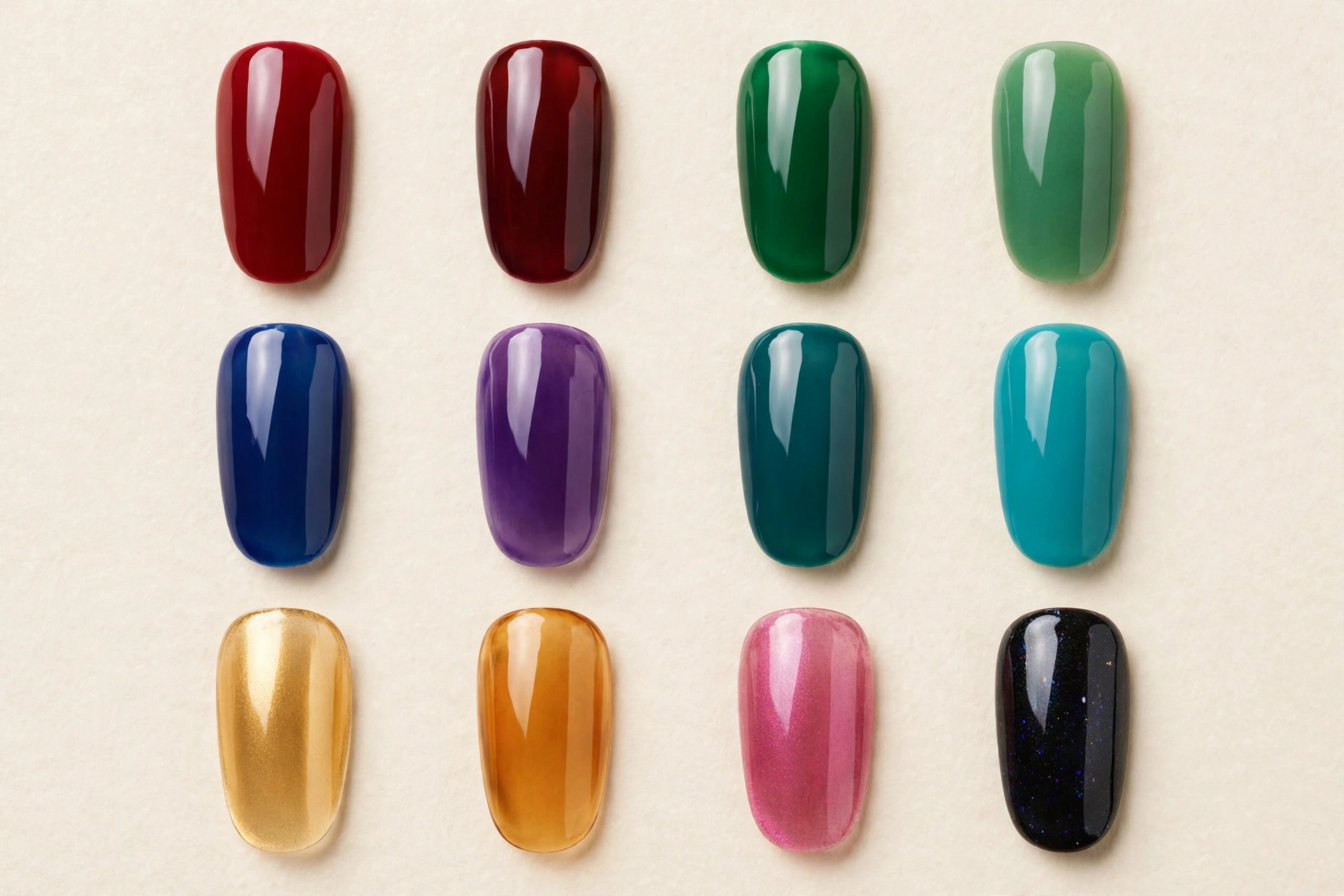
How to Use This Jewel Tone Nails Palette
- Pick your undertone family first. Jewel tones run warm (ruby, garnet, topaz, amber) and cool (emerald, sapphire, amethyst, teal). Warm and golden skin leans into the warm gems; cool and pink-undertoned skin leans into the cool ones; neutral skin gets to play the whole chart.
- Depth is your dial. The chart runs from bright, saturated stones (turquoise, topaz, pink tourmaline) to near-black depths (garnet, black opal, midnight sapphire). Lighter, brighter gems read festive and playful; the deepest shades read formal and expensive.
- Finish changes everything. The same ruby in a cream finish looks classic; loaded with fine shimmer it looks like a polished gemstone. If your shade feels flat on the nail, it’s usually a finish problem, not a color problem.
- Compare before you commit. Jewel tones shift dramatically between bottle, swatch, and nail. Hold the shade against your fingertip in daylight — the right one makes your skin look calm and even, not sallow or grey.
- Plan the occasion. Holiday parties want the high-drama stones; office wear wants the deepest, most muted ones worn on short, neat nails; New Year’s Eve can handle the brightest, shiniest picks in the box.
1. Ruby Red — #9B1B30
The queen of the jewel box: a true, saturated ruby with a clear blue-red undertone and a glassy, high-gloss cream finish. This is not a classic fire-engine red and not a wine — it’s the exact midpoint, with the kind of saturated depth that reads expensive from across a room. It flatters warm and neutral skin tones beautifully, and it’s one of the few reds that works across light, medium, and deep skin without washing anyone out — the blue undertone keeps it from turning orange on warm skin, while the depth keeps it from looking neon on fair skin. Best occasions: Christmas dinners, holiday parties, date nights, and any event where you want one color doing all the talking. Compared with Garnet in the chart (deeper, more wine-like, nearly black in low light), Ruby Red is brighter and more vibrant — pick Ruby when you want the gem to glow, Garnet when you want it to smolder. Next to a standard classic red polish, the difference is saturation and depth: Ruby has a polished-stone density that flat reds simply don’t. Wear it in two thin coats over a ridge-filling base; deep reds show every imperfection in the nail surface, and that base coat is what gives you the glass-smooth gemstone look. For the long-wear version, this is one of the best gel shades you can choose — dark, saturated creams cure evenly and chip far less visibly than pale ones. Pair it with gold jewelry and it sings; with silver it turns cooler and more dramatic. If ruby-adjacent reds are your lane, our garnet nails guide charts 12 January-birthstone shades that sit one step deeper and moodier on the same red-to-wine spectrum.
2. Emerald — #0F7B61
A rich, true emerald with a cool-leaning green undertone and a polished, mirror-gloss cream finish. This is the shade that made jewel tone nails a search trend in the first place — emerald manicures photograph like actual gemstones, with that unmistakable green that feels both festive and luxurious. It flatters warm and golden skin tones especially well, where the cool green creates a striking contrast that makes skin look warmer and more luminous by comparison; on very cool, pink skin it can pull slightly blue, so cool-toned wearers may prefer the slightly warmer Jade in the chart. Best occasions: holiday parties, winter weddings, New Year’s Eve, and office looks during December when you want festive without red. Compared with the Jade shade on the chart (lighter, softer, more leaf-like), Emerald is deeper, richer, and more formal — Jade is daytime, Emerald is evening. Compared with forest green polishes, Emerald is cleaner and brighter, with less of that murky olive undertone that can make greens read muddy. Two thin coats give full opacity; emeralds are pigment-heavy and level beautifully, so application is easier than the depth suggests. This shade also wears exceptionally well for a week-plus in gel, holding its glassy finish without the dulling that paler greens suffer. If you live in this color family, our emerald nails palette breaks down 12 jewel-green holiday shades with the same undertone-first detail.
3. Sapphire — #1E3A8A
A deep, royal sapphire with a strong blue undertone and a lustrous cream finish. This is the blue that reads as jewelry rather than as “blue nail polish” — dense, saturated, and dark enough to look almost black in dim light, then revealing its true blue in daylight or flash photography. It flatters cool and neutral skin tones gorgeously, where it harmonizes with pink undertones and silver jewelry; on warm, golden skin it creates a bold, high-contrast look that’s striking rather than clashing — just keep the nail shape neat, since high-contrast colors punish ragged cuticles. Best occasions: New Year’s Eve, winter formal events, evening parties, and December office wear when you want something darker than red but more interesting than black. Compared with the mid-tone blue on the chart’s row two, Sapphire is deeper and more formal — the lighter blue reads playful, Sapphire reads expensive. Compared with navy polishes, Sapphire has more vividness and life; navy can go flat and inky, while Sapphire keeps a gemstone glow even in low light. Deep blues are among the most forgiving dark shades to apply — they self-level well and hide brush strokes that would scream in a pale color. In gel, this is a workhorse: dark blues cure reliably and resist the tip-wear that shows on lighter shades. Our sapphire nails guide maps 12 jewel-blue winter shades from icy to midnight if you want to explore the whole blue-gem family.
4. Amethyst — #8A5FB0
A vivid violet-purple with a warm-leaning red undertone and a silky, luminous cream finish. Amethyst sits in the sweet spot of the jewel box: colorful enough to be interesting, deep enough to be elegant, and unusual enough that it doesn’t read as a generic holiday color. It flatters neutral and warm skin tones especially well — the red undertone keeps it friendly to golden skin — and on deep skin tones it looks absolutely regal, one of those shades that seems designed for rich complexions. Best occasions: holiday parties, winter date nights, February events (it’s the February birthstone), and anyone who wants festive color without doing red or green. Compared with the pink tourmaline shade on the chart (brighter, pinker, more playful), Amethyst is moodier and more sophisticated — tourmaline is the party, Amethyst is the after-party. Compared with standard purple polishes, Amethyst has more red and more depth; flat purples can look chalky or juvenile, while this reads like a cut stone. Purple creams can be slightly streaky in regular polish, so the two-thin-coats rule matters more here than for the reds and blues — and a glossy top coat is non-negotiable, since matte or dull amethyst loses the whole gemstone effect. In gel it performs beautifully, with the depth actually intensifying under the glossy cure.
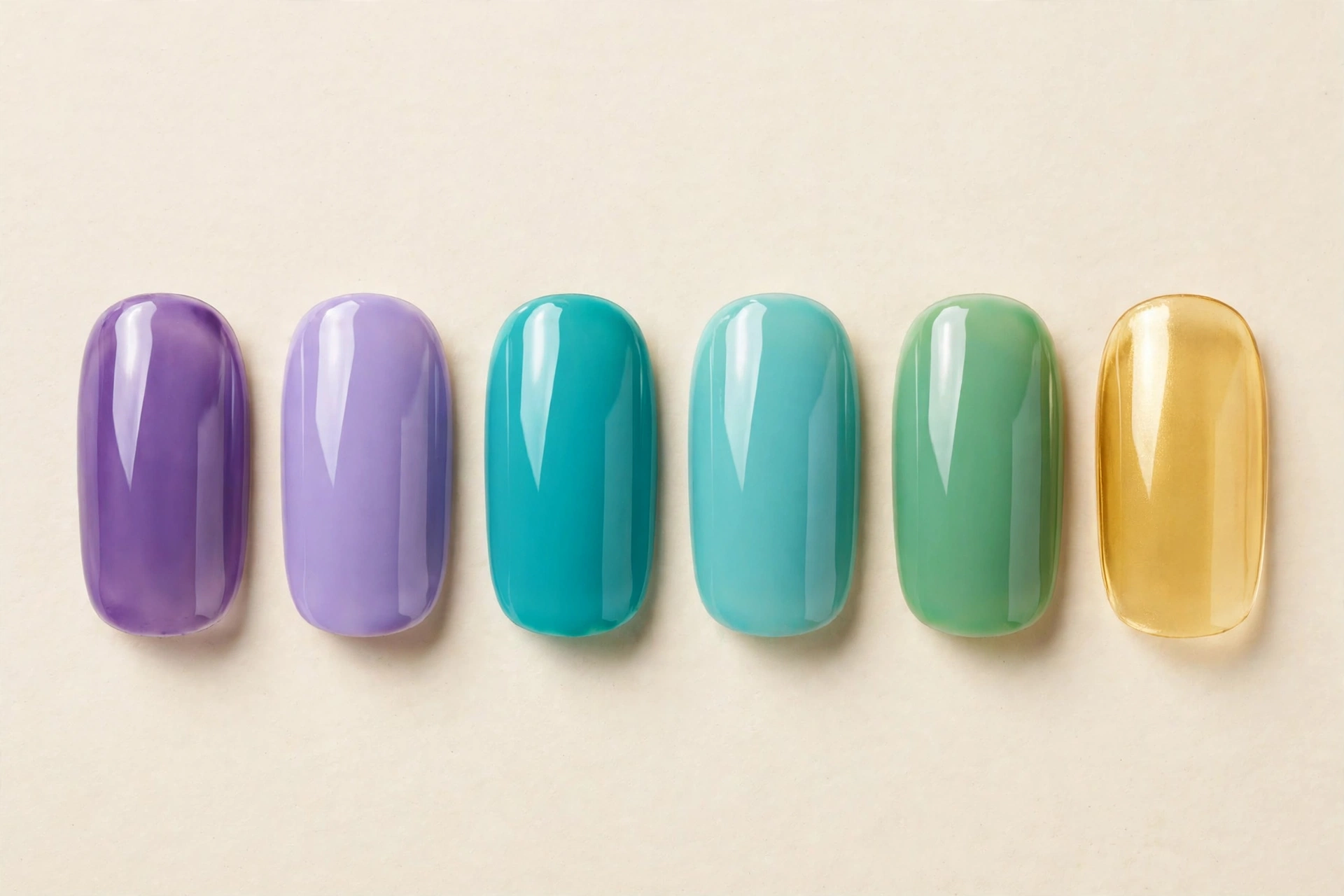
5. Teal — #1F8A8A
A saturated blue-green teal with a balanced cool undertone and a glassy cream finish. Teal is the jewel tone that surprises people — it’s less expected than emerald, less common than sapphire, and it has a modern, almost peacock quality that makes a manicure look instantly current. It flatters cool and neutral skin tones best, where the blue-green reads crisp and clean; on very warm skin it can pull slightly green, so warm-toned wearers should look for the slightly bluer teal in the chart or wear it on shorter nails where the effect is subtler. Best occasions: winter parties, New Year’s Eve, creative workplaces in December, and anyone who wants a jewel tone that doesn’t scream “holiday” — teal works straight through January and February without feeling seasonal. Compared with the turquoise shade on the chart (brighter, lighter, more tropical), Teal is deeper, more formal, and more winter-appropriate — turquoise is summer’s jewel, teal is winter’s. Compared with emerald, teal is bluer and cooler, with a more contemporary feel; emerald is the classic, teal is the update. Teals apply beautifully — the pigment density means two thin coats give full, even coverage with minimal streaking. This is also one of the best jewel tones for nail art accents: a teal base with a thin gold line or a single glitter accent nail looks intentional and expensive rather than busy.
6. Golden Topaz — #D4A017
A rich, honeyed gold-yellow with a warm amber undertone and a radiant cream finish. Topaz is the wildcard of the jewel box — the only warm, light jewel tone in a family of deep, cool stones — and that’s exactly what makes it so useful. It flatters warm and deep skin tones spectacularly, where it reads like actual gold jewelry on the nails; on fair, cool skin it works best as an accent or on shorter nails, where the warmth becomes a feature rather than a clash. Best occasions: New Year’s Eve, holiday parties with gold accessories, Thanksgiving-week manicures, and as the accent shade in any jewel-tone combination — one topaz nail among ruby or emerald is a classic. Compared with the amber shade on the chart (deeper, more orange-brown, more subdued), Golden Topaz is brighter and more golden — amber is the cozy firelight version, topaz is the champagne version. Compared with metallic gold polishes, Topaz has more color and depth; metallics can look flat or brassy, while a cream topaz reads like a polished gemstone. Yellows and golds are the trickiest jewel tones to apply evenly, so this is the shade where a ridge-filling base and truly thin coats matter most — three very thin coats beat two medium ones here. In gel, golden shades hold their vibrancy exceptionally well and resist the fading that sunlight can cause in regular polish. Topaz also makes the perfect bridge shade: it pairs with every other jewel tone on this chart, which makes it the ideal choice for mismatched or accent-nail designs.
Jewel Tone Nails vs. Classic Holiday Reds and Greens
Here’s the question worth asking: why go jewel tone when classic holiday red already exists? The answer is depth and range. A classic red is a single note — beautiful, but one-dimensional. Jewel tone nails give you the same festive register with actual variety: ruby’s glow, emerald’s richness, sapphire’s drama, amethyst’s mystery, teal’s modernity, topaz’s warmth. You can match the shade to the outfit, the event, and your mood instead of defaulting to the same red every December.
There’s also a wearability argument. Classic bright reds can feel loud in daylight and harsh against certain skin tones. Jewel tones, by contrast, have built-in depth — they’re saturated but not neon, rich but not flat — which makes them flattering across a wider range of skin tones and lighting conditions. A deep garnet at brunch looks intentional; a fire-engine red at brunch can look like last night’s party followed you home. And for anyone building a holiday nail wardrobe rather than a single look, the jewel family is designed to mix: ruby and topaz, emerald and gold, sapphire and silver — these are the pairings that make December manicures look styled instead of painted.
Styling Tips for Jewel Tone Nails
Jewel tones are statement colors, so the styling around them should support rather than compete. A few rules that keep the look expensive:
- Let the nails be the jewelry. When your manicure is this saturated, scale back rings and bracelets — one simple band or a delicate bracelet is plenty. The nails are doing the accessorizing.
- Match your metals. Warm gems (ruby, garnet, topaz, amber) pair with gold; cool gems (emerald, sapphire, amethyst, teal) pair with silver or platinum. This isn’t a hard rule, but it’s the fastest way to make a jewel manicure look cohesive.
- Keep the shape clean. Almond and oval shapes flatter jewel tones best — the tapered shape echoes a cut gemstone. Very long stilettos can push deep jewel tones into costume territory; short squoval keeps them office-appropriate.
- Cuticle work matters more. Dark, saturated colors show every ragged edge. Push back and tidy cuticles before you paint — with jewel tones, the prep is half the manicure.
- Try the single-stone accent. One nail in a contrasting jewel (topaz with emerald, amethyst with sapphire) or a thin metallic stripe reads as intentional design, not indecision. Keep it to one or two nails.
- Gloss is the whole point. Jewel tones live and die by their shine — a gemstone without luster is just a rock. A fresh glossy top coat every few days keeps the depth alive for the full week of wear.
Getting the Gemstone Finish: Application and Longevity
The difference between a jewel tone manicure that looks like polished stones and one that looks like ordinary dark polish comes down to finish work. Start with a ridge-filling base coat — deep, saturated colors magnify every ridge and imperfection in the nail plate, and a smooth canvas is what creates that glassy, cut-gem surface. Apply two genuinely thin coats rather than one thick one; jewel-tone pigments are dense and self-level well, but a thick coat pools at the cuticle and takes forever to dry, which is how you get dents and bubbles in dark colors.
Cap the free edge on every layer — base, both color coats, and top coat. Dark colors chip more visibly than pale ones, and wrapping the tip is the single biggest factor in getting a full week of wear. Apply your glossy top coat while the final color coat is just tacky, not fully dry; this melts the layers together and produces the deep, wet-looking gloss that sells the gemstone effect. If you want extra dimension, a second layer of top coat on day three refreshes the shine and adds chip protection.
For gel wearers, jewel tones are one of the best families to choose. Dark, saturated gels cure evenly, resist tip wear, and hold their gloss for two to three weeks without the dulling that affects pale shades. Cure each thin layer fully — under-cured dark gel can wrinkle, and the depth of jewel tones makes any texture issue visible. One caution: the darkest shades (garnet, black opal, midnight sapphire) can stain the nail plate, so never skip the base coat, and consider a slightly longer soak-off if you see staining after removal.
Removal deserves a mention too. Deep jewel tones — especially ruby, garnet, and emerald — bleed pigment during removal. Use the foil-and-soak method rather than scrubbing, and expect to need a second cotton pad. A quick swipe of cuticle oil after removal restores moisture that acetone strips away.
Best Occasions for Jewel Tone Nails
Jewel tones are the rare color family that covers the entire holiday calendar without repeating itself:
- Christmas Eve and Christmas Day: Ruby Red or Garnet — the classic holiday register, but with gemstone depth instead of flat red.
- Holiday office parties: Emerald or deep Sapphire on short, neat nails — festive, polished, and professional.
- New Year’s Eve: Sapphire, Teal, or Golden Topaz — the night calls for drama, shine, and a little sparkle-friendly depth.
- Winter weddings: Amethyst or Emerald — rich enough for evening formality, unusual enough to feel personal rather than themed.
- Date nights through December: Ruby or Amethyst — both flatter candlelight and low lighting beautifully.
- Thanksgiving week: Golden Topaz or Amber — warm, golden, and perfectly in tune with the season’s palette.
- Everyday December wear: Teal or the chart’s Jade — jewel tones that read as color without reading as costume.
For the full holiday picture beyond the jewel family, our Christmas nail colors guide charts 30 festive shades — reds, greens, metallics, and glitters — so you can see exactly where these jewel tones sit in the season’s bigger palette.
Polish and Gel Picks
Regular polish picks: OPI Malaga Wine. OPI Lincoln Park After Dark. Essie Bordeaux. Essie Off Tropic. Sally Hansen Emerald. Zoya Blaze. Olive and June Ruby.
Gel picks: Beetles Deep Red Gel. Beetles Emerald Green Gel. Modelones Sapphire Blue Gel. DND Amethyst Gel. OPI Teal GelColor. Beetles Golden Topaz Gel.
Inspiration-Palette Disclaimer
These are inspiration shades charted as swatch art: the hex codes are approximations of how each jewel tone reads on the nail, not exact product matches. Take the chart to your nail tech, name the undertone and depth you want, and they will match the closest real-world shade.
Frequently Asked Questions
What are jewel tone nails?
Jewel tone nails are manicures built on the rich, saturated colors of gemstones — ruby red, emerald green, sapphire blue, amethyst purple, teal, topaz, garnet, and similar deep, vivid shades. They’re defined by depth and saturation rather than brightness: the colors look like they glow from inside the nail, the way a polished stone catches light.
Which jewel tone nail color is best for the holidays?
Ruby red and emerald green are the two most classic holiday jewel tones — they read festive instantly. For something less expected, sapphire blue and deep garnet both photograph beautifully at evening events, and golden topaz is the perfect warm accent. If you want one shade that covers the whole season, ruby is the safest pick: it works for Christmas, New Year’s Eve, and everything between.
Do jewel tone nails suit warm or cool skin tones?
Both — that’s the advantage of a whole family over a single shade. Warm and golden skin tones shine in the warm gems (ruby, garnet, golden topaz, amber), while cool and pink-undertoned skin flatters the cool gems (sapphire, emerald, amethyst, teal). Neutral skin tones can wear the entire chart. When in doubt, hold the shade against your fingertip in daylight: the right jewel tone makes your skin look calm and even.
How do I make jewel tone nails look expensive instead of flat?
The secret is finish, not color. Start with a ridge-filling base coat for a glass-smooth surface, apply two thin coats, cap the free edge on every layer, and finish with a high-gloss top coat applied while the color is still tacky. A gemstone without luster is just a rock — the wet-looking gloss is what separates a jewel tone manicure from ordinary dark polish. Refresh the top coat on day three to keep the depth alive all week.