
Not quite black nails are the answer to the oldest dark-manicure problem: full black is striking, but it can read flat, harsh, or simply too much for everyday wear. This chart collects twelve shades that look almost black from a distance but reveal a hidden undertone — plum, cherry, espresso, blue, olive — the moment light hits them.
The secret of the almost-black shade is that it keeps everything you like about black nails — the edge, the drama, the way dark polish makes your whole outfit look intentional — while quietly removing the heaviness. A pure black nail has no depth; it absorbs light and gives nothing back. An almost-black with a plum or espresso undertone has somewhere for the light to go, which means it flatters your skin instead of sitting on top of it. That one detail is why these shades work on people who have always said “I can’t wear black nails.”
If you have never worn anything this dark, do not start with all ten in Ink Black. Pick one accent nail per hand — the ring finger is the classic — in a softer option like Black Cherry or Espresso Black, and keep the rest in a shade you already wear. Dark colors show every chip and every uneven cuticle, so this test run also tells you honestly whether your wear time and maintenance habits can carry a near-black before you commit to the full set.
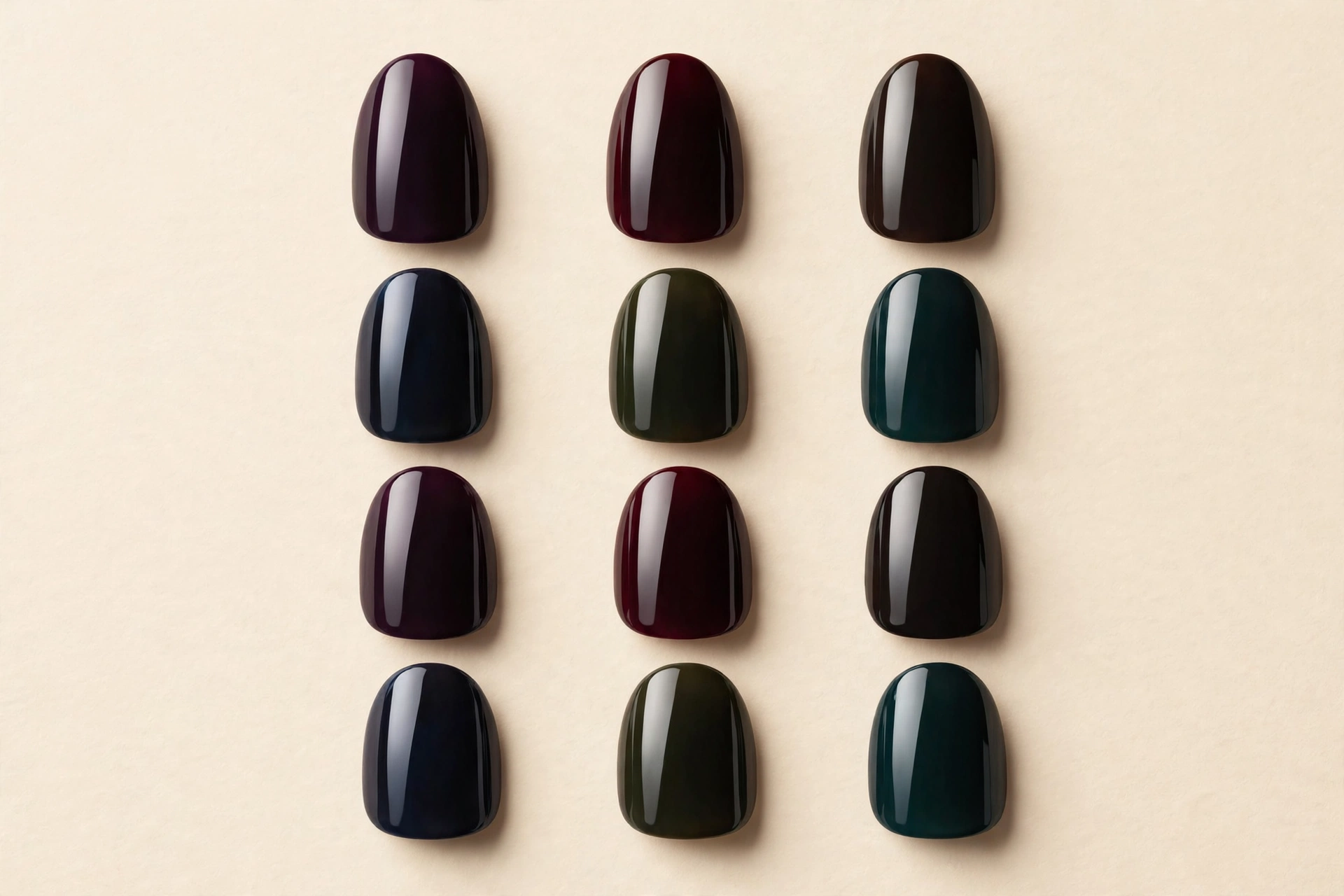
How to use this palette
- Screenshot this post and bring it to your appointment — pointing at a swatch is faster than trying to describe “black but with a hint of purple” from memory.
- Decide your undertone family first: warm (cherry, espresso, bronze) or cool (plum, blue, teal), because mixing a warm black with a cool black on the same hand can look accidental.
- Apply two thin coats rather than one thick coat — almost-blacks show brush strokes and pooling more than mid-tone shades do.
- Always use a ridge-filling or smoothing base coat: near-black magnifies every ridge and uneven edge on the nail plate.
- Match the finish to the depth: a glossy top coat shows off the hidden undertone, while matte makes all twelve look closer to true black.
- These shades grow out visibly, so if you are between appointments, keep the length short to medium — our office-friendly shades chart has the same low-maintenance logic applied to subtler colors.
One decision shapes the whole manicure: gel or regular polish. Gel is the practical default for near-blacks — the color goes on evenly in two coats, the glossy finish holds the undertone for two to three weeks, and dark gel hides tip wear better than light colors do. Regular polish absolutely works, but expect five to seven days of clean wear before the edges show it, and plan a fresh top coat mid-week to keep the depth. Cuticle oil is not optional with dark shades: dry cuticles next to an almost-black nail draw the eye straight to the ragged edge, so oil nightly and the whole manicure reads as deliberate.
Not quite black nails: 12 almost-black shades, charted
Wine-tinged almost-black shades
Midnight Plum #1F1526 — the deepest plum you can get before a nail reads purple. Indoors it looks like black; in sunlight it glows wine-dark red-purple at the edges. Flatters fair and light skin beautifully — the red undertone warms up cool pale complexions — and on deep skin it reads rich and dramatic rather than heavy.
Black Cherry #1E1216 — black with a crushed-cherries core. This is the warmest shade on the chart and the best entry point if you have never worn dark nails, because it registers as “deep red” more than “near black.” Flatters medium and warm olive skin tones especially well; on fair skin it is bold but wearable.
Raisin Black #201419 — the softest of the wine family, like a raisin held up to the light. It has more brown than the other two, so it is the most forgiving near-black for beginners — chips and imperfect edges show less here. Flatters deep skin tones gorgeously and works on fair skin that wants drama without severity.
These three are the natural stepping stones from red or burgundy into dark territory. Midnight Plum is the coolest and most formal of the trio, the one to reach for with evening outfits and black clothing. Black Cherry is the crowd-pleaser — it looks almost-black in office lighting and reveals its warmth at dinner, which makes it a perfect date-night shade. Raisin Black is the quiet one: the safest everyday almost-black on the entire chart, and the least demanding about perfect application.
The three: Midnight Plum #1F1526, Black Cherry #1E1216, Raisin Black #201419
Polish pick: a black-cherry crème polish with a glassy finish.
Gel pick: a deep plum-black gel sealed with a high-shine top coat.
Warm espresso and olive near-black nails
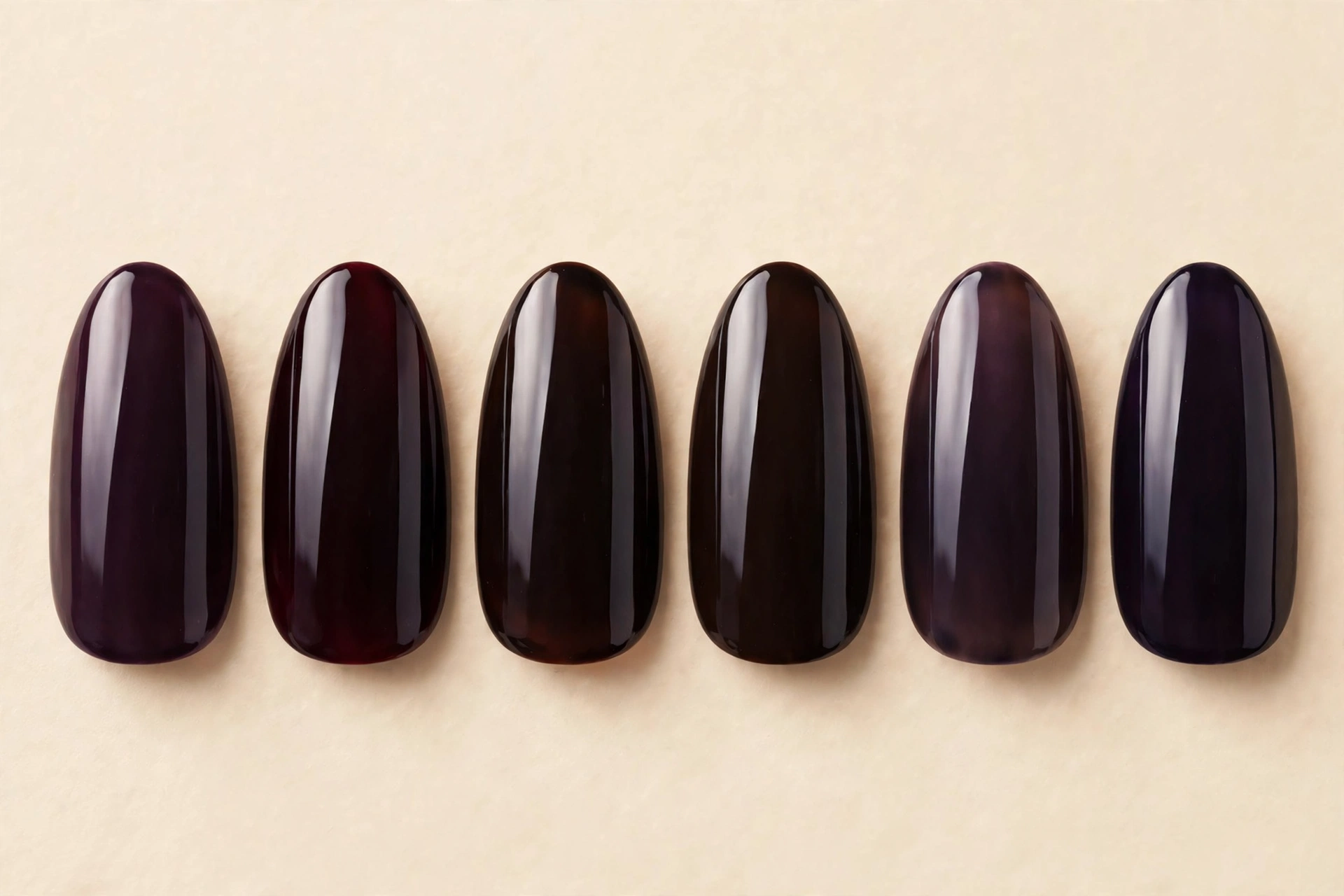
Espresso Black #1C1512 — black coffee in nail form, the brown-black that started the whole not-quite-black trend. Under fluorescent light it looks black; in daylight the warm brown shows through. Flatters warm and medium skin tones like it was made for them, and on fair skin it is softer and more approachable than any cool black.
Blackened Bronze #1E1710 — espresso with a metallic whisper. The bronze undertone is barely there in the bottle but catches golden light on the nail, giving it a richness the other shades lack. Flatters deep skin tones spectacularly and adds warmth to light skin that can look washed out against flat black.
Black Olive #1B1E17 — the wildcard: black with a green undertow. It sounds strange, but on the nail it reads as the most natural almost-black here — earthy, grounded, almost like the color of dark bark. Flatters warm olive undertones beautifully and looks surprisingly neutral on fair skin.
This is the warm family, and it is the right place to start if cool blacks drain you. Espresso Black and Blackened Bronze are cousins — choose espresso for daytime neutrality and bronze when you want a hint of shimmer without committing to glitter. Black Olive is the insider pick: green-undertone blacks are having a quiet moment, and this one pairs with olive clothing and gold jewelry in a way no other shade on the chart can. If your jewelry box is mostly gold rather than silver, shop this group first.
The three: Espresso Black #1C1512, Blackened Bronze #1E1710, Black Olive #1B1E17
Polish pick: an espresso-black crème with a subtle satin finish.
Gel pick: a bronze-tinged black gel for extra depth under glossy top coat.
Cool blue and teal black nail shades
Ink Black #101318 — the darkest, bluest shade on the chart, like a fountain-pen inkwell. This is the one to wear when you want the drama of black with just a whisper of something else — from across the room it reads black, but up close the blue keeps it from looking flat. Flatters cool and fair skin tones; on warm skin it can look stark, so wear it with silver jewelry to tie it together.
Coal Blue #131A24 — midnight blue pushed so dark it barely qualifies as blue anymore. If you have ever loved navy nails but found them too blue for fall, this is your shade — the blue is there, but only as depth, not as color. Flatters light and medium skin tones and is the most professional of the cool family.
Blackened Teal #121E1E — the green-blue middle ground, like deep seawater at night. This one reads the most “colored” of the cool group — there is no mistaking it for true black in good light — which makes it the best choice if you want an almost-black that still feels like a color. Flatters cool undertones and looks striking on deep skin.
The cool family is where almost-blacks start to feel like colors again, and that is their advantage. Ink Black is the purist’s choice — maximum drama, minimum fuss — but it is the least forgiving shade on the chart, so application has to be clean. Coal Blue is the most wearable of the three for daytime; it reads as a “color” in the office and an almost-black at night. Blackened Teal is the conversation piece, and it takes beautifully to a magnetic cat-eye finish if you want extra dimension — our velvet magnetic shades chart shows how that finish adds depth over dark bases.
The three: Ink Black #101318, Coal Blue #131A24, Blackened Teal #121E1E
Polish pick: a blue-black crème with a mirror-gloss finish.
Gel pick: a magnetic cat-eye gel in a deep blue-black.
Soft black and onyx nail colors
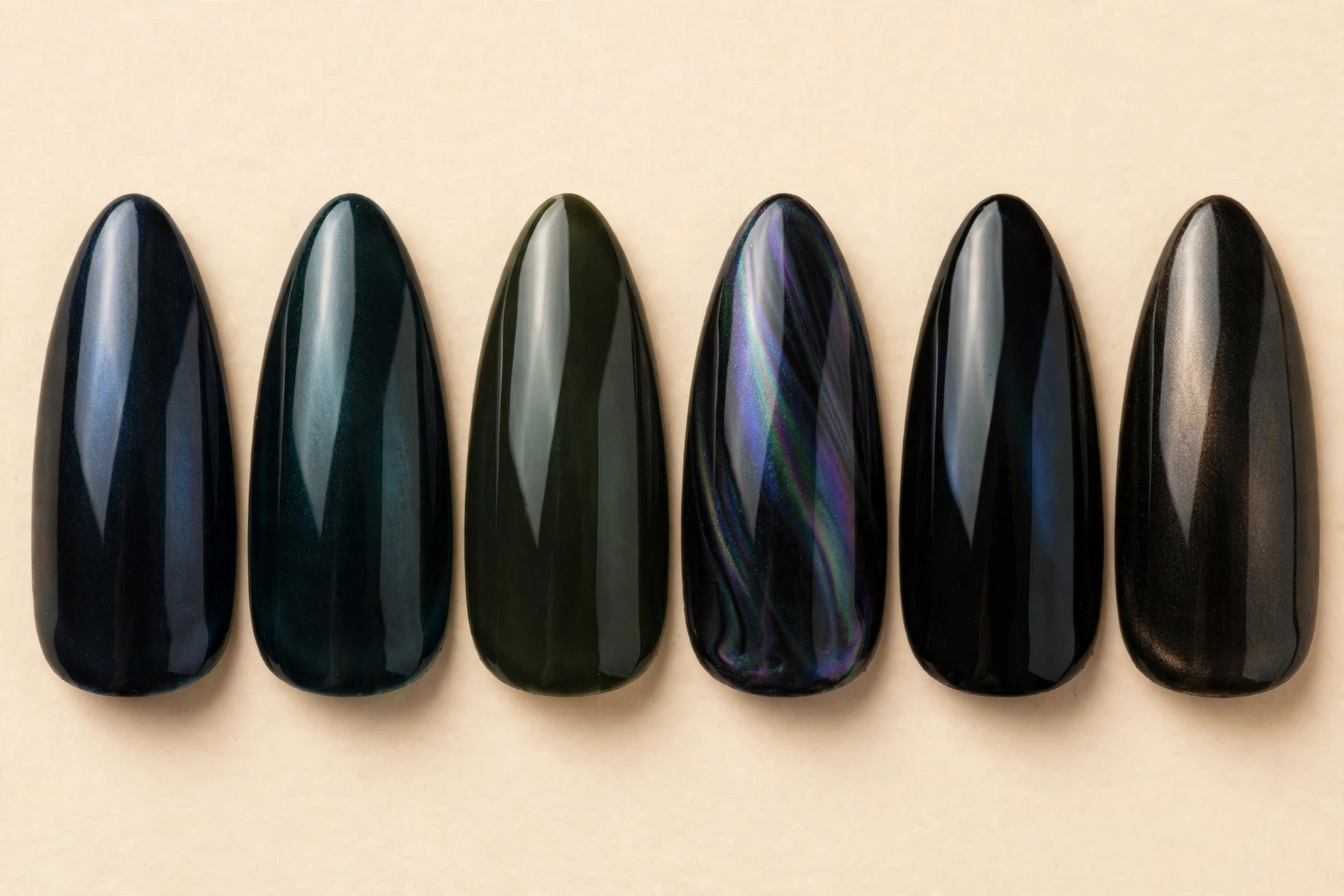
Oil Slick Black #16181D — the everyday black: neutral, deep, with no strong pull toward warm or cool. Named for the way it shifts almost imperceptibly in different lights, this is the shade for anyone who wants black nails without committing to the severity of a true black. Flatters every skin tone because its undertone is so balanced.
Almost Onyx #141114 — a true onyx stone look: black with the faintest violet-gray breath. It is the softest-reading shade on the chart, the one least likely to startle anyone who knows you as a nude-polish person. Flatters fair skin that finds pure black too harsh and reads elegantly on deep skin.
Smoked Aubergine #221A24 — purple-brown-black, like smoke over a plum. This is the moodiest shade here — warm enough to wear with brown boots and gold jewelry, dark enough to count as an evening nail. Flatters medium and deep skin tones best, where the aubergine undertone glows rather than disappearing.
These three are the safety net of the chart — the shades to pick when you want near-black but zero risk. Oil Slick Black is the universal donor: if you are buying one bottle from this post, make it this one. Almost Onyx is the best almost-black for people with short nails or conservative workplaces, since it reads as the least aggressive. Smoked Aubergine is the fall-est shade on the chart — it matches leather boots, wool coats, and plum lipstick in a way the truer blacks cannot, so save it for October and November.
The three: Oil Slick Black #16181D, Almost Onyx #141114, Smoked Aubergine #221A24
Polish pick: a neutral soft-black crème with a glossy top coat.
Gel pick: a black gel finished with one sheer plum coat for the aubergine depth.
Styling tips for not quite black nails
Almost-blacks are strong colors, so styling is about what you pair them with — the shades do the talking, and everything else should support them. Gold jewelry warms up the whole manicure and looks best with the warm family (Espresso Black, Blackened Bronze, Black Olive, Black Cherry); silver jewelry cools it down and suits the cool family (Ink Black, Coal Blue, Blackened Teal, Midnight Plum). If you mix metals, stick with the neutral shades — Oil Slick Black, Almost Onyx, Raisin Black — which sit happily with both.
Nail shape matters more with dark shades than light ones. Almond and oval shapes keep almost-blacks elegant; the tapered shape softens the edge of the color so it reads as fashion rather than statement. Square and coffin shapes make the same shades read bolder and more editorial — great for events, heavier for the office. Short nails are the easiest canvas for almost-blacks: the color stays fun instead of dramatic, chips show less, and grow-out is less obvious. If you are wearing them long, keep the application immaculate, because dark polish on long nails has nowhere to hide.
For outfits, treat your almost-black nails like a neutral with an opinion. They pair with everything black pairs with — gray, camel, cream, denim — plus one bonus: because each shade has an undertone, you can echo it in your outfit. Black Cherry nails with a burgundy scarf, Espresso Black nails with brown boots, Coal Blue nails with a navy coat. The monochrome-plus-undertone trick makes the whole outfit look deliberately styled rather than just dark.
Texture pairings work well too. A glossy almost-black against matte fabrics (wool, suede, knit) creates contrast that makes the nails pop; against patent leather or silk, the nails blend into a sleek all-gloss look. Matte nails against matte fabric can disappear entirely, so if you go matte, wear it with something that has a sheen.
Best occasions to wear almost-black nails
Almost-blacks are evening naturals. Dinners, concerts, holiday parties, and any event with warm low lighting are where the hidden undertones perform — a Black Cherry or Smoked Aubergine that looked nearly black in the office reveals its depth under restaurant lighting, which is exactly the effect you want. They photograph beautifully in the evening too, since the glossy finish catches light that flat black would swallow.
For formal occasions, almost-blacks are the safe edge: dramatic enough to feel special, dark enough to suit formal dress codes. Midnight Plum and Ink Black work with black-tie outfits without disappearing against a black dress, and Almost Onyx is formal without competing with jewelry. Fall weddings are a natural home for this palette — Smoked Aubergine and Espresso Black suit autumn florals and brown leather details in a way true black never quite manages.
Daytime wear depends on the shade, not the palette. Espresso Black, Raisin Black, and Almost Onyx are the daytime-friendly trio — dark enough to be interesting, soft enough not to dominate a meeting. The bolder picks (Ink Black, Coal Blue, Midnight Plum) work for daytime if the rest of your look is simple; dark nails plus a busy outfit reads chaotic before noon. One occasion to think twice about: anything where your hands will be photographed in harsh close-up daylight, like holding flowers at an outdoor daytime wedding — very dark shades can read as pure black in bright sun and lose the undertone detail that makes them special. For those days, choose Black Cherry or Blackened Bronze, which keep their warmth in any light.
Seasonally, this is a fall and winter palette at heart — the moody depths suit dark clothing and short days. But do not shelve it in spring: Blackened Teal and Black Olive work surprisingly well with spring brights, and a single almost-black accent nail can ground an otherwise pastel manicure.
Finish, longevity, and application tips
The finish you choose changes an almost-black more than the shade itself does. High gloss is the default for a reason: it shows off the hidden undertone and makes the nail look deep rather than flat. A matte top coat over any of these twelve pulls them all closer to true black — use that deliberately if you want to mute the undertone, or save matte for a single accent nail so the gloss on the rest shows off the color. A velvet or magnetic cat-eye finish adds a moving dimension that is especially gorgeous over Midnight Plum, Blackened Teal, and Smoked Aubergine — the magnetic stripe reads like light moving across the surface.
Application is where almost-blacks punish laziness. Always start with a ridge-filling base coat, because near-black magnifies every imperfection on the nail plate. Apply two thin coats, not one thick one — thick coats pool at the cuticle and look muddy, and they take forever to cure under a lamp with gel. Clean up the cuticle line before curing or drying: dark polish on skin is far more visible than nude polish on skin, and it will stain if you leave it. A small flat brush dipped in acetone is the tool for the job, and thirty seconds of cleanup per hand is the difference between salon-looking and DIY-looking.
For longevity, dark shades have one real enemy: tip wear shows as a light line against the dark color. A gel manicure sealed with a quality top coat holds two to three weeks with minimal visible wear; reapply a thin top-coat layer around day seven to reseal the tips. With regular polish, expect five to seven days, and touch up the top coat mid-week rather than waiting for chips. Wear gloves for cleaning — harsh chemicals dull dark polish faster than light polish — and apply cuticle oil nightly, because dry cuticles against an almost-black nail are the single fastest way to make a fresh manicure look grown out.
One specific warning: almost-blacks can stain the nail plate when worn for weeks, especially the red-leaning shades like Black Cherry and Midnight Plum. A good base coat prevents most staining; if you notice yellowing after removal, buff gently and give your nails a few polish-free days before the next dark manicure.
A note on color matching
Screens shift near-black tones more than almost any other shade family, so treat this chart as inspiration rather than an exact product match. Compare any bottle against this chart in daylight to find your closest shade.
Frequently asked questions
What are not quite black nails?
Not quite black nails are manicure shades that look almost black at first glance but carry a visible undertone — plum, cherry, espresso, blue, olive, or teal — when light hits them. They give you the drama of black nails with more depth, more flattering wear on different skin tones, and a softer overall impression than true black.
Which almost-black shade is best for beginners?
Start with Raisin Black or Espresso Black. Both read as “very dark” rather than “black,” so they are less shocking if you have never worn dark nails, and their warm undertones are more forgiving about application imperfections. Wear one or two accent nails first before committing to all ten.
Do almost-black nails work for the office?
Yes, with the right shade. Almost Onyx, Espresso Black, and Raisin Black are the most office-friendly picks — they read as sophisticated dark neutrals rather than statement nails. Keep the length short to medium and the finish glossy, and skip matte or chrome finishes if your workplace is conservative.
Gel or regular polish for near-black shades?
Gel is the practical choice: it applies more evenly, holds the glossy finish that shows off the undertone, and wears two to three weeks without visible tip wear. Regular polish works fine if you change your manicure weekly, but plan a fresh top coat mid-week and accept about a week of clean wear.