
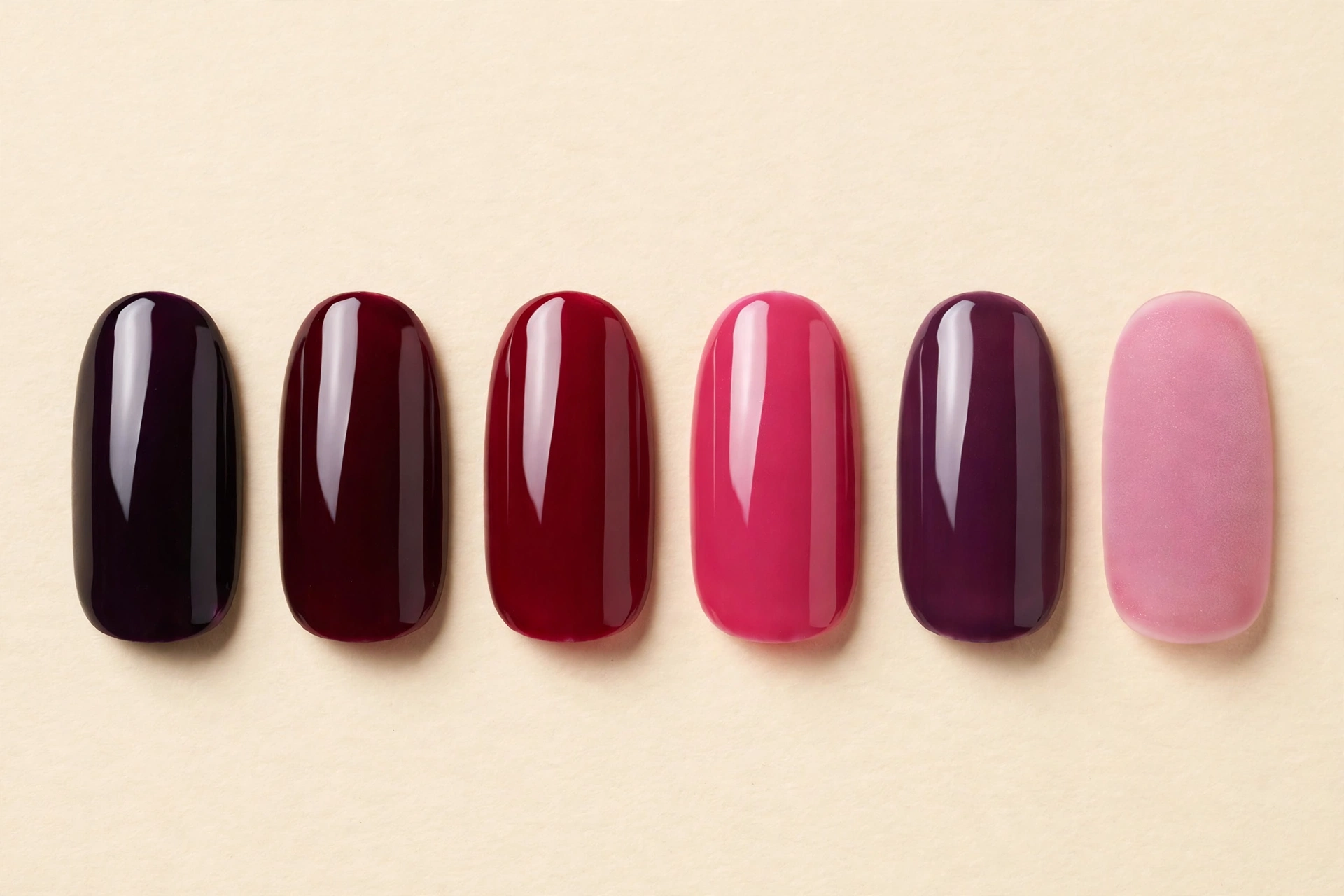
Winter berry nails are the easiest way to wear colour through the cold months without committing to a single shade. Berries sit in that sweet spot between red and purple: warmer than plum, deeper than pink, and dark enough to look intentional against winter knits and coats. This palette pulls six mixed berry shades together, from near-black blackberry to a soft frosted berry pink, so you can wear one shade all week or mix several across your nails for a tonal set that still reads as one idea.
How to use this palette
- Wear the darkest shades as a full manicure and save the brighter berries for accent nails, so the set stays grounded rather than looking like six separate ideas.
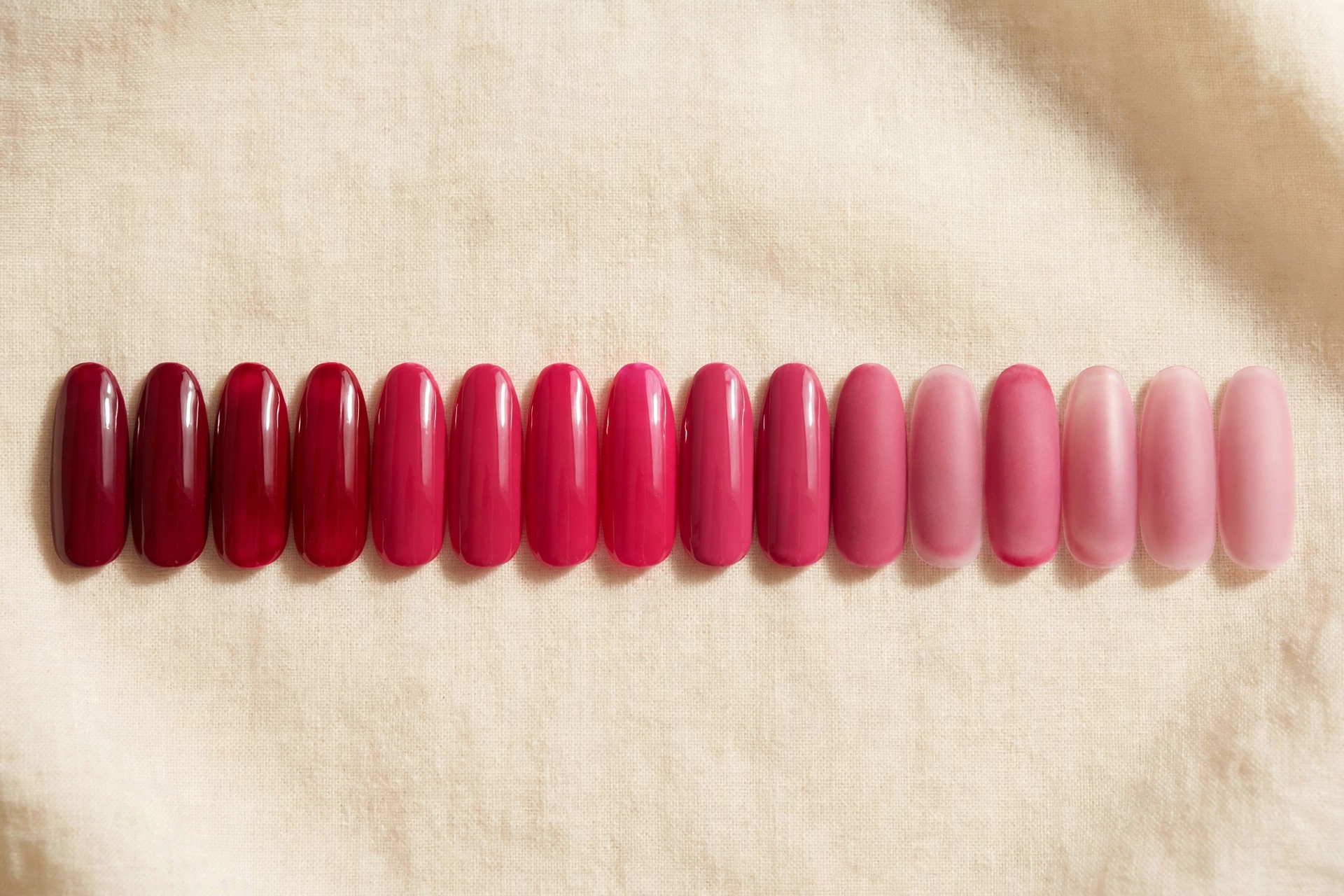
- For a tonal manicure, paint the shades in order from thumb to pinky, darkest to lightest, which gives a smooth gradient effect with no blending or special tools.
- Keep the nail shape neat and simple. Berry shades look best on short almond, squoval, or rounded nails, where the colour is the focus and the shape does not compete with it.
- Pair one berry shade with a single gold or champagne accent nail for festive occasions, but stop at one or two accents so the berry colour stays the hero.
- Always use a base coat under dark berry polish. Blackberry and black cherry shades stain bare nails easily, and a good base coat makes removal far less of a chore.
- Finish with a glossy top coat and refresh it every two to three days. Berry shades look their best with shine, and a fresh top coat is what keeps a dark manicure looking newly done all week.
The 6 winter berry nails shades
1. Blackberry Dusk — #3A2430
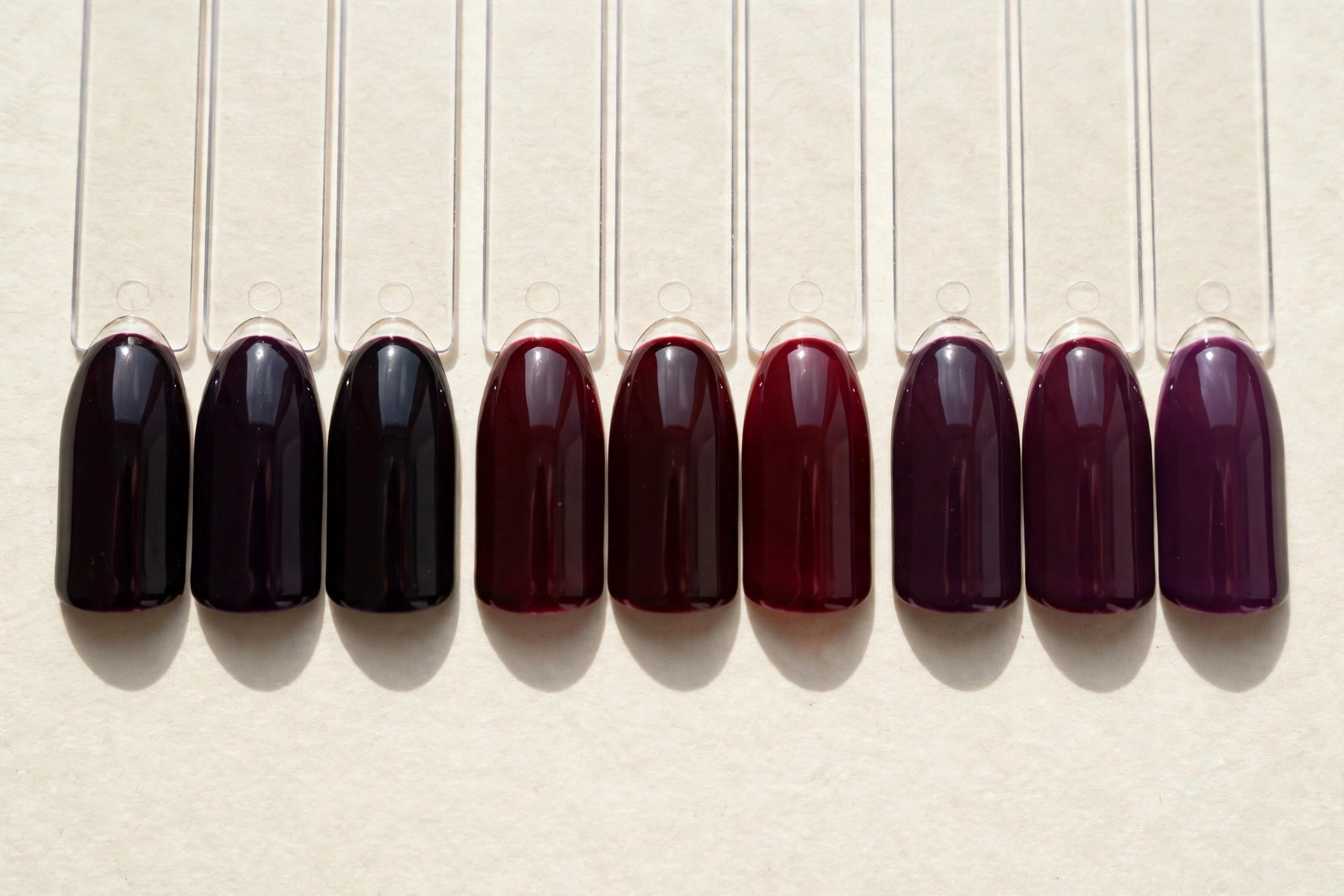
Blackberry Dusk is the darkest shade in this palette, a near-black berry with a deep purple undertone that only reveals itself in good light. It is the shade that makes the whole palette feel like winter: rich, quiet, and a little bit moody, without ever looking flat or muddy. The finish is a high-gloss creme, which keeps it sleek rather than gothic, and two thin coats give full, even coverage. On fair skin it creates a dramatic evening contrast that looks polished without any nail art, while on medium and deep skin tones it sits richly and evenly, reading almost like a natural extension of the skin’s own depth. This is the shade to reach for when you want a dark manicure that still has colour in it — for work, for formal dinners, and for any occasion where black feels too harsh but a bright colour feels too loud. It pairs beautifully with silver jewellery, a charcoal coat, and a plum or berry lip, and it hides minor chips better than any lighter shade in this palette. Apply it in two thin coats rather than one thick one, because very dark shades show streaks more easily, and seal the free edge with top coat to slow down tip wear. If you only buy one shade from this palette, make it this one, because it covers the most ground across the whole season.
2. Black Cherry — #471022
Black Cherry is a deep, wine-dark berry with a strong red undertone, the colour of cherries stewed until they are almost black. It is warmer than Blackberry Dusk, which makes it a touch more approachable, and it is the shade in this palette most likely to earn compliments from people who notice nails. The finish is a glossy creme with just enough depth to look expensive in photographs, and it flatters warm and neutral skin tones especially well, because the red undertone harmonises rather than clashes. On cool skin it still works, reading as a classic dark red with berry character rather than a true red, and on deep skin tones it glows without washing out. Black Cherry is a wonderful choice for date nights, winter weddings, and holiday parties, when you want colour that feels festive but not loud. It also works brilliantly as the base of a tonal set: paint four nails in Black Cherry and leave the ring fingers in a brighter raspberry, and the whole manicure lifts without changing its mood. On shorter nails this shade is especially forgiving, because its darkness draws the eye to the colour rather than the length. Keep the cuticles tidy, wear a base coat without fail, and refresh the top coat halfway through the week, and Black Cherry will carry a whole outfit on its own. Readers who love this end of the berry family may also enjoy the black cherry shades in our dedicated black cherry post, which explores the darkest cherry tones in more depth.
3. Mulberry Wine — #6B2D4F
Mulberry Wine sits in the middle of the dark half of this palette: a saturated purple-berry with a balanced undertone that leans neither too blue nor too red. That balance is why it suits almost everyone, and why it is such a reliable choice when you are buying polish without trying it on first. On fair skin it looks vivid and intentional, on medium skin it looks rich and even, and on deep skin it glows warmly without losing its purple character. The finish is a glossy creme, which means it looks just as good on day one as it does on day five, provided you refresh the top coat. Mulberry Wine is the shade to choose for everyday winter wear when you still want real colour: it works with denim, with chunky knitwear, with grey tailoring, and with the black and navy that dominate winter wardrobes. It is also one of the best pedicure shades in this palette, because it is dark enough to last between appointments and bright enough to notice. For a simple twist, wear it with a single gold dot at the base of one nail, or pair it with a lighter berry on the ring finger for a subtle two-tone effect. Compared with Black Cherry, Mulberry Wine reads more purple and less red, so reach for it when your outfit already has red in it and you want your nails to sit beside that colour rather than match it exactly.
4. Cranberry Crush — #9E2B25
Cranberry Crush is the brightest true red in the palette, a vivid cranberry with a cool undertone that keeps it looking like a berry rather than drifting into orange-red territory. It is the shade that wakes the whole set up: where the darker berries are quiet and evening-ready, Cranberry Crush is sociable, confident, and made for days when you want your nails noticed. The finish is a high-gloss creme, and because the colour is so saturated, two thin coats are plenty for full coverage. On fair skin it pops beautifully against winter neutrals, on medium skin it looks rich and festive, and on deep skin tones it reads as a joyful, classic red-berry that never looks washed out. This is the obvious pick for holiday gatherings, Christmas parties, and New Year celebrations, and it pairs naturally with gold jewellery, a black dress, and a matching berry lip. It also works as an accent shade in a darker set: one or two nails in Cranberry Crush can lift a full manicure of Blackberry Dusk or Black Cherry without changing the overall mood. Because brighter shades show regrowth and chips sooner, keep the manicure neat with a top-coat refresh every two or three days, and carry the bottle for a quick touch-up if you are wearing it for a special event. If cranberry is your favourite berry tone, our cranberry shades roundup goes deeper into the full cranberry family, from bright to dark.
5. Winter Raspberry — #B01E4F
Winter Raspberry is a cool, pink-leaning berry that brings a touch of brightness to the palette without ever turning neon. Its undertone is blue-leaning, which keeps it looking like a true raspberry rather than a hot pink, and its glossy creme finish gives it a clean, lacquered shine. This is the shade for the days when the darker berries feel too quiet: a birthday dinner, a night out, a winter brunch, or simply a grey week that needs brightening. On deep skin tones it looks electric and joyful, on medium skin it pops against camel and cream knitwear, and on fair skin it makes a confident statement that still feels wearable because the colour is pure rather than fluorescent. Winter Raspberry also works brilliantly as the lightest shade in a tonal gradient, sitting next to Mulberry Wine on one side and Frosted Berry on the other, and it is the best shade in this palette for shorter nails, because its brightness draws the eye to the colour rather than the length. Compared with Cranberry Crush, Winter Raspberry is pinker and cooler, so choose it when your outfit leans towards pink, plum, or silver, and save Cranberry Crush for outfits built around gold, black, or true red. A single gold stripe or dot on one accent nail is all the decoration this shade needs; the colour itself is the design.
6. Frosted Berry — #C4838F
Frosted Berry is the softest shade in the palette, a muted rose-berry with a frosted, slightly sheer finish that feels like the first light on a cold morning. It is the shade that makes this palette wearable for people who find the darker berries intimidating, and it is also the perfect counterweight in a tonal set, giving the eye somewhere soft to land after five deeper shades. The finish is a sheer-to-medium creme with a delicate frosted glow, which means it looks lovely in two coats on its own, or layered over a neutral base for a softer effect. On fair skin it looks like a natural, polished berry-pink, on medium skin it reads as a soft, romantic neutral with berry warmth, and on deep skin tones it works best as an accent or layered shade, where its lightness creates a beautiful contrast against the darker berries. Frosted Berry is the ideal choice for daytime occasions, work settings where a dark manicure feels too much, and winter weddings where you want colour without drama. It is also the most forgiving shade in the palette when it comes to application, because its lighter, frosted finish hides small imperfections that darker cremes would show. Wear it on its own for a gentle, polished look, or use it as the lightest nail in a full tonal gradient from Blackberry Dusk to Frosted Berry for a manicure that tells the whole berry story in one hand.
How to style winter berry nails
Berry shades are strong colours, so the rest of your styling works best when it supports rather than competes with them. Gold jewellery is the classic pairing for the red-leaning berries like Black Cherry and Cranberry Crush: a thin gold ring or bracelet warms up the colour and gives the whole look a festive, jewellery-box feel. Silver works better with the cooler, purple-leaning shades like Blackberry Dusk and Winter Raspberry, and it suits a more modern, minimal outfit. When it comes to clothing, berry nails sit happily next to black, charcoal, cream, camel, navy, and grey, and they can also hold their own against emerald or forest green if you keep the rest of the outfit simple. The one combination to be careful with is bright red: a true red coat or bag next to a red-undertone berry can clash, so choose a burgundy or plum piece instead when you are wearing the warmer shades in this palette.
For nail art, less is genuinely more with berries. A single gold dot at the base of each nail, a thin metallic stripe on one accent nail, or a half-moon in a lighter berry are all enough, and a well-shaped, glossy set in one berry shade will look more expensive than a busy design in a weaker colour. The same restraint applies to length: very long, pointed nails in bright raspberry can tip into costume territory, while a neat almond or squoval shape keeps the colour elegant. If you want to extend the palette beyond a single manicure, think in tones rather than exact matches. A berry lipstick, a plum scarf, or a wine-coloured bag can echo the nails without matching them shade for shade, and that near-match looks far more intentional than a perfect match. For a broader winter wardrobe of dark shades, our winter nail colours roundup puts berries alongside moody blues, deep greens, and near-black neutrals for the full cold-weather set.
Best occasions for winter berry nails
Few colour families cover as many occasions as berries, which is part of their appeal in winter. For everyday wear, Mulberry Wine and Black Cherry are the safest choices: they are polished enough for work, interesting enough for weekends, and dark enough to hide minor chips between manicures. For formal events, Blackberry Dusk and Mulberry Wine come into their own, because their depth reads as evening colour without needing any embellishment. For parties and celebrations, Cranberry Crush and Winter Raspberry are the obvious picks, since they catch the light and stand out in photographs. A winter wedding is one occasion where the whole palette earns its keep: bridesmaids can each wear a different shade from the same berry family for a tonal effect, or the bride can wear a deep berry on her toes and Frosted Berry on her hands for a softer bridal look.
Seasonal occasions suit berries particularly well. They are a natural fit for holiday parties, Christmas dinners, New Year gatherings, and winter birthdays, and they pair with festive metallics without looking like a Christmas-only colour. They also work for occasions that have nothing to do with the calendar: a job interview where you want to look polished but not plain, a dinner where you want one confident detail, or a weekend away where you only pack one polish. If you are choosing between shades for a specific event, match the finish to the setting as well as the colour: glossy cremes suit bright, social settings, while the frosted finish of Frosted Berry suits quieter, daytime rooms. And because berries are a classic rather than a trend, a berry manicure never looks dated in photographs, which matters more than people admit when the pictures come back from a big event.
Shade-to-shade comparisons
Choosing between six berries is easier once you know what separates them. Blackberry Dusk and Black Cherry are the two darkest shades, but they are not interchangeable: Blackberry Dusk leans purple and cool, while Black Cherry leans red and warm, so pick based on your undertone and on whether your outfit already contains red or purple. Mulberry Wine sits between them in depth but is more saturated than either, which makes it the best everyday choice when you want colour that is clearly visible without being loud. Cranberry Crush and Winter Raspberry are the two brightest shades, and the difference between them is temperature: Cranberry Crush is a true red-berry that suits gold and warm outfits, while Winter Raspberry is a pink-berry that suits silver and cool outfits. Frosted Berry stands apart from all five because of its finish as much as its colour: it is lighter, softer, and frosted rather than glossy, which makes it the daytime and workplace option in a palette otherwise built for evenings.
A useful way to shop this palette is to buy one dark, one bright, and one soft shade rather than all six at once. Blackberry Dusk covers the dark end, Cranberry Crush or Winter Raspberry covers the bright end depending on your undertone, and Frosted Berry covers the soft end. That trio gives you a full range of winter looks — a dark manicure for formal days, a bright one for parties, and a soft one for work — without six bottles competing for space. If you already own a burgundy polish, compare it before buying Black Cherry, because the two families overlap: burgundy leans browner and more wine-like, while Black Cherry leans redder and more fruit-like. Our burgundy shades post is a good side-by-side reference if you are deciding which family deserves the space in your collection.
Application, finish, and longevity tips
Dark berry polish rewards a little patience, and the difference between a good and a great berry manicure usually comes down to preparation. Start with clean, dry nails, push back the cuticles gently, and file in one direction to avoid splitting. A ridge-filling base coat is worth using under these shades, because it smooths the nail surface, stops the colour from settling into ridges, and protects against the staining that blackberry and black cherry shades are known for. Apply the first coat thinly, leaving a tiny gap at the cuticle, and let it dry for at least two minutes before the second coat. Two thin coats will always look smoother than one thick coat, and they dry faster and chip less.
Top coat is not optional with berry shades. A good glossy top coat deepens the colour, protects it from scratches, and makes the manicure look freshly done for longer. Reapply a thin layer every two to three days, wrapping it over the free edge, and you can easily stretch a berry manicure to a full week. For Frosted Berry, a glossy top coat will deepen its frosted glow slightly, while a matte top coat over Blackberry Dusk creates a velvety, evening-ready effect that is worth trying once. When it is time to remove dark berry polish, soak a cotton pad in remover, press it onto the nail for thirty seconds before wiping, and wipe towards the tip rather than scrubbing side to side, which spreads pigment onto the skin. A little cuticle oil after removal restores moisture, and waiting a day before your next dark shade gives nails a brief rest.
Longevity also depends on how you treat your hands during the week. Wear gloves for washing up and cleaning, because hot water and detergent are the fastest way to dull a glossy berry finish. Avoid using your nails as tools to open cans or scrape labels, since the tips are where berry polish chips first. If a chip does appear, a small dab of the same shade followed by top coat will disguise it for a day or two, which is much easier than redoing the whole manicure. For gel wearers, the same shade logic applies, but cure each layer fully and cap the free edge with each coat, because berry gel shades show lifting at the tips sooner than sheer shades do. With that care, a berry manicure is one of the longest-wearing colour families you can choose, which is exactly why it suits the busy weeks of winter.
Polish and gel picks
For a classic at-home manicure, look for a near-black blackberry creme polish for the darkest option, a deep black cherry polish with a red undertone for evenings out, and a mulberry wine polish for everyday winter wear. Add a vivid cranberry creme polish for parties and a cool raspberry polish for brighter days, and keep a frosted rose-berry polish on hand for work settings and daytime occasions. A ridge-filling base coat is essential with this palette, since the darkest berries stain bare nails, and a glossy top coat will improve every shade here. For gel, choose a blackberry gel polish for long wear, a black cherry gel shade for formal occasions, and a cranberry gel for special events, and cure each layer fully according to your lamp’s instructions. A peel-off base coat is a practical extra if you change shades often, since dark berry pigment can stain bare nails. Keep a bottle of cuticle oil beside your polish collection, because well-moisturised cuticles make dark colours look far more polished. No single brand owns this colour family, so pick formulas you already trust for coverage and wear, and test one shade before buying the whole range.
Please note that these are inspiration palettes: the shades above are suggestions to guide your choice, not exact matches to any one polish, so check the polish shade in store or on a swatch before buying.
Frequently asked questions
What is the difference between winter berry nails and burgundy nails?
Winter berry nails cover a wider family than burgundy. Burgundy is one specific wine shade with a brownish-red character, while the berry family spans blackberry purples, black cherry reds, cranberry brights, and raspberry pinks. Think of burgundy as one branch of the berry tree: if you love burgundy, you will almost certainly love black cherry and mulberry too, but the berry palette gives you lighter and brighter options, like Winter Raspberry and Frosted Berry, that burgundy on its own does not offer. If you are choosing between the two, pick burgundy for a single, classic shade and pick the berry palette when you want a range to mix across the season.
Which winter berry shade suits my skin tone?
All six shades suit all skin tones, but the most flattering pick depends on your undertone. Cool, purple-leaning berries like Blackberry Dusk and Winter Raspberry look striking on cool and fair skin, while warmer, red-leaning berries like Black Cherry and Cranberry Crush harmonise beautifully with warm and medium skin. Deep skin tones can wear the whole palette, with the darkest berries looking especially rich and the brightest berries looking especially vivid. Frosted Berry is the gentlest entry point if dark polish usually feels too severe for you, and Mulberry Wine is the safest middle-ground shade if you are buying without trying it on first, because its balanced undertone suits nearly everyone.
How do I stop dark berry polish from staining my nails?
Always wear a base coat, and make it a good one. A ridge-filling or stain-blocking base coat creates a barrier between the pigment and the nail plate, which is the single most effective step against staining. Two thin coats of colour, rather than one thick coat, also reduce staining, because less pigment sits on the nail for longer. When removing the polish, soak rather than scrub, and follow up with cuticle oil to restore moisture. If staining has already happened, a gentle buff and a few days without dark polish will usually fade it. Wearing a peel-off base coat is another option if you change shades often, since it lifts the colour off cleanly.
Can I wear winter berry nails to work?
Yes, and the darker half of this palette is made for it. Blackberry Dusk reads as a dark neutral from a distance and only reveals its berry character up close, which makes it the safest option for conservative workplaces. Mulberry Wine is slightly brighter but still reads as a polished, intentional colour rather than a loud one, and Frosted Berry is the best choice for very formal offices, since its soft finish looks like a classic neutral with berry warmth. Keep the nails short and neatly shaped, skip glitter and bold nail art, and let the colour itself do the work. Save Cranberry Crush and Winter Raspberry for weekends and evenings if your workplace is formal, and bring them out for the office party instead.