
Winter pastel nails are winter at its softest. Think of the pale blue of a frosty morning sky, the lilac-grey of snow in shade, the faint pink of cold cheeks, and the creamy white of fresh snowfall — all translated into shades that sit gently on the nail instead of shouting. Where deep burgundies and dark greens dominate most winter manicures, winter pastel nails offer a quieter alternative: colour that still feels seasonal, but light, fresh, and easy to wear every day.
The reason this palette works so well in winter is that pastels behave differently in cold light than they do in summer. In July, a pastel can look sugary and bright. In December, under grey skies and warm indoor lighting, the same family of shades turns icy and calm, more like frost on a window than candy in a jar. The six shades below are chosen for exactly that quality: each one is soft without being washed out, pale without being invisible, and cool enough to read as winter while still flattering a wide range of skin tones.
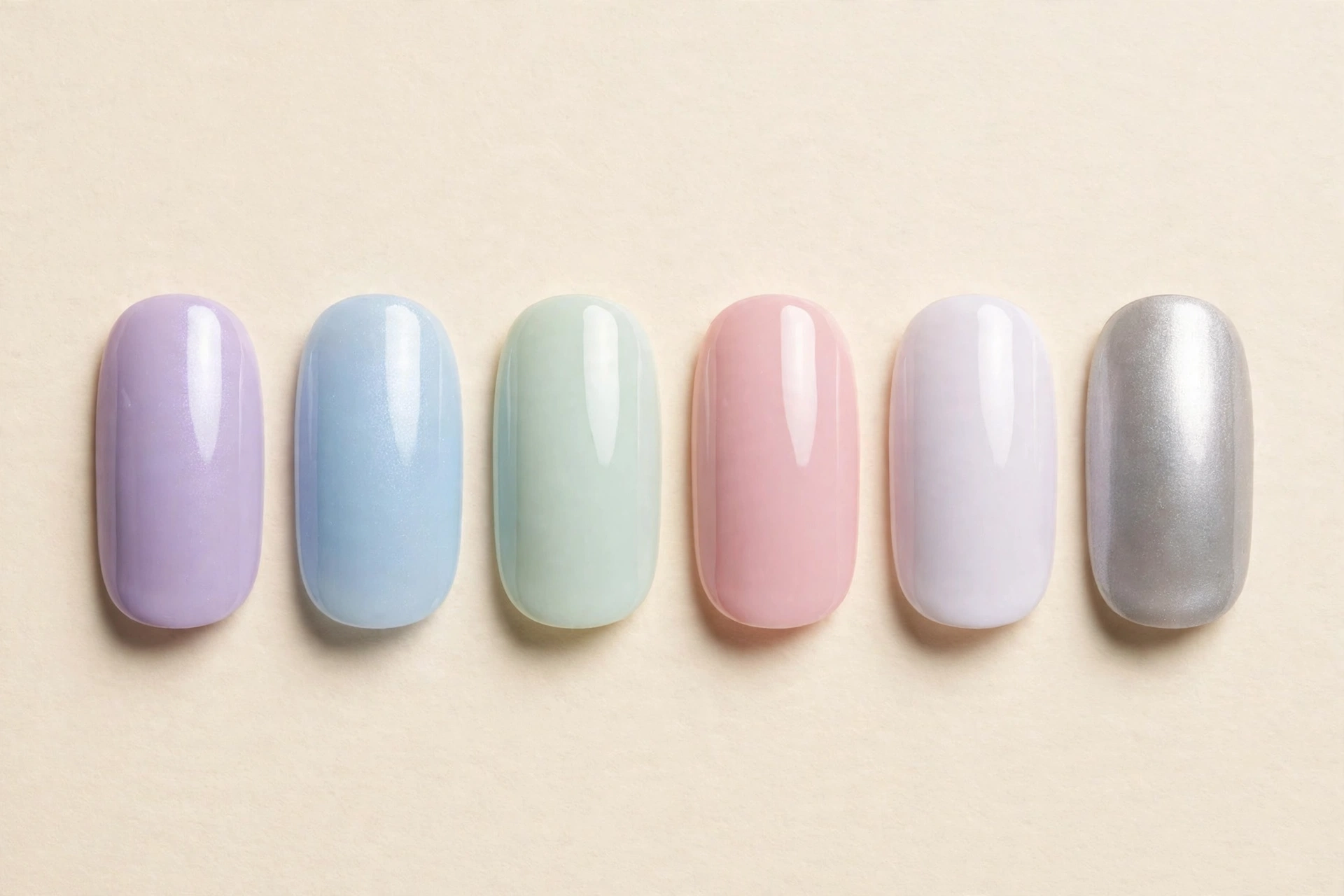
How to Use This Winter Pastel Nails Palette
- Wear one shade alone for the cleanest version of the look. Pastels look most elegant as a single, even colour with a glossy finish, especially on short to medium nails.
- Alternate two or three shades across your nails for a soft, tonal manicure. Pairing the blue with the lilac, or the mint with the blush, gives variety without breaking the calm mood of the palette.
- Keep nail art minimal. A single silver dot, a thin white French tip, or one fine glitter accent nail is plenty; heavy patterns fight the gentle quality that makes pastels work in winter.
- Match the undertone to your skin. Cool, blue-leaning pastels flatter cool skin; slightly warmer pastels, like the blush and the cream, flatter warm skin; neutral skin can wear the whole range.
- Choose a neat, rounded shape. Almond, oval, and squoval shapes suit pastels best, because a soft colour on a sharp, very long stiletto can look unbalanced, while a rounded shape keeps the whole manicure gentle.
- Pair the palette with winter textures: cream knitwear, grey wool, pale denim, silver jewellery, and soft white coats. Pastels sit beautifully next to muted winter neutrals.
- Finish with a high-shine top coat. Gloss is what keeps pale shades from looking chalky, and it gives the manicure the icy, light-catching quality that defines the palette.
1. Frosted Lilac — #D8CFF0
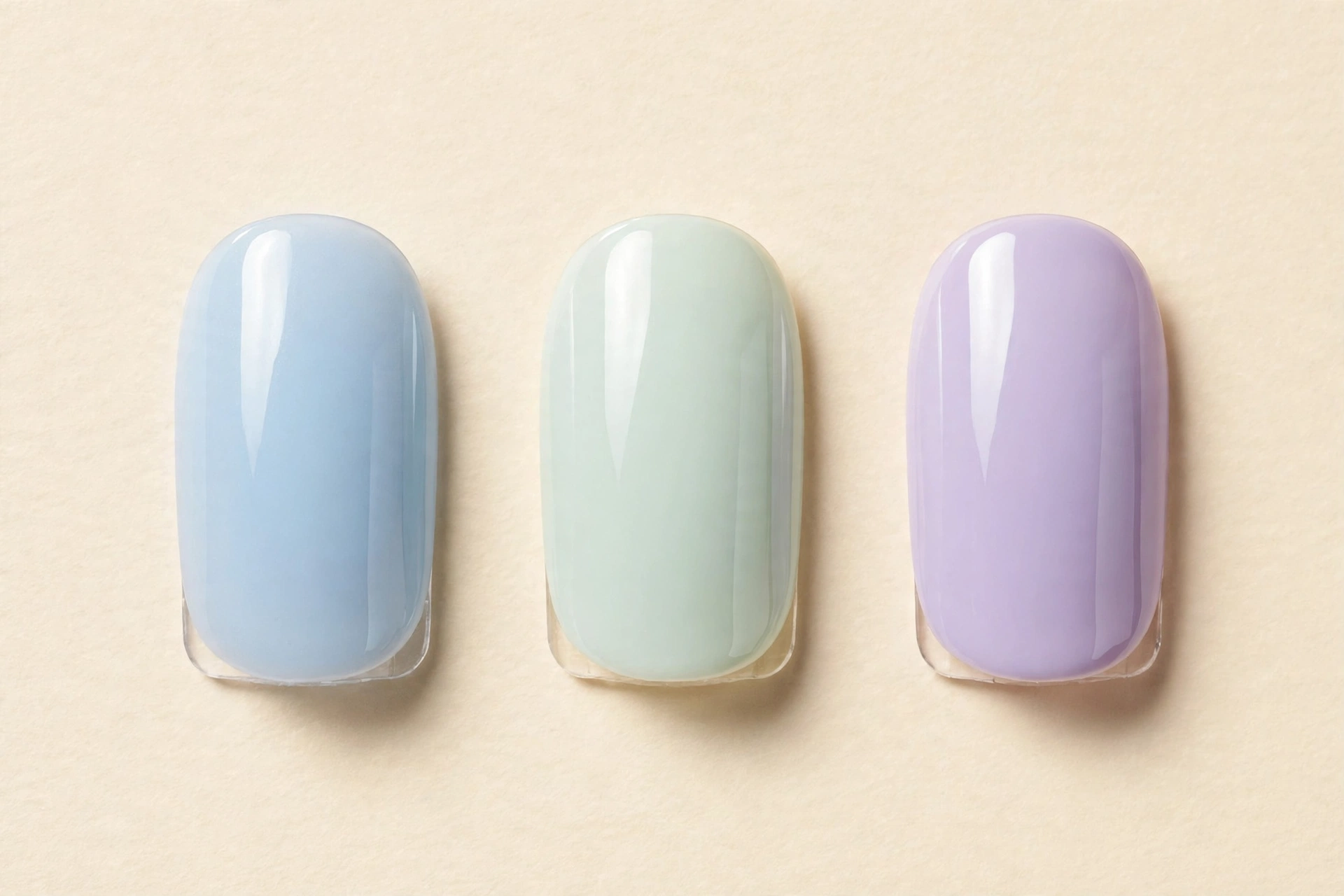
Frosted Lilac is the hero shade of the palette: a soft, icy lavender with a cool grey undertone and a smooth, glossy crème finish. It is lavender with the brightness taken down and the frost turned up, like the colour of a winter sky just before snow, or lilac petals seen through frosted glass. On the nail it reads calm, elegant, and quietly seasonal, without ever looking like a spring pastel borrowed out of season.
This is the shade to reach for when you want the simplest, most wearable version of winter pastel nails. On fair skin, Frosted Lilac gives a gentle contrast that looks polished and fresh, especially on a neat almond shape with a glossy top coat. On medium skin, it sits as a soft, visible lavender that flatters without demanding attention, and it pairs beautifully with silver jewellery and grey knitwear. On deep skin, it stands out as a luminous pale accent, a shade that shows up clearly and looks modern rather than washed out, particularly when worn with a high-shine finish that keeps the colour from going flat.
Wear Frosted Lilac on its own for everyday winter wear, for the office, for a winter lunch, or for any occasion when you want colour that feels considered but not loud. It looks wonderful with a cream sweater, a grey wool coat, a white scarf, or a pale denim jacket, and it is the shade to choose if you only buy one from this palette. It also makes a lovely base for a single silver accent nail or a thin white French tip, both of which keep the frosty mood intact.
2. Glacier Blue — #BFDCEF
Glacier Blue is a frosted baby blue with a clean, cool undertone and a glossy crème finish. It is the colour of ice on a bright winter morning: pale, clear, and fresh, without the intensity of a cobalt or the greyness of a slate. Where Frosted Lilac is soft and dreamy, Glacier Blue is crisp and clean, and that clarity is what makes it such a useful shade in a winter palette.
The coolness of Glacier Blue is its greatest strength and the one thing to choose carefully. On fair skin with cool undertones, it looks like it was made for you, a shade that brightens the hands and echoes the winter light. On medium skin, it provides a clean, visible contrast that still feels soft, especially when worn on a short squoval shape with a glossy top coat. On deep skin, it works best as a bright accent, either on its own as a statement pale blue or alternated with the lilac or the silver-grey, where its clarity keeps the manicure from looking muted.
Wear Glacier Blue when you want your manicure to feel fresh and wintry rather than cosy. It suits winter walks, bright snowy days, office days when you want something a little different from a nude, and evenings with silver jewellery and a white or pale grey outfit. It also pairs beautifully with the mint shade in this palette for a cool, tonal gradient across the nails, and with a single silver glitter accent nail for a hint of frost without turning the whole manicure into a party look.
3. Mint Frost — #C8E6D9
Mint Frost is a pale, icy mint green with a cool undertone and a soft, glossy finish. It is mint with the sweetness removed: less like a spring mint and more like frost on evergreen leaves, a shade that feels clean, calm, and quietly wintry. Green is often the hardest colour to wear in pastel form, because it can tip into mint-chocolate territory, but Mint Frost stays firmly on the frosty side, thanks to its grey-green balance.
What makes Mint Frost so wearable is its neutrality. It is cool enough to sit comfortably next to the blue and the lilac, but soft enough to flatter warm skin tones too, especially when paired with gold jewellery rather than silver. On fair skin, it gives a fresh, clean finish that looks like a polished neutral with a hint of colour. On medium skin, it reads as a gentle green that lengthens the fingers on a neat oval shape. On deep skin, it shows up as a luminous pale green, and it is especially striking as an accent nail among the lilac and blue shades, or worn alone with a glossy top coat that keeps it looking icy rather than flat.
Wear Mint Frost for everyday winter wear, for a fresh alternative to a nude at work, or for a winter weekend when you want colour without commitment. It looks lovely with cream, sage, grey, and white, and it pairs well with both silver and gold jewellery, which makes it one of the most versatile shades in the palette. If you usually avoid green polish because it feels too bold, Mint Frost is the gentle entry point, a green that whispers rather than shouts.
4. Winter Blush — #F3D3DA
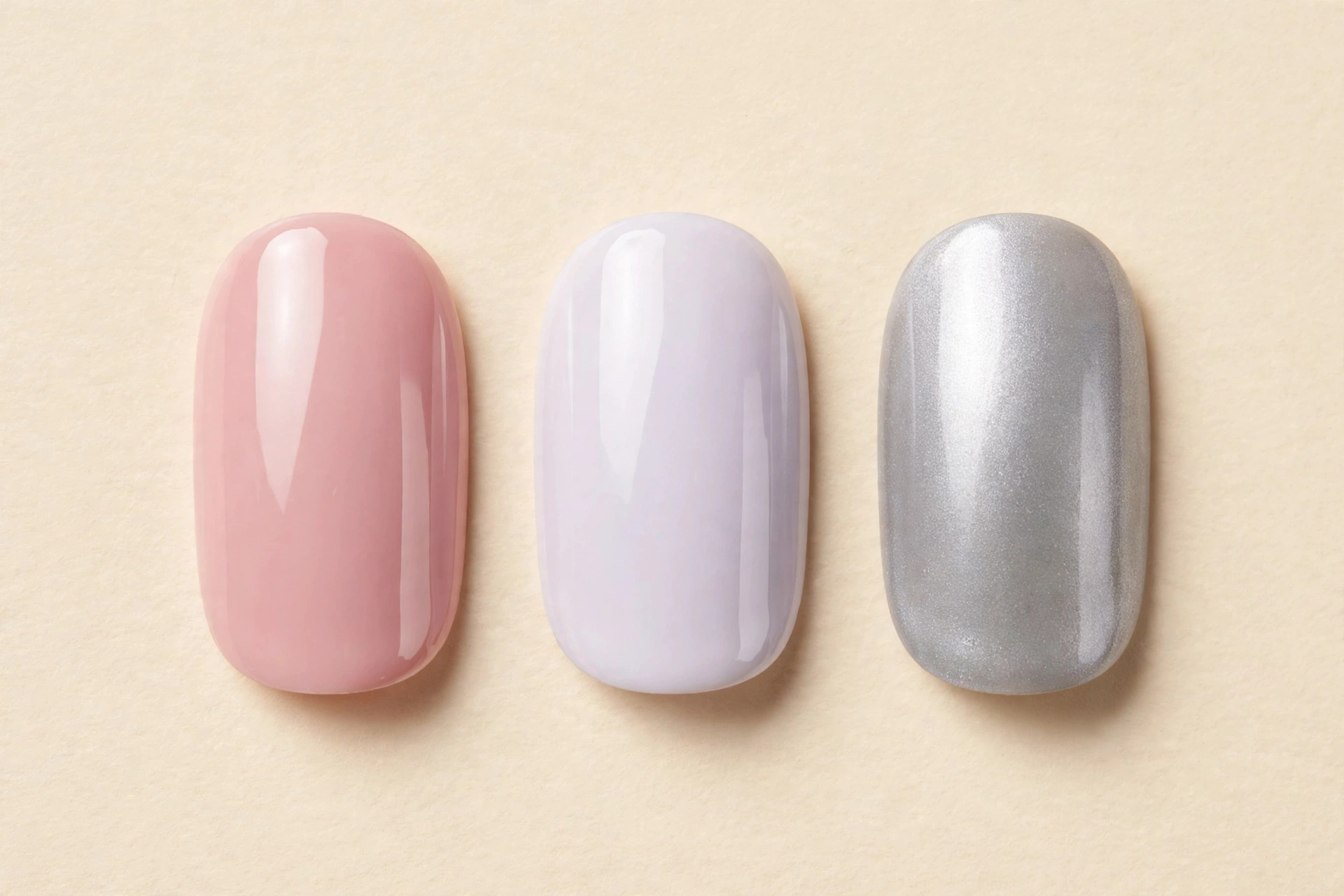
Winter Blush is a soft, cool-toned blush pink with a faint rosy undertone and a creamy, glossy finish. It looks like the natural flush of cheeks on a cold day, translated into polish form: gentle, romantic, and warm enough to keep the palette from feeling entirely icy. Where the first three shades are cool and frosty, Winter Blush brings the human warmth back into the manicure, and that balance is what makes the whole palette wearable rather than chilly.
The pink undertone is what makes this shade so universally flattering. Pure pale pinks can look washed out on some skin tones, but Winter Blush has just enough rosiness to give the nail a healthy, polished look on everyone. On fair skin, it gives a soft, flushed finish that looks like a dressed-up nude with a winter twist. On medium skin, it blends into a gentle rosy neutral that lengthens the fingers and looks lovely with rose-gold jewellery. On deep skin, it works as a luminous pale pink that shows up clearly and looks fresh rather than pale, especially with a glossy top coat.
This is the shade to choose when you want the winter pastel idea without the coolness of blue or lilac. Wear it alone for a soft December manicure, pair it with Frosted Lilac as an accent nail for a gentle two-tone look, or use it as the base for a delicate white French tip. It is also a lovely choice for a winter wedding, for a family gathering where you want to look polished rather than bold, and for anyone who usually wears nudes but wants something with a seasonal feel. Readers who love soft pink winter shades will also enjoy our frosted nails, which explore sparkly winter pinks and whites in more depth, while Winter Blush stays smooth, creamy, and calm.
5. Snowdrift Cream — #EDE8F0
Snowdrift Cream is the palest shade in the palette, a lavender-white cream with the faintest lilac undertone and a smooth, glossy finish. It is not a stark white and not a beige nude either; it sits in that gentle middle ground that looks like snow in shade, soft and luminous, with just enough lilac to keep it from reading as plain white. In bright light it looks almost white, and in low light the lilac comes forward, which gives the shade a quiet depth that plain whites rarely have.
What makes Snowdrift Cream so useful is that it works as both a colour in its own right and as the partner shade for every other colour in the palette. On fair skin, it gives a clean, bright finish that looks polished and wintry, especially when worn with a glossy top coat that keeps it from looking flat. On medium skin, it provides a soft contrast that still reads clearly as a pale shade, and it elongates the fingers when worn on a neat almond shape. On deep skin, it stands out as a luminous pale accent, and it is especially striking as a single accent nail among lilac or blue nails, or as the base for a thin silver stripe.
Wear Snowdrift Cream alone when you want a quiet, snowy manicure with a pastel edge, or use it as the pale partner for any shade in the palette. It also makes an excellent base for a French tip with a lilac or blue tip, for a half-moon design, or for a simple silver dot accent at the cuticle. Because it carries a whisper of lilac rather than a cold blue, it flatters more skin tones than a pure white, and it never makes hands look washed out the way a blue-white sometimes can. For a bolder frosty look built around white and icy blue, our snowflake nails round up frosty shades that pair well with this palette’s softer approach.
6. Silver Mist — #D9DEE2
Silver Mist is a soft silver-grey with a pearly, light-catching finish and a cool undertone. It is the most grown-up shade in the palette, a grey that leans silver rather than charcoal, with a subtle pearl shimmer that catches the light as you move your hands. Where the other five shades are creamy pastels, Silver Mist adds a metallic note, and that shimmer is what gives the palette its winter-evening option.
The pearl finish is the detail that sets Silver Mist apart from a flat grey polish. A flat grey can look dull or heavy, but the subtle shimmer gives this shade dimension and light, so it looks luminous rather than flat. On fair skin, it gives a sleek, silvery finish that looks modern and polished. On medium skin, it provides a cool, elegant contrast that suits evening occasions beautifully. On deep skin, it stands out as a luminous silver accent, especially on a short, neat shape with a glossy top coat that amplifies the pearl effect.
Wear Silver Mist as the evening shade of the palette, as a single accent nail among the pastels, or on its own for a sleek winter manicure that still feels soft. It is also the best shade in the palette for nail art, since its shimmer keeps thin white stripes, dots, and French tips looking refined. If you love grey polish but have always found it a little serious, Silver Mist is the version that finally makes grey feel wintry and light, rather than heavy. Readers planning a full winter wardrobe of shades will find our winter nail colors 2027 roundup useful for placing these pastels alongside the season’s deeper tones.
Winter Pastel Nails for Every Skin Tone
The advantage of a six-shade winter pastel palette is that nobody has to force a single pale colour to work. Fair skin tends to shine in Frosted Lilac and Glacier Blue, where the contrast is soft but clear, with Winter Blush as the warmer option. Medium skin has the widest choice: Frosted Lilac, Mint Frost, and Winter Blush all sit beautifully, with Snowdrift Cream as the clean pale partner shade. Deep skin looks stunning across the whole range, but Frosted Lilac, Glacier Blue as an accent, and Silver Mist are the standouts, offering colour that still reads clearly on the nail.
Undertone matters more than depth when you choose your pastel. If your veins look blue and silver jewellery suits you, lean towards the cooler shades: Frosted Lilac, Glacier Blue, and Silver Mist. If your veins look green and gold suits you, lean slightly warmer: Winter Blush and Mint Frost, with Snowdrift Cream as your pale neutral. If you suit both metals, you are neutral, and the entire palette is open to you. When in doubt, hold the bottle against your hand in natural daylight rather than under shop lighting, which can make every pastel look warmer or cooler than it really is.
Pastels also behave differently on different nail lengths, which is worth knowing before you commit. On short nails, a single pastel shade looks neat and intentional, and the colour reads as a polished neutral from a normal distance. On medium nails, alternating two pastels gives a gentle tonal effect that looks more interesting up close. On very long nails, pastels can look washed out if the finish is matte, so keep the gloss high and the shape rounded, and consider Silver Mist or Frosted Lilac, which have the most depth of the six.
Styling Ideas for Winter Pastel Nails
Winter pastel nails are at their easiest when the rest of your look stays in the same soft winter world. Cream, ivory, pale grey, white, soft denim, and muted sage are natural partners, and silver jewellery works across the whole palette, with rose gold suiting the blush and mint shades especially well. A cream sweater with Frosted Lilac nails is a winter look that never fails. A grey wool coat with Silver Mist nails looks sleek and intentional. A white scarf with Glacier Blue nails is the snowy-day outfit that still feels considered.
For texture, think knitwear, wool, cashmere, and soft faux fur. A chunky cream knit with Winter Blush nails looks soft and romantic. A grey cashmere scarf with Snowdrift Cream nails looks clean and expensive. And a pale denim jacket with Mint Frost nails is the casual winter outfit that still feels fresh. Pastels also sit beautifully next to winter whites, which is useful if your wardrobe leans heavily on cream and ivory in the cold months.
If you like nail art, winter pastels reward a light touch. A single silver dot at the cuticle of each nail gives a hint of frost without breaking the calm. A thin white French tip over a lilac or blue base is a winter twist on a classic manicure. A single glitter accent nail, in silver or white, adds sparkle for an evening without turning the whole manicure into a party look. Heavy patterns, bold colour blocking, or dark nail art fight the gentle quality of pastels, so let the soft colour be the statement and keep everything else quiet around it. Readers who love soft winter shades with a cosy twist will also enjoy our cozy cabin nails, which explore warm winter neutrals alongside this palette’s cooler pastels.
Best Occasions for Winter Pastel Nails
Winter pastel nails are genuinely hard to get wrong in the cold months, which is why they work across so many occasions. For everyday winter wear, Frosted Lilac and Winter Blush are the safest, most polished choices. For the office, Mint Frost and Snowdrift Cream read as soft neutrals with a hint of colour, provided the finish is glossy and the length is neat.
For winter weddings, Winter Blush and Snowdrift Cream are the obvious choices: soft, romantic, and photogenic without competing with the occasion. For winter parties, Silver Mist brings the shimmer, and Glacier Blue brings the freshness. For cosy weekends, Mint Frost and Frosted Lilac feel relaxed and gentle without trying too hard. And for the festive season itself, a combination of Frosted Lilac with a Silver Mist accent is a look that feels seasonal without relying on red or green, which makes it a good choice if you want something different from the usual holiday manicure.
Pastels also work well as a bridge between seasons. In late autumn, they soften the transition away from deep fall shades. In early spring, they carry easily into the lighter colours of the new season, which means a bottle of Frosted Lilac or Winter Blush bought in winter will still earn its place in spring. That longevity makes the palette practical as well as pretty: these are not shades you wear once and forget.
Application and Longevity: Making Winter Pastel Nails Last
Pastels are among the least forgiving colours when it comes to application, so preparation matters more here than with a dark shade. Start with clean, dry nails and a good base coat. Pale polish in particular shows ridges and unevenness, so a ridge-filling base coat is worth using if your nail surface is uneven. A smooth base is what lets pale shades lie flat and look even, instead of pooling, streaking, or going patchy.
Apply two thin coats rather than one thick one, letting the first coat dry properly before the second. Thin coats level out more smoothly and are far less likely to bubble, which is the most common problem with pale polish. A third thin coat is sometimes needed for the palest shades, like Snowdrift Cream, to reach full opacity, and that is normal: it is better to build up slowly than to flood the nail with one thick coat. Clean up the edges with a flat brush dipped in remover before the top coat, since pale polish at the cuticle edge is very visible.
A glossy top coat is essential for this palette: it deepens the colour, adds the shine that keeps pastels from looking chalky, and protects the manicure for longer. Reapply top coat every two to three days to keep the shine alive and delay chipping. Pastel polish also shows chips more obviously than dark polish, because the contrast between the pale colour and the bare nail is stark, so keep a bottle of your shade on hand for quick touch-ups. With those habits, a winter pastel manicure should comfortably last a full week, and a gel version two to three weeks.
For gel, the same rules apply with one extra benefit: gel pastels tend to look more even than regular polish pastels, because the gel levels itself during curing. If you have struggled with streaky pale polish in the past, a gel version of Frosted Lilac or Glacier Blue is worth trying. Just be careful with curing times, since under-cured pale gel can look dull, and always finish with a glossy gel top coat rather than a matte one, which flattens pastels badly.
Winter Pastel Nails vs Other Winter Palettes: How to Choose
It is worth knowing how winter pastel nails differ from their winter neighbours, because winter is a crowded season for nail colour. A deep winter palette, built on burgundy, forest green, and navy, is rich, dark, and evening-ready, suited to occasions where you want your nails to look dramatic. A frosted or glitter palette is bright, sparkly, and festive, built for parties and the holiday season. A nude winter palette is quiet and neutral, built on beige, taupe, and soft brown.
Winter pastel nails sit in a different place from all three. They are lighter than a deep winter palette, calmer than a frosted palette, and more colourful than a nude palette. The defining quality is softness with colour: you can see that colour is present, but it never dominates. That combination is also what makes them so versatile: you can lean cool and frosty with Glacier Blue and Silver Mist, soft and romantic with Winter Blush and Snowdrift Cream, or fresh and clean with Mint Frost and Frosted Lilac, all from the same six shades.
When shopping, look for shade names that mention frost, glacier, lilac, pastel, mist, or snowdrift, and check the swatch in daylight before committing, since pastels shift more than most colours between shop lighting and natural light. A shade that looks blue in the shop may read grey at home, and a shade that looks pink under warm lighting may read lilac in daylight. If you are choosing between two similar pastels, pick the one with the cooler undertone for a truly wintry feel, and the warmer one if you want the shade to double as a spring colour later.
Polish and Gel Picks for Winter Pastel Nails
For a classic glossy manicure, look for crème polishes in soft pastel families: a pale icy lilac polish for the hero shade, a frosted baby blue polish for the glacier tone, a pale mint polish for the green, a soft blush pink polish for the warm option, a lavender-white cream polish for the palest shade, and a silver-grey pearl polish for the metallic note. Brands with strong pastel ranges tend to label these as lilac, baby blue, mint, blush, milky white, or pearl grey, so check the undertone description rather than the name alone, and choose a cool-leaning pastel rather than a warm candy pastel for the winter feel.
For gel, choose pastel gel polishes in a similar range, applied over a clear gel base with a high-shine gel top coat. Gel is the better choice if you want two to three weeks of wear without chipping, especially in winter when hands are washed more often and exposed to cold air, and it is also the better choice for pale shades, since gel pastels level more evenly than regular polish pastels. For a softer, more forgiving option, a sheer pastel-tinted gel base gives a wash of colour that grows out gracefully, though it will not give the full opacity of the shades in this palette.
Whatever format you choose, keep a matching glossy top coat and a good ridge-filling base coat on hand. Winter pastel nails live or die by their smoothness and their shine, and a fresh top coat every few days is the simplest way to keep the colour looking salon-fresh between manicures. Avoid matte top coats on this palette unless you are deliberately going for a frosted effect, since matte dulls the gloss that keeps pastels looking icy rather than chalky.
Frequently Asked Questions About Winter Pastel Nails
What are winter pastel nails?
Winter pastel nails are a winter manicure built around soft, icy pastel shades: pale lilac, frosted blue, icy mint, soft blush, lavender-white cream, and silver-grey pearl. Unlike spring pastels, which are bright and sugary, winter pastels are cooler, softer, and frostier, chosen to echo winter light, snow, and frost rather than flowers and candy.
When should I wear winter pastel nails?
Winter pastel nails are best worn through the cold months, from late autumn right through winter and into early spring. They suit everyday wear, office occasions, winter weddings, and festive gatherings where you want something softer than the usual red or green. The shades also transition well into spring, so they are a practical choice beyond a single season.
Which winter pastel shade suits my skin tone?
Cool, blue-leaning pastels like Frosted Lilac and Glacier Blue flatter cool skin best. Slightly warmer pastels, like Winter Blush and Mint Frost, flatter warm skin. Neutral skin can wear the whole range. On deep skin, Frosted Lilac, Glacier Blue as an accent, and Silver Mist are the standouts, offering colour that still reads clearly on the nail with a glossy finish.
How do I stop pastel polish from looking streaky or chalky?
Start with a ridge-filling base coat, apply two or three thin coats rather than one thick one, letting each coat dry before the next, and finish with a high-shine glossy top coat. Thin coats level more smoothly and are far less likely to streak or bubble, and gloss is what keeps pale shades looking icy rather than chalky. Reapply top coat every two to three days to maintain the shine.
Winter pastel nails are proof that winter colour does not have to be dark to feel seasonal. Six shades, one soft icy story, and a manicure that works for the office, a winter wedding, a snowy weekend, and every cold day in between. Pick your pastel, keep the shine high, and let the frost do the rest.
The shades in this post are an inspiration palette: use the hex codes as a guide when choosing a polish, and expect small variations between brands, finishes, and lighting.