
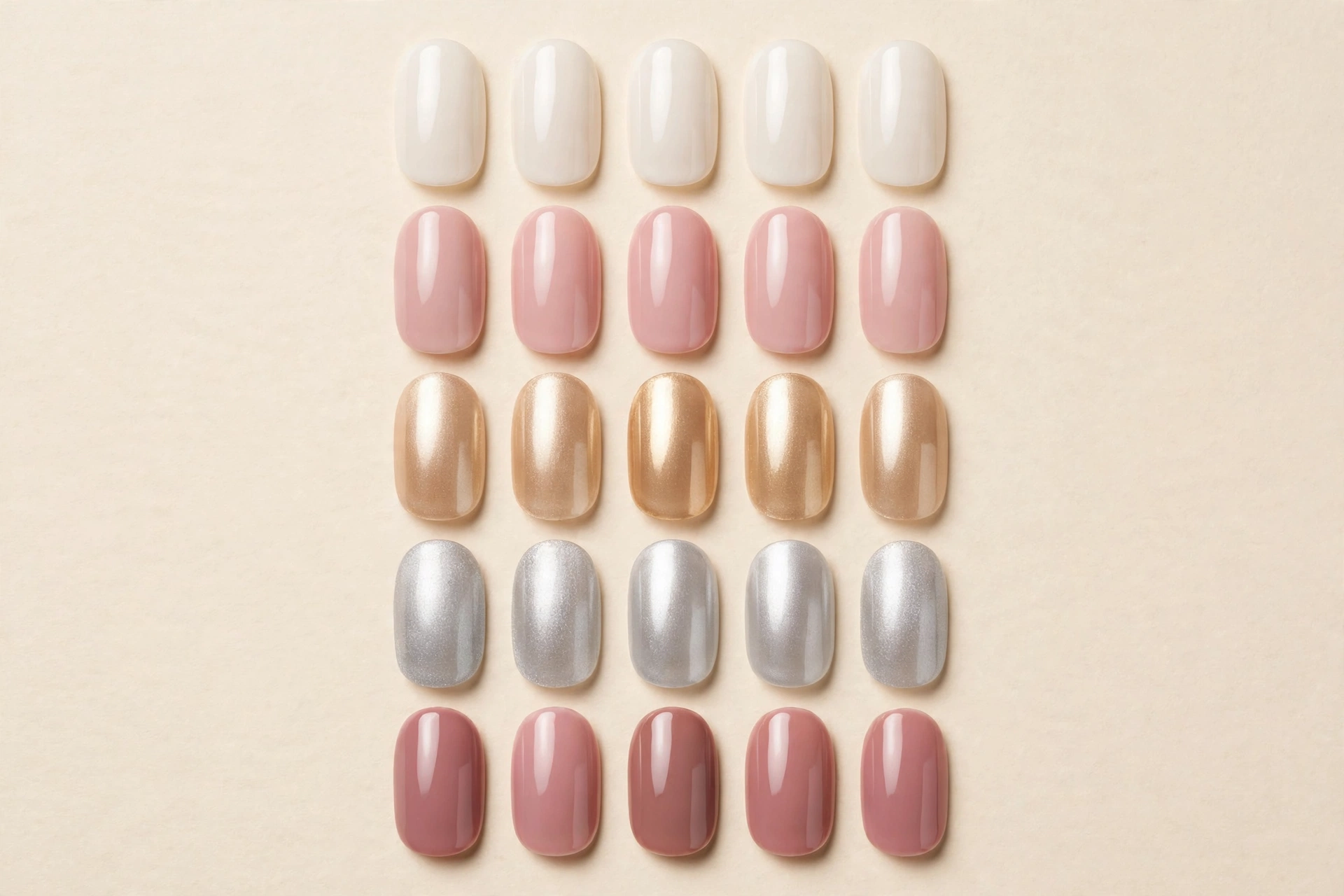
A winter wedding asks for nails that look calm, polished and warm at the same time. Winter wedding nails 2027 lean into soft whites, frosted metallics, dusty roses and one or two deep jewel tones, so the manicure reads beautifully in church light, in snow-bright daylight and in evening photographs. This palette of 16 shades covers the bride, the bridesmaids and the guest who wants to look considered without stealing the focus, and every shade here works on its own or as part of a small, planned combination.
The point of a wedding palette is not to collect as many colours as possible. It is to choose one main shade, one accent and, if you like, one metallic, and then let the dress, the bouquet and the jewellery do the rest. The shades below are ordered that way: the soft neutrals first, the romantic pinks and mauves in the middle, and the deeper, more dramatic shades at the end for evening ceremonies, velvet dresses and anyone who wants a little contrast against white or ivory fabric.
How to Use This Palette
- Pick one main shade for all ten nails, then add a single accent nail in a metallic or glitter finish if you want sparkle without fuss.
- Match the undertone of your polish to your dress: warm ivory dresses sit best with warm pinks, champagne and gold, while bright white dresses suit cool pearl, silver and icy blue-grey.
- Try your shade two weeks before the wedding, in daylight and in the evening, so you can see how it photographs and whether it needs a second coat.
- Keep the shape simple. Almond and soft square shapes flatter almost every winter wedding shade, and a shorter length lasts better through a long day of greeting guests, holding a bouquet and dancing.
- Book a trial manicure with the same products your nail artist will use on the day, and take a photograph of the finished result to compare against your dress fabric.
- If you are a bridesmaid, check the bride’s palette first and choose a shade one step softer or deeper than hers, never an exact match.
- Carry a small bottle of your shade and a top coat in your clutch for quick repairs between the ceremony and the reception.
The 16 Winter Wedding Nails 2027 Shades
1. First Snow Ivory — #F7F3EC
First Snow Ivory is a warm, creamy white with the faintest hint of vanilla, and it is the closest thing in this palette to a classic bridal white without looking stark. It flatters fair and light skin beautifully, and on medium and deep skin it reads as a soft, luminous contrast rather than a flat white. The undertone is warm and slightly milky, the finish is a smooth creme, and it suits a church ceremony, a winter garden reception and any bride who wants her nails to look clean, quiet and deliberate in every photograph.
2. Frosted Pearl — #EDE8E0
Frosted Pearl is a pale, pearly white with a whisper of silver shimmer that catches the light without looking glittery. It works on every skin tone, because the pearl finish softens the white and keeps it from washing out fair hands or looking chalky on deep skin. The undertone is cool-neutral, the finish is a soft pearl shimmer, and it is ideal for a bride who wants a little light on the nail, for a bridesmaid in a silver or grey dress, and for a winter evening reception under warm lights.
3. Blush Chapel — #E8C8C8
Blush Chapel is a gentle, dusty pink with a warm rose undertone, the kind of shade that looks like a healthy natural nail with the colour turned up one notch. It flatters fair, medium and deep skin tones alike, and it is especially kind to cool undertones in the skin. The finish is a soft creme with a glossy shine, and it suits a daytime ceremony, a blush or ivory dress, and a bride who wants romance without a strong pink statement.
4. Dusty Rose Vow — #C9A0A0
Dusty Rose Vow is a muted rose with a mauve edge, deeper than blush but still firmly in the soft, romantic family. It looks lovely on medium and olive skin, and on fair skin it gives a gentle definition that photographs well without dominating the hand. The undertone is cool mauve-rose, the finish is a creme with a satin gloss, and it is a strong choice for a winter afternoon wedding, for a bridesmaid in dusty rose or sage, and for a guest who wants a shade that feels seasonal and grown-up.
5. Champagne Toast — #E3C98F
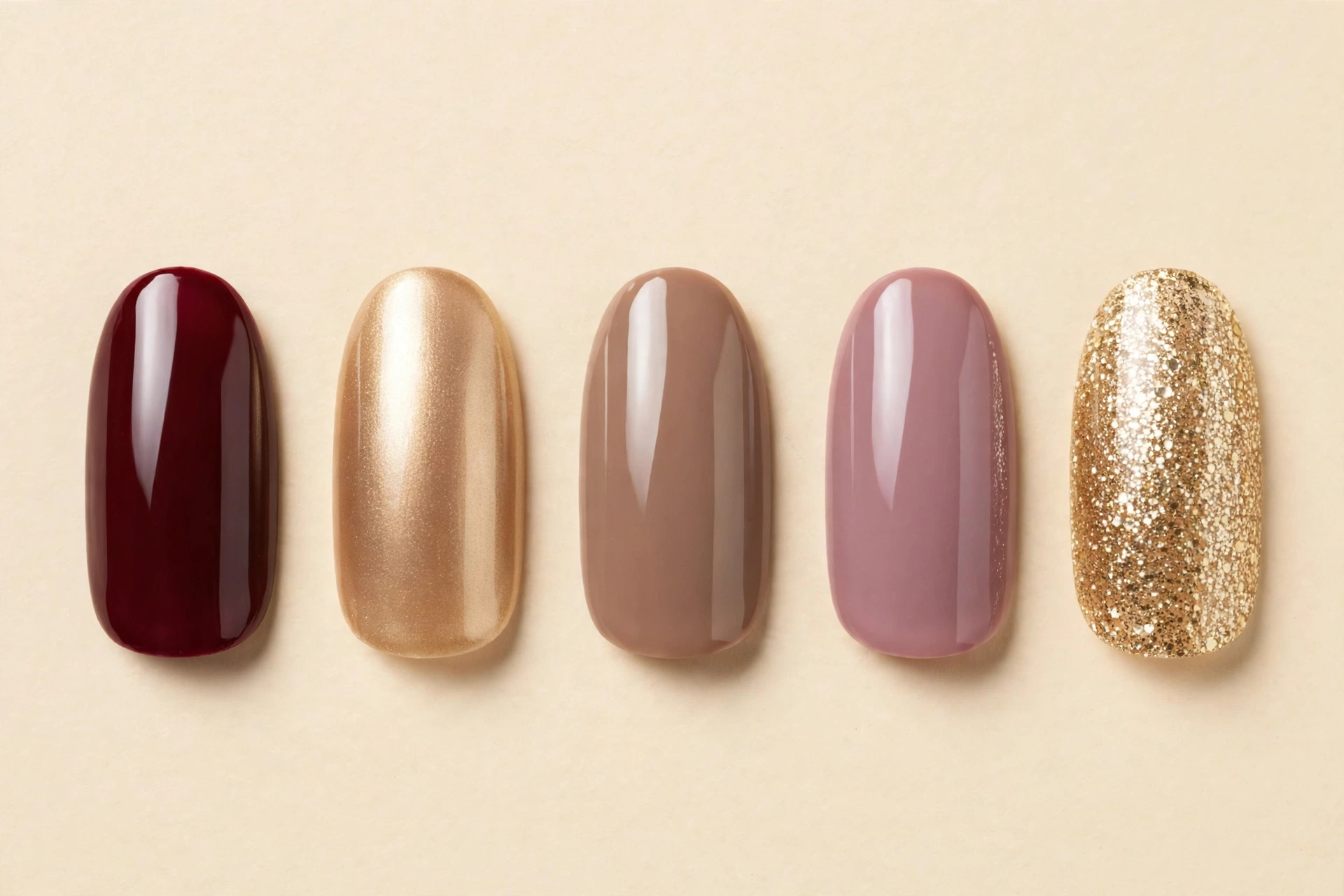
Champagne Toast is a warm, golden champagne with a fine, soft shimmer that reads as light rather than glitter. It flatters warm and neutral skin tones best, and on deep skin it glows like candlelight, especially against gold jewellery. The undertone is warm gold, the finish is a shimmering metallic-cream, and it suits a New Year wedding, a candlelit reception, a gold-accented dress and anyone who wants a celebratory shade that still feels elegant.
6. Silver Frost — #C9CDD3
Silver Frost is a cool, pale silver with a smooth metallic finish that feels like frost on a windowpane. It suits fair and cool-toned skin particularly well, and on medium skin it makes a striking, modern accent nail against a softer main shade. The undertone is cool blue-silver, the finish is a polished metallic, and it works for a winter evening ceremony, a silver or white dress, and a bride who wants a hint of ice without a full glitter manicure.
7. Icy Blue Grey — #A9B8C6
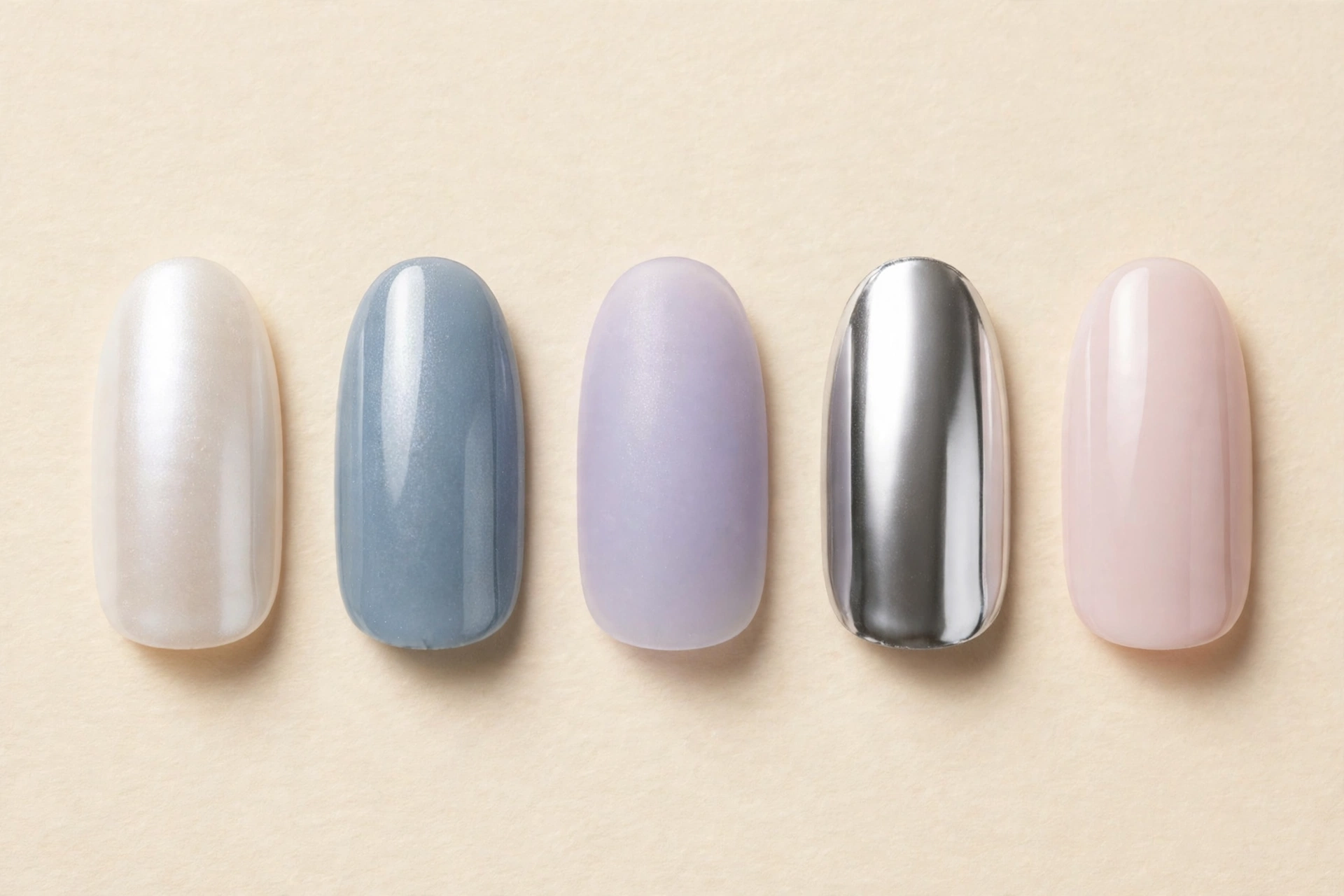
Icy Blue Grey is a soft, misty blue-grey that brings the winter sky onto the nail without turning cold or gloomy. It flatters fair and light-medium skin, and on deep skin it reads as a calm, smoky statement that pairs beautifully with silver jewellery. The undertone is cool blue with a grey base, the finish is a smooth creme, and it suits a snowy outdoor ceremony, a blue or grey bridesmaid dress, and a guest who wants something seasonal but understated.
8. Frosted Lavender — #C5B8D4
Frosted Lavender is a pale, cool lavender with a soft, almost powdery finish that feels like winter twilight. It looks lovely on fair and cool-toned skin, and on medium skin it adds a gentle lilac light that works well with silver and pearl accessories. The undertone is cool violet, the finish is a creme with a faint pearl glow, and it is a good choice for a lavender-accented wedding, a winter bridesmaid in lilac or grey, and a bride who wants a whisper of colour rather than a plain neutral.
9. Winter Burgundy — #6E1F2E
Winter Burgundy is a deep, rich wine red with a warm plum undertone, and it is the most dramatic shade in this palette without ever feeling loud. It flatters every skin tone: on fair skin it looks bold and classic, on medium skin it reads as warm and expensive, and on deep skin it glows with a jewel-like depth. The finish is a glossy creme, and it suits an evening ceremony, a velvet or burgundy-accented wedding, a bride who wants a strong lip-and-nail match, and a guest who wants one confident colour.
10. Deep Plum Vow — #5C2E4A
Deep Plum Vow is a dark, velvety plum with a cool berry undertone that sits between burgundy and purple. It is especially flattering on medium, olive and deep skin, where the plum reads as rich rather than dark, and on fair skin it makes a striking winter statement. The finish is a smooth, high-gloss creme, and it works for a late-afternoon ceremony, a plum or navy wedding palette, and a bridesmaid who wants a deep shade that still photographs as elegant rather than heavy.
11. Warm Taupe Promise — #A8988A
Warm Taupe Promise is a soft, warm taupe with a gentle brown-grey balance that makes it one of the most wearable shades in the whole palette. It flatters warm and neutral skin tones, and on deep skin it reads as a polished, understated nude with real depth. The undertone is warm greige, the finish is a smooth creme, and it suits a civil ceremony, a winter registry wedding, a bridesmaid in taupe or brown, and any guest who wants a quiet, grown-up manicure that goes with everything.
12. Soft Mauve Morning — #B99AA5
Soft Mauve Morning is a gentle mauve-pink with a cool, dusty undertone that feels calm and slightly vintage. It looks lovely on fair and light-medium skin, and on olive skin it brings out a soft, rosy warmth that suits winter light. The finish is a creme with a satin shine, and it is ideal for a morning ceremony, a mauve or grey dress, a bridesmaid who wants a soft shade with more character than plain nude, and a bride who prefers mauve to pink.
13. Glitter Gold Aisle — #D4AF6A
Glitter Gold Aisle is a warm, sparkling gold with fine glitter that reads as festive rather than flashy when it is kept to one or two accent nails. It flatters warm skin tones best, and on deep skin it catches the light beautifully against gold jewellery and warm-toned dresses. The undertone is warm yellow-gold, the finish is a fine glitter, and it suits a reception, a New Year wedding, a gold-accented bouquet and anyone who wants a little celebration on the ring finger or the thumb.
14. Midnight Chapel Blue — #1F2A44
Midnight Chapel Blue is a deep, inky navy with a cool undertone that feels formal, calm and quietly dramatic. It flatters fair skin by giving a strong, clean contrast, and on deep skin it reads as a rich, almost-black blue that pairs beautifully with silver and pearl. The finish is a glossy creme, and it works for an evening ceremony, a navy or midnight-blue wedding palette, a winter ballroom reception and a guest who wants a dark shade that still feels wedding-appropriate.
15. Evergreen Vow — #2E4A3A
Evergreen Vow is a deep, muted forest green with a cool, pine-like undertone that feels unmistakably winter. It looks lovely on medium, olive and deep skin, where the green reads as rich and earthy, and on fair skin it makes a striking seasonal statement against white or ivory. The finish is a smooth, high-gloss creme, and it suits a Christmas-season wedding, a green-accented bouquet, a velvet bridesmaid dress and a guest who wants a seasonal shade with real depth.
16. Rose Gold Frost — #E0B4A4
Rose Gold Frost is a soft, warm rose-gold with a fine metallic shimmer that sits between pink and gold. It flatters warm and neutral skin tones, and on fair skin it adds a gentle glow that looks lovely in photographs and candlelight. The undertone is warm rose-gold, the finish is a soft metallic shimmer, and it is a good choice for a bride who wants a metallic without silver’s coolness, for a bridesmaid in blush or champagne, and for a reception manicure that needs to sparkle under evening lights.
How to Style Winter Wedding Nails 2027
Styling a winter wedding manicure starts with the dress, not the polish bottle. A bright white dress can take a cool pearl, silver or icy blue-grey without looking washed out, while a warm ivory or champagne dress sits better with blush, dusty rose, champagne and gold. If the dress has lace, look at the lace tone rather than the main fabric: cream lace wants warm shades, white lace wants cool ones. The same rule applies to the bouquet. White roses and eucalyptus pair well with soft neutrals, while burgundy dahlias or deep plum flowers ask for a deeper nail, such as Winter Burgundy or Deep Plum Vow, so the hand does not disappear against the flowers.
Jewellery is the second guide. Silver and pearl jewellery suit Silver Frost, Frosted Pearl and Icy Blue Grey. Gold jewellery suits Champagne Toast, Glitter Gold Aisle and Rose Gold Frost. If the ring is the star, keep the ring-finger nail simple: a plain creme or a soft pearl lets the stone do the talking, and a glitter accent on that finger can fight with the ring in close-up photographs. Many brides choose a plain shade on the left ring finger and a shimmer on the right hand instead, which keeps the photographs clean and still gives a little sparkle.
The season itself is part of the styling. Winter light is cooler and softer than summer light, so shades look a touch deeper indoors than they do outside. A shade that looks pale in the salon can look perfect in a snow-bright church, and a deep shade that looks dramatic in daylight can look almost black in a candlelit room. That is why a trial in both kinds of light matters more for a winter wedding than for a summer one. It is also why a glossy top coat matters: winter air dries the nail surface, and a fresh top coat on the morning of the wedding restores the shine that cold, dry air takes away.
For brides who want a little more detail, the safest winter wedding nail art is also the simplest. A thin gold line along the tip, a single pearl dot at the cuticle, or a soft ombre from ivory to blush all add interest without dating the photographs. Heavier art, such as large snowflakes or chunky glitter, photographs well on the day but can look busy in close-ups of the hands holding the bouquet or exchanging rings. If you love nail art, keep it on one or two nails and let the rest of the manicure stay plain.
Brides who are choosing between this palette and a more classic bridal look will find useful context in our guide to bridal nails, which covers timeless shades for winter weddings in more depth. The two palettes overlap on purpose: a classic bridal shade is a safe base, and the winter wedding shades here are the seasonal layer on top of it.
Best Occasions for Each Shade Family
Not every shade in this palette is meant for the bride, and that is deliberate. The soft neutrals — First Snow Ivory, Frosted Pearl, Blush Chapel and Warm Taupe Promise — belong to the bride first, because they keep the focus on the dress and the ring. The romantic pinks and mauves — Dusty Rose Vow, Soft Mauve Morning and Frosted Lavender — work for the bride, the bridesmaids and a close family member, because they are soft enough for the ceremony and warm enough for the reception.
The metallics — Champagne Toast, Silver Frost, Glitter Gold Aisle and Rose Gold Frost — are the most flexible family in the palette. They suit the bride as an accent, the bridesmaids as a main shade, and a guest who wants a festive manicure without a strong colour. Metallics also photograph well in low light, which makes them a practical choice for an evening reception where the main photographs are taken under warm, dim lights.
The deep shades — Winter Burgundy, Deep Plum Vow, Midnight Chapel Blue and Evergreen Vow — are best for evening ceremonies, for bridesmaids, and for guests. A bride can wear them, and many do, especially for a second look at the reception or for a winter wedding where the dress is ivory rather than bright white. But a deep shade on the bride needs a confident dress and a confident lip colour to balance it, so it is worth trying the full look together before the day rather than deciding on the nail alone.
For the wedding party, coordination matters more than matching. If the bridesmaids all wear the same shade, the group photographs look calm and intentional. If they wear different shades from the same family — one in dusty rose, one in soft mauve, one in frosted lavender — the photographs look softer and more modern, but the shades need to share an undertone, warm with warm or cool with cool, or the group will look mismatched. Our guide to winter bridesmaid nails works through those combinations in detail, including which shades suit which dress colours.
Guests have the most freedom, and the only real rule is to avoid a shade that matches the bride’s exactly. A guest in a dark dress can wear Winter Burgundy or Midnight Chapel Blue with confidence, while a guest in a light dress will look more balanced in Blush Chapel, Warm Taupe Promise or Frosted Pearl. If you are unsure, choose a shade one step deeper than the bride’s, and keep the finish glossy rather than glittery for the ceremony, saving glitter for the reception. The guest guide to winter wedding guest nails covers that balance in more detail, with shades chosen specifically for guests rather than for the bridal party.
Application Tips for a Long Wedding Day
A wedding manicure has to last from the morning photographs to the last dance, and that means preparation matters as much as the shade. Start with clean, dry nails and push the cuticles back gently rather than cutting them, because cut skin is more likely to catch on lace and fabric. A ridge-filling base coat helps pale shades such as First Snow Ivory and Frosted Pearl, which show every ridge and uneven patch if they are applied straight onto the bare nail. Two thin coats always look better than one thick coat, and pale shades often need a third thin coat on the tips to avoid a see-through patch where the nail shows through.
Let each coat dry properly before the next one. In winter, polish dries more slowly in a cold room, so give each coat at least three to four minutes, and avoid hot water for the first few hours after the manicure. A fast-drying top coat applied on the morning of the wedding, over a manicure done the day before, is the simplest way to restore shine and add a fresh layer of protection. It also seals the free edge, which is where chips start, especially when the hands are busy with a bouquet, a clutch and a lot of handshakes.
For gel wearers, the same shades work, but the timing changes. Book the gel manicure two days before the wedding rather than the day before, so any lifting at the edges has time to show up and be fixed. Ask for a thin, flexible gel rather than a thick, rigid one, because winter cold makes rigid gel more likely to lift at the corners. And if you are trying a new shade for the first time, try it in regular polish first: a gel removal and re-do is a much bigger job than a polish change, and it is not a job to do the night before a wedding.
Cold weather also affects the skin around the nail. Keep a hand cream and a cuticle oil in your bag, and use them through the day, because dry cuticles draw the eye away from even the best shade. A small bottle of cuticle oil applied before the photographs makes the whole manicure look fresher, and it takes ten seconds. Avoid applying hand cream just before the photographs, though, because it can leave a shine on the skin that the camera picks up.
Finish and Longevity: What Lasts in Winter
The finish you choose changes how a shade looks and how long it lasts, and winter is the season when that choice matters most. A glossy creme is the most forgiving finish for a wedding: it looks polished, it photographs well, and a top coat can refresh it in seconds. A matte finish looks modern and soft, but it shows marks more easily, it can look dull in photographs, and it is harder to repair on the day, so save matte for a guest manicure or a second look rather than the ceremony itself.
Shimmer and pearl finishes, such as Frosted Pearl, Champagne Toast and Rose Gold Frost, are good at hiding small imperfections, because the light play distracts the eye from a tiny ridge or a slightly uneven edge. They are also the most forgiving if a chip appears, because the shimmer breaks up the outline of the chip. Metallic finishes, such as Silver Frost, are the opposite: they show every brush stroke and every ridge, so they need a smooth base coat and a steady hand, or a professional application.
Glitter finishes last well, because the glitter itself adds texture and thickness, but they are the hardest to remove and the hardest to repair. If you choose Glitter Gold Aisle as an accent, apply it over a matching creme base, such as Champagne Toast, so a chip in the glitter still shows a similar colour underneath rather than bare nail. And if you are wearing glitter on all ten nails, accept that the removal will take longer, and plan a proper soak-off rather than peeling it off, which damages the nail surface.
In general, a regular polish wedding manicure lasts two to three days with careful wear, while a gel manicure lasts two weeks or more. For a wedding, gel is the practical choice if the manicure needs to survive the rehearsal dinner, the ceremony and a honeymoon departure without a touch-up. Regular polish is the better choice if you want to change your shade between the ceremony and the reception, or if you simply prefer the feel of a lighter manicure. Either way, the shade matters less than the preparation: clean nails, thin coats, a sealed free edge and a fresh top coat will do more for longevity than any single product.
Shade-to-Shade Comparisons
Choosing between two similar shades is the hardest part of a wedding palette, so it helps to compare them directly. First Snow Ivory and Frosted Pearl look similar in the bottle, but on the nail they are different: First Snow Ivory is warm, flat and creamy, while Frosted Pearl is cool, light-catching and slightly translucent. Choose First Snow Ivory for a warm ivory dress and a classic look, and Frosted Pearl for a bright white dress or a bride who wants a little light on the nail.
Blush Chapel and Dusty Rose Vow are the same kind of choice in the pink family. Blush Chapel is lighter, warmer and more obviously pink, while Dusty Rose Vow is deeper, cooler and more mauve. Blush Chapel suits a daytime ceremony and a fair complexion, while Dusty Rose Vow suits an afternoon or evening ceremony and a medium or olive complexion. If you cannot decide, try Blush Chapel on the left hand and Dusty Rose Vow on the right, and look at both in daylight: the right shade will look like it belongs with your skin, and the wrong one will look like it is sitting on top of it.
Winter Burgundy and Deep Plum Vow are the deep pair. Winter Burgundy is warmer, redder and more classic, while Deep Plum Vow is cooler, darker and more modern. Winter Burgundy pairs with gold jewellery and a warm lip, while Deep Plum Vow pairs with silver jewellery and a berry lip. Both are strong choices for an evening wedding, and the deciding factor is usually the dress: a warm-toned dress wants burgundy, a cool-toned dress wants plum.
Champagne Toast and Rose Gold Frost are the warm metallic pair, and the difference is in the base colour. Champagne Toast is gold with a warm, yellow light, while Rose Gold Frost is pink with a warm, rosy light. Champagne Toast suits gold jewellery and a champagne dress, while Rose Gold Frost suits rose-gold jewellery and a blush dress. For a bride who wants a metallic accent, Champagne Toast is the safer choice with most dresses, while Rose Gold Frost is the more romantic one. If you want a deeper dive into the champagne family, our champagne nails guide covers twelve shades for winter and New Year celebrations, including how to wear them without looking overdone.
Polish and Gel Picks
Look for these shades in a regular polish for a trial and in a gel for the wedding day itself, so the colour you test is the colour you wear. For the neutrals, choose First Snow Ivory in a warm ivory creme, Frosted Pearl in a pearl-white shimmer, Blush Chapel in a dusty rose creme, and Warm Taupe Promise in a warm taupe creme. For the metallics, choose Champagne Toast in a fine golden shimmer, Silver Frost in a polished silver metallic, Glitter Gold Aisle in a fine gold glitter, and Rose Gold Frost in a soft rose-gold shimmer. For the deep shades, choose Winter Burgundy in a glossy wine creme, Deep Plum Vow in a glossy plum creme, Midnight Chapel Blue in a deep navy creme, and Evergreen Vow in a deep forest creme. For the cool pastels, choose Icy Blue Grey in a misty blue-grey creme, Frosted Lavender in a pale lavender creme, Dusty Rose Vow in a muted rose creme, and Soft Mauve Morning in a soft mauve creme. Buy the base coat, the colour and the top coat from the same range where you can, because shades from the same range are tested to work together, and a mismatched top coat can change the way a pearl or metallic finish looks.
This is an inspiration palette. The shade names and hex codes here are a starting point for finding a colour you love, not an exact match to any single polish on the shelf, so compare the swatch against your skin and your dress in daylight before you commit, and ask your nail artist to adjust the shade lighter or deeper to suit you.
Frequently Asked Questions
What colour nails should a bride wear for a winter wedding in 2027?
A winter bride in 2027 can wear almost any shade in this palette, but the safest and most photographed choices are the soft neutrals: First Snow Ivory, Frosted Pearl, Blush Chapel and Warm Taupe Promise. They suit white and ivory dresses, they photograph cleanly in winter light, and they keep the focus on the dress and the ring. If you want more colour, add a metallic accent or choose a deep shade such as Winter Burgundy for the reception, when the light is warmer and the mood is more relaxed.
When should I get my nails done before a winter wedding?
Book a regular polish manicure the day before the wedding, and a gel manicure two days before, so there is time to fix any lifting or chipping. Do a trial manicure at least two weeks earlier, with the same shade and the same products, and wear it for a few days to see how it holds up in your daily life. Avoid a first-time shade or a first-time salon the week of the wedding, because a colour you have not lived with can look different on the day than it did in the bottle.
Which winter wedding nail shades suit deep skin tones?
Deep skin tones suit almost every shade in this palette, and the most flattering are the ones with warmth and depth: Winter Burgundy, Deep Plum Vow, Champagne Toast, Glitter Gold Aisle and Evergreen Vow all glow on deep skin, while Frosted Pearl and First Snow Ivory give a clean, luminous contrast. The shades to try carefully are the palest pastels, such as Frosted Lavender and Icy Blue Grey, which can look chalky if they are too sheer, so choose an opaque formula and apply a third thin coat if needed.
What nail shape is best for a winter wedding?
Almond and soft square shapes suit most winter wedding shades and most hand shapes, because they look elegant without being fragile. Almond lengthens the fingers and suits a longer nail, while soft square suits a shorter nail and is more practical for a long day of holding a bouquet and greeting guests. Avoid a very long stiletto for the ceremony itself, because it can catch on lace and fabric, and it draws attention away from the ring in close-up photographs.